 跳到内容
跳到内容 
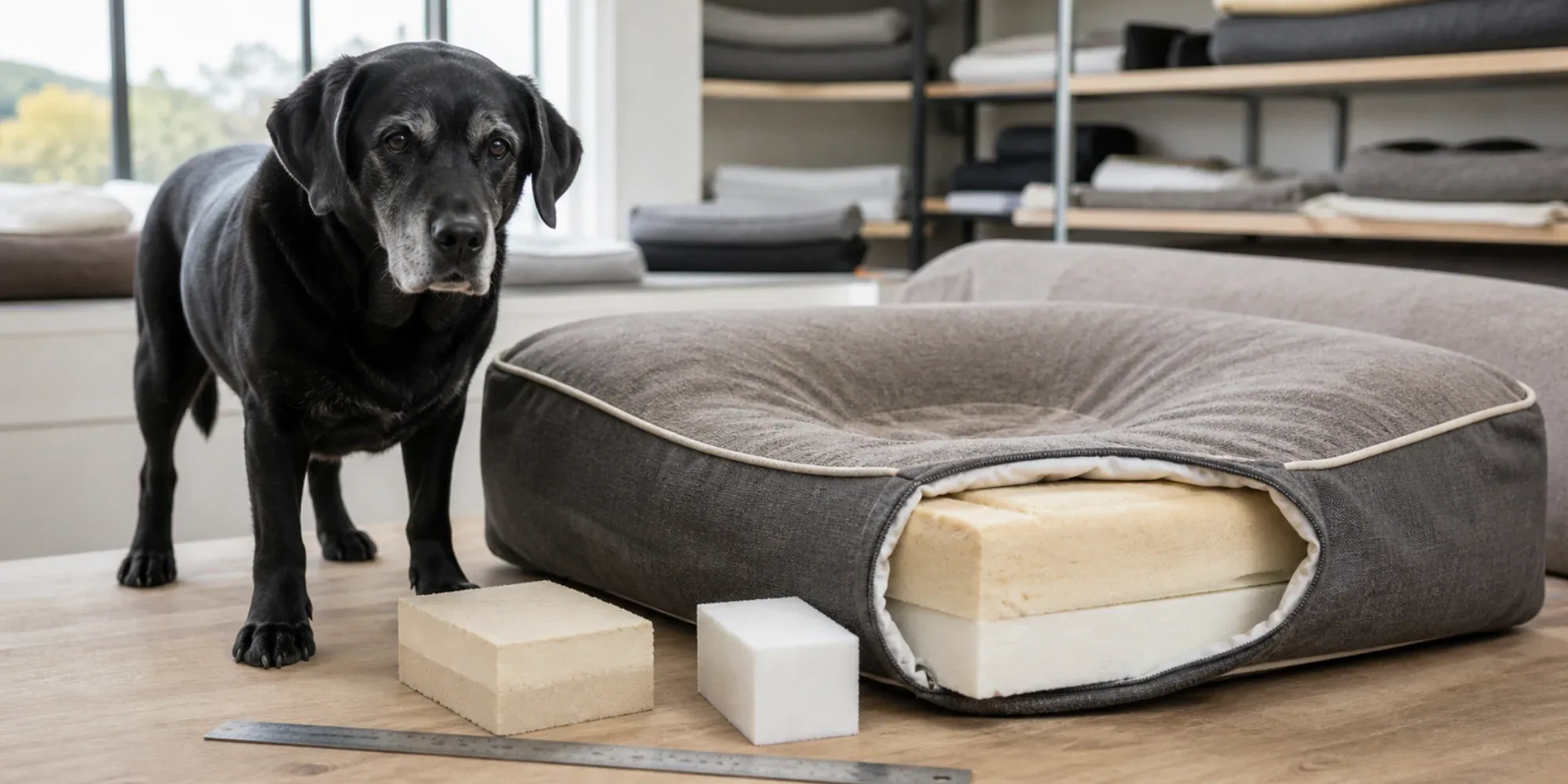
Orthopedic dog beds go flat primarily due to two distinct mechanical processes: foam fatigue and compression set. Foam fatigue occurs when repeated use breaks down the foam's internal cell struts, causing it to lose its firmness and load-bearing capacity over time, even if it appears to recover its shape. Compression set happens when constant, heavy static weight permanently compresses the foam, preventing it from rebounding to its original thickness. For large or senior dogs relying on joint support, both processes lead to the bed 'bottoming out,' reducing its ability to relieve pressure.
The Mechanics of Foam Degradation
Flexible polyurethane foam, the standard core for orthopedic dog beds, relies on a three-dimensional network of microscopic polymer struts separated by air-filled cells. When a dog lies on the bed, these struts buckle to absorb the weight, and when the dog leaves, they rebound to their original shape. The long-term durability of the bed depends entirely on how well this cellular matrix tolerates mechanical stress. When consumers report that a bed has gone flat or bottomed out, they are usually observing the late stages of two distinct modes of mechanical failure: dynamic foam fatigue and static compression set. Understanding the difference is crucial for product developers evaluating foam density, structure, and expected service life.
Foam fatigue is a dynamic degradation process driven by repeated motion. As a dog steps, turns, digs, and circles to nest on the bed, the localized kinetic energy repeatedly flexes and stresses the foam internal struts. Over thousands of cycles, these microscopic struts begin to micro-fracture or lose their structural elasticity. The result is a progressive loss of load-bearing capacity, commonly referred to as softening. Crucially, a fatigued bed may still look perfectly thick and pristine when the dog is not on it. The foam appears to recover its shape, but it no longer possesses the firmness required to keep the dog suspended above the hard floor. The bed fails its orthopedic purpose before any visible flattening occurs.
In contrast, compression set is a static failure. It occurs when foam is subjected to a constant, sustained load over an extended period. When a large or heavy dog remains stationary on a bed for many hours a day, the continuous pressure forces the polymer struts to remain in a buckled, compressed state. Under constant strain, and sometimes exacerbated by body heat, the polymer undergoes a permanent physical deformation. When the load is finally removed, the struts lack the structural memory to spring back to their original height. The foam suffers a permanent loss of thickness, leaving a visible depression in the center of the bed where the dog typically sleeps.
Distinguishing between these two mechanisms is essential when specifying materials for private-label and retail pet products. A common mistake in product development is attempting to solve a compression set problem by simply increasing the initial firmness of the foam, which does little to prevent the polymer from permanently deforming under sustained heat and weight over time. By isolating whether a bed is failing due to dynamic strut fracture from movement or static structural deformation from resting weight, brands can better align their material specifications, such as density and layer structure, with the actual physical demands of large or aging dogs.
Foam Fatigue: The Loss of Load-Bearing Capacity
To develop an orthopedic dog bed that retains its supportive qualities, product teams must first understand how a dog's behavior drives dynamic foam fatigue. Unlike a human mattress, which typically experiences broad, relatively static weight distribution across a large surface area, a pet bed is subjected to highly concentrated, active movements. Before a dog settles down to sleep, they frequently circle, dig, and nest. This natural behavior concentrates the dog's entire kinetic energy and body weight into the small surface area of their paws. As the dog steps onto the bed and turns, the underlying flexible polyurethane foam is forced into deep, localized compression. Over months of daily use, these repeated dynamic impacts inflict thousands of extreme flexion cycles on the microscopic polymer struts that make up the foam matrix.
Foam fatigue is the mechanical degradation of these internal cellular structures. When the foam is new, the three-dimensional network of struts easily buckles under the dog's weight and elastically rebounds when the pressure is removed. However, continuous flexing eventually causes the polymer material to experience physical fatigue. The tiny struts begin to micro-fracture or permanently lose their structural elasticity. As a greater percentage of the struts within the high-traffic center of the bed weaken and break, the cellular matrix loses its collective resistance to applied weight. This progressive loss of load-bearing capacity is commonly referred to in the industry as softening. The foam simply cannot push back against the dog's weight with the same firmness it possessed when it rolled off the production line.
The deceptive nature of foam softening presents a significant challenge for retail and private-label buyers handling product returns or negative customer reviews. A consumer may inspect a flattened bed after the dog gets up and assume the foam has magically repaired itself, only to watch their senior dog struggle to stand up from a bed that compresses entirely under their weight. This dynamic fatigue is not limited to sleeping surfaces. It is a critical engineering consideration across multiple support products. For example, when designing Custom Foam Pet Stairs and Ramps, product developers must account for the intense kinetic energy of a dog pushing off and landing on individual steps. If the foam in a step softens due to fatigue, it creates an unstable surface that can cause the dog to stumble, defeating the product's purpose of providing safe, low-impact access to furniture.
Mitigating this dynamic breakdown requires moving beyond basic firmness measurements during the specification phase. Many buyers mistakenly assume that starting with an extremely firm foam will prevent the bed from softening. However, initial firmness, often measured as Indentation Load Deflection, only dictates how the bed feels on day one. A low-density foam manufactured to feel firm will still suffer rapid fatigue because it lacks sufficient polymer mass to absorb repeated kinetic impacts. The remaining thin struts are simply subjected to higher individual stress levels, accelerating their eventual fracture.
To combat dynamic fatigue and maintain load-bearing capacity over the product's expected service life, product teams must prioritize foam density. Density represents the actual weight of the polyurethane polymer per cubic volume. Higher density foam contains thicker, more robust struts and fewer empty air voids, meaning there is physically more material available to share the mechanical stress of the dog's nesting and stepping behaviors. By specifying a higher density core, brands ensure that the cellular matrix can survive thousands of compression cycles without catastrophic micro-fracturing, keeping the aging or large-breed dog properly elevated and supported long after the initial purchase.
Compression Set: Why Beds Permanently Flatten
While foam fatigue is driven by kinetic energy and motion, compression set is a failure of static endurance. When a dog rests in one position for hours, the polyurethane foam must support a continuous, unyielding load. The microscopic polymer struts that form the foam's cellular matrix remain in a buckled state for prolonged periods. Over time, this constant mechanical strain causes the polymer chains within the struts to physically reorient in a phenomenon known as creep. If the static load exceeds the foam's engineered resistance, or if the load is maintained for too long without a sufficient recovery period, the material passes its elastic threshold. The struts undergo permanent physical deformation, losing their structural memory and their ability to spring back to their original shape once the weight is removed.
The visible result of this static deformation is a permanent loss of thickness. Unlike dynamic fatigue, which degrades the bed's load-bearing firmness while often leaving its unweighted appearance intact, compression set leaves a distinct, lasting indentation. A physical crater forms in the center of the bed where the dog habitually sleeps, and the foam remains compressed even when the bed is empty. This permanent thinning directly reduces the available clearance between the resting dog and the hard floor beneath the bed. Once a bed suffers severe compression set, the physical structure of the foam has fundamentally changed. The damaged polymer struts cannot be repaired, meaning the product cannot be fluffed or rotated back to its original dimensions to restore support. This mechanical failure disproportionately impacts the exact demographic of dogs that require orthopedic support the most. The downward static force applied to a bed scales directly with the animal's weight.
According to the American College of Veterinary Surgeons, osteoarthritis commonly affects young large breed dogs with developmental bone disease, as well as older, overweight large breed dogs. As dogs age, the composition of their joint cartilage changes, reducing its ability to repair damaged areas and leading to inflammation and cartilage breakdown. Osteoarthritis in Dogs – American College of Veterinary Surgeons
For these heavy, aging dogs, a bed that maintains its full thickness is critical. However, their substantial body mass places significant continuous stress on the foam's cellular matrix. Heavy dogs act as the primary catalyst for compression set, exerting static forces that easily overpower standard low-density foams designed for lighter pets. The relationship between joint disease and prolonged resting creates a compounding challenge.
The American College of Veterinary Surgeons notes that the most common cause of osteoarthritis in canine patients is secondary to other orthopedic diseases, such as cranial cruciate ligament rupture, osteochondrosis, or trauma. Osteoarthritis in Dogs – American College of Veterinary Surgeons
Because these underlying conditions and the resulting joint inflammation cause significant discomfort, affected dogs often become considerably less mobile. They spend significantly more continuous hours resting on their beds compared to highly active, healthy dogs. This behavioral shift translates to a drastically increased duration of static loading on the foam. The bed is subjected to heavy, localized weight for much longer uninterrupted periods. This extended strain denies the foam adequate time to recover its shape, which directly accelerates the permanent physical deformation of the polymer struts. Overweight dogs present an even steeper challenge, as excess body mass is deeply intertwined with joint health.
The American College of Veterinary Surgeons highlights that diet restriction in dogs has been shown to decrease the incidence of osteoarthritis in vulnerable areas like the hips, elbow joints, and shoulder joints. Osteoarthritis in Dogs – American College of Veterinary Surgeons
Until that excess weight is successfully managed through veterinary guidance, a dog's heavier mass continually drives rapid compression set. If the foam's density and compression modulus are not specifically engineered to resist this heightened load, the bed will quickly thin out directly beneath the heaviest parts of the dog's body, failing exactly where reliable support is most critical for comfort.
When compression set heavily compromises the bed, the foam eventually bottoms out. The remaining compressed material is no longer thick enough or firm enough to decelerate the dog's weight. As a result, the dog's prominent pressure points press entirely through the depleted foam and bear the resistive force of the hard floor. For a senior or overweight large-breed dog managing deteriorating cartilage, resting on a permanently flattened bed provides little to no orthopedic relief. Preventing this outcome requires product teams to evaluate static load scenarios realistically and select foam structures capable of withstanding prolonged compression without yielding their permanent shape.
Evaluating Physical Property Metrics in Foam
Translating theoretical foam failure into practical product application requires objective measurement. A common pitfall in pet product development is relying on the subjective feel of a new dog bed. Pressing a hand into a freshly manufactured foam core provides an impression of surface firmness, but offers no reliable indication of how the underlying cellular matrix will perform over time. To evaluate true durability, pet product brands and retailers must rely on standardized physical property testing. These laboratory protocols establish reliable benchmarks for how flexible polyurethane foam responds to the specific mechanical stresses inflicted by heavy or aging dogs. By requesting these specific metrics, buyers can accurately verify a material's baseline resistance to both dynamic degradation and static deformation.
To ensure consistency, the flexible foam industry relies on established evaluation frameworks. For instance, the formal technical guidelines governing CertiPUR-US certification specify the exact environmental criteria and physical property tests required for flexible polyurethane foams intended for bedding and furniture applications. By requiring manufacturing partners to adhere to these or equivalent standardized testing methodologies, product teams ensure that the materials proposed for a supportive dog bed possess the structural integrity necessary to survive sustained mechanical use without premature failure. Technical Guidelines
Evaluating a foam formulation's resistance to compression set requires simulating the prolonged static weight of a resting heavy dog. In a standard laboratory test, a precisely measured sample block of polyurethane foam is placed between rigid steel plates and mechanically compressed to a specific percentage of its original height. This clamped apparatus is then transferred into a temperature-controlled environment for an extended duration. The elevated ambient temperature simulates the localized body heat of a resting animal, which accelerates the physical reorientation of the polymer chains while they remain under constant mechanical strain. Once the designated testing period concludes, the plates are removed, and the foam is given a brief, standardized recovery period before its final thickness is measured.
The final measurement determines the permanent loss of structural thickness, expressed as a percentage of the foam block's original unweighted height. A low compression set percentage indicates that the foam's polymer memory remains largely intact, allowing the material to successfully rebound to its initial dimensions after the prolonged static load is removed. For orthopedic pet beds tasked with supporting large-breed dogs managing joint conditions, buyers should specify foam with the lowest possible compression set value. If a material yields a high percentage during laboratory evaluation, it will inevitably leave a permanent crater in the center of the product under real-world static loading, rapidly failing its primary purpose of elevating the dog above the hard floor.
Conversely, evaluating dynamic foam fatigue requires a completely different testing approach designed to replicate the kinetic energy of a dog repeatedly stepping, turning, and nesting. Dynamic fatigue testing subjects the material to thousands of rapid, forceful compression cycles. Depending on the protocol, this is typically achieved using a heavy roller or pounding mechanism that continuously strikes the foam sample. This intensive cycle forces the microscopic internal struts to repeatedly buckle and rebound in rapid succession, simulating months of intense localized movement in a matter of hours. The objective is to force the cellular matrix to the point of structural exhaustion, determining how the polymer struts respond to extreme, repetitive kinetic impact.
Unlike compression set testing, which measures a permanent loss of physical height, dynamic fatigue testing primarily evaluates the loss of load-bearing capacity. Technicians record the foam's firmness before and after the pounding cycle. The difference between these two measurements reveals the extent of internal structural softening. If the testing demonstrates a significant drop in firmness, the foam will quickly fatigue under the dynamic movements of a dog, even if it visually recovers its unweighted thickness. Isolating these two failure modes through distinct physical property tests allows product teams to construct highly targeted specifications. A successful orthopedic dog bed requires a cellular structure that excels in both metrics, resisting the permanent thinning of compression set and the hidden structural softening of dynamic fatigue.
Specifying Materials for Orthopedic Support Needs
Translating mechanical failure into practical product design requires moving from understanding foam fatigue and compression set to actively specifying materials that resist them. For orthopedic pet beds, the fundamental objective is maintaining a physical barrier between a dog's joints and the hard floor. When product developers ignore the distinct mechanics of dynamic softening and static deformation, they risk specifying beds that visually appeal to owners on the retail shelf but physically fail the pets relying on them.
The stakes of this material selection are particularly high when developing products for dogs diagnosed with chronic joint diseases. Organizations like the Orthopedic Foundation for Animals focus extensively on inherited conditions such as canine hip dysplasia, providing information and data to help manage the disease. Similarly, resources from Canine Arthritis Resources and Education emphasize the importance of identifying and managing canine arthritis to keep dogs active and comfortable. Dogs managing these structural and inflammatory conditions depend heavily on their beds for sustained pressure relief. If the foam permanently compresses under their static weight or fatigues to the point of bottoming out, the bed ceases to provide any orthopedic benefit, forcing the dog's sensitive joints directly against the floor. About Us | OFA Hip Dysplasia | OFA Canine Arthritis Resources & Education | Dog arthritis tips and resources
To prevent this structural failure, developers must prioritize resistance to compression set in the bed's foundational layers. A common specification error is relying on a single, thick block of low-density foam that has been chemically formulated to feel exceptionally firm when first touched. While this initial firmness might seem supportive, low-density materials lack the internal polymer mass necessary to withstand the continuous static weight of a large-breed dog over long resting periods. Over time, the internal struts yield to the constant heat and pressure, and the bed permanently flattens. Instead, product teams must specify high-density polyurethane foam for the base layer. Higher density ensures a thicker, more robust network of polymer struts, providing the physical strength required to resist permanent deformation under sustained static loads.
Alongside static resting weight, the specified foam must also survive the dynamic fatigue caused by a dog's natural behavior. When a dog steps onto the bed, turns, and circles to nest, their full body weight is concentrated into the small surface area of their paws. This kinetic energy forces the foam through extreme localized compression cycles. If the foam lacks sufficient structural resilience, these repeated deep impacts will cause the internal cellular matrix to micro-fracture. The material softens and loses its load-bearing capacity, meaning it will easily collapse when the dog finally lies down, even if the bed still appears visually thick to a standing observer.
Because a single type of foam rarely excels at both extreme load-bearing endurance and yielding pressure relief, the most effective orthopedic designs often utilize a layered structure. A robust, high-density conventional polyurethane base provides the necessary resistance against static compression set and dynamic bottoming out. Above this firm foundation, developers can specify a top layer of viscoelastic polyurethane, commonly known as memory foam. Memory foam excels at contouring to a dog's specific body shape, distributing the resting pressure evenly across the surface rather than concentrating it on prominent hips or elbows.
Developing a Custom Orthopedic Memory Foam Dog Bed requires carefully balancing these distinct layers. If the viscoelastic memory foam layer is too thick, a heavy dog will sink entirely through it before their weight engages the supportive base layer beneath, negating the bed's overall structural integrity. Conversely, if the base layer is insufficiently dense, the entire assembly will suffer compression set, rendering the memory foam ineffective as the whole structure gets crushed against the floor. Product teams must calculate the appropriate ratio of comfort layer to support layer based on the target breed size, ensuring that the combined structure maintains an adequate clearance gap beneath the dog's heaviest pressure points at all times.
Clear communication with manufacturing partners is essential when finalizing these structural choices. Retail buyers and private-label teams should establish minimum acceptable thresholds for foam density rather than relying solely on subjective marketing terms like premium or supportive. Requesting material data that shows the foam's measured performance in standard compression set and dynamic fatigue tests allows teams to verify that the specified materials can handle the intended weight class.
Ultimately, a durable orthopedic bed is an engineered support system. By differentiating the kinetic damage of fatigue from the static crushing of compression set, developers can construct highly targeted specifications. They can choose high-density foundational foams to anchor the bed against sustained weight, alongside durable comfort layers to cushion against immediate pressure. This rigorous approach to material selection ensures the final product successfully maintains the critical protective clearance between the resting dog and the floor over an extended service life.
