 跳到内容
跳到内容 
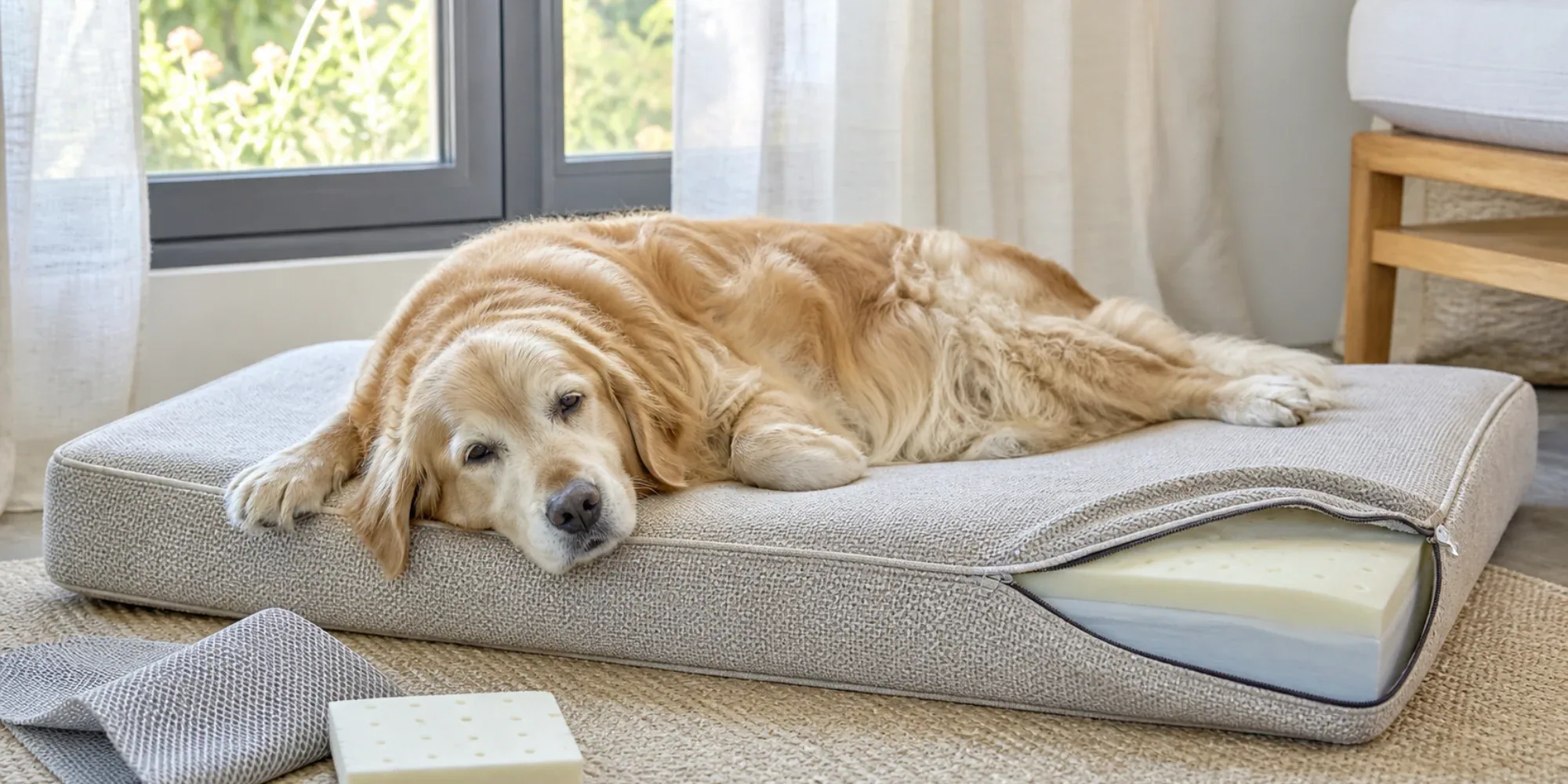
You should replace a senior dog bed when the foam bottoms out, fails to rebound, or develops permanent impressions that force your dog's joints against the hard floor. Check for seven specific signs: the dog bottoming out under their own weight, permanent unweighted divots, sluggish foam recovery, internal clumping, loss of thermal insulation, behavioral avoidance of the bed, and increased stiffness when the dog tries to stand.
Why Foam Failure Amplifies Senior Dog Joint Pain
A dog bed provides essential relief for an aging body, but that relief disappears when the internal foam begins to break down. Understanding why a senior dog requires functioning foam starts with recognizing how their joints change over time. As dogs get older, the cartilage in their joints alters its composition and becomes less capable of repairing damaged areas, which leads directly to cartilage breakdown and inflammation. Older, overweight large breed dogs are especially susceptible to osteoarthritis. When healthy, dense foam supports these vulnerable areas by distributing the dog's weight evenly across the surface. This structural barrier prevents the concentrated weight of a resting dog from pressing directly against the hard floor beneath the bed. For a senior dog with compromised cartilage, this continuous pressure relief is a basic physical necessity. Osteoarthritis in Dogs – American College of Veterinary Surgeons
When the foam inside a dog bed degrades, its internal cellular structure collapses, causing the material to lose its ability to push back against the dog's weight. Instead of suspending the hips and elbows in a neutral resting position, a failing bed forces already inflamed joints to bear the brunt of gravity against an unyielding floor. This ongoing physical stress can exacerbate joint inflammation and make it significantly harder for a senior dog to stand up after a long period of rest. The loss of load-bearing capacity directly removes the primary orthopedic benefit the bed was originally meant to provide.
Beyond physical cushioning, functioning foam plays a critical role in thermal insulation. Intact foam contains countless small air pockets that trap body heat, creating a warm environment that protects the dog from cold drafts and unheated floor surfaces. Sustained warmth tends to help control the pain of arthritis associated with hip dysplasia. However, when foam flattens and loses its supportive structure, it also loses these critical insulating air pockets. A flattened bed leaves the senior dog exposed to cold floors, which can increase joint stiffness and make daily mobility much more difficult. Hip Dysplasia | OFA
Recognizing the difference between a slightly worn cover and a bed that has actively lost its internal support is essential for managing a senior dog's comfort. Because dogs cannot verbally communicate their physical discomfort, owners must rely on specific, observable cues. By systematically checking the bed for structural failure and monitoring how your dog interacts with their resting space, you can identify a failing support system. Knowing exactly what to look for allows you to replace the bed before the degraded foam significantly worsens their arthritis or compromises their daily quality of life.
Sign 1: Bottoming Out Under the Dog's Weight
When a senior dog steps onto or lies down on a bed, the foam should compress to contour to their body while maintaining a supportive layer between the dog and the floor. Bottoming out occurs when the foam yields entirely under the dog's weight, allowing their hips, elbows, or shoulders to press directly against the hard surface beneath the bed. For an aging dog, this represents a complete functional failure of the bed's load-bearing capacity, meaning the material can no longer perform its primary job.
The physical consequence of bottoming out is immediate. A senior dog relies on that suspended foam layer to alleviate pressure on compromised cartilage. If the foam bottoms out, the bed essentially acts as a thin fabric cover over a hard floor. The concentrated weight resting on unprotected hips and elbows can quickly aggravate existing inflammation and create painful pressure points. Instead of resting in a neutral, supported position, the dog's joints must endure continuous physical stress against the unyielding ground.
The most accurate way to check for bottoming out is to test the bed while the dog is actively resting on it. Wait until your senior dog is lying in their usual sleeping position, then carefully slide your hand flat under the bottom of the dog bed, directly beneath their heaviest points like the hips or shoulders. If you can clearly feel the hard, distinct outline of their joints pressing down against your hand through the bottom fabric, the foam lacks the density required to support their frame.
You can also test the bed manually when the dog is elsewhere. Form a fist and push it firmly into the center of the bed, simulating the concentrated weight of a large dog dropping an elbow onto the surface as they lie down. If your knuckles easily hit the floor beneath the bed without meeting significant upward resistance, the foam structure is exhausted. A functioning support layer will actively push back against your fist, preventing it from striking the ground even under heavy localized pressure.
Bottoming out is not a cosmetic issue or a minor loss of comfort; it is the most critical sign that the bed requires immediate replacement. Often, a degraded bed may still look perfectly thick and plush when unoccupied, masking the internal failure. However, its inability to support dynamic weight means it no longer serves an orthopedic purpose. If a bed bottoms out, placing extra blankets over the top will not restore the missing structural support beneath, and the core foam must be replaced to protect the dog.
Sign 2: Permanent Compressions and Divots
While bottoming out is tested when your dog is actively resting, you can also identify failing support by inspecting the bed when it is empty. Flexible polyurethane foam used in furniture and bedding is evaluated on specific physical properties, but it remains subject to structural fatigue over time. After months or years of extended use, the constant pressure of a heavy, resting dog gradually breaks down the material's internal cellular walls. As this internal structure weakens, the foam loses the mechanical ability to bounce back to its original flat shape. Technical Guidelines
When physical fatigue reaches a critical point, the microscopic cells within the foam permanently collapse. This breakdown manifests as permanent compressions or divots in the sleeping surface. Unlike the temporary impressions left immediately after a dog gets up, a permanent divot remains clearly visible hours or even days after the bed was last used. The presence of these unweighted depressions indicates that the foam has permanently lost its load-bearing capacity in those specific areas and can no longer push back against applied weight.
To properly inspect for permanent compressions, remove the outer fabric cover, which can easily mask internal foam degradation. Once the core foam is exposed, view the surface from eye level to look for obvious dips, localized flattening, or a visible bowl shape exactly where your senior dog usually sleeps. Next, run your open hand flat across the entire surface. The foam should feel uniform and level. If you detect subtle valleys, uneven ridges, or areas that feel significantly softer than the outer edges, the core support structure is failing.
The consequence of permanent divots for a senior dog is a severe reduction in pressure relief. A functional dog bed relies on an even density across its entire surface to distribute the dog's weight and prevent painful pressure points. When a dog lies down in a pre-compressed divot, that specific section of foam has already surrendered a large portion of its cushioning depth. Because the foam in the divot is already flattened, the dog's hips and elbows sink much closer to the hard floor right from the start, significantly increasing the likelihood of the bed bottoming out entirely.
It is helpful to distinguish between intentional contouring and actual structural failure. Memory foam is designed to yield to a warm body and may hold a temporary shape after the dog stands up, but it should eventually recover its flat profile. If the foam remains sunken long after it has cooled, the material has exhausted its useful life. A bed with permanent divots can no longer deliver the consistent, even support an aging dog requires for comfortable rest.
Sign 3: Sluggish or Absent Rebound
A dog bed must do more than just cushion a static shape; it must respond dynamically to movement. When a senior dog shifts weight, stretches, or rolls over during sleep, the underlying foam needs to adapt immediately. Functioning foam compresses under localized weight but retains its internal elasticity, ready to push back upward and fill the vacated space the moment that pressure is removed or transferred.
As the material ages and endures repeated compression, the internal cellular structure loses this essential elasticity. Instead of snapping back into a flat surface, exhausted foam reacts sluggishly. When a senior dog changes positions on degraded foam, the material leaves a temporary crater behind them. Because the foam fails to recover its shape quickly, the dog is forced to settle into an already compressed, unsupportive section of the bed until the material eventually expands to meet their new posture.
This lack of dynamic response takes a direct physical toll on an aging dog. Older dogs managing joint inflammation or muscle weakness already find it difficult to adjust their bodies. If the foam fails to rebound promptly, the dog must expend additional energy just to maneuver out of the sunken impression they just created. Furthermore, because the newly occupied area of the bed is still partially collapsed from the previous position, the dog's hips and elbows drop dangerously close to the hard floor precisely when they are trying to resettle.
Owners can easily test for absent or sluggish rebound when the bed is empty and resting at standard room temperature. Press a heavy hand or fist deeply into the center of the primary sleeping area, hold the pressure steady for several seconds, and then rapidly pull your hand away. Watch the material closely to see how quickly it restores a level profile.
Healthy, supportive foam will track your hand upwards almost immediately, restoring a flat, even surface within a second or two. If the foam takes several seconds to slowly rise back into place, or if a distinct handprint lingers visibly in the material before gradually fading, the foam has lost its dynamic responsiveness. For a senior dog, this sluggish recovery confirms that the bed can no longer provide the active, continuous pressure relief required for safe and comfortable rest.
Sign 4: Internal Shifting and Clumping
Not all dog beds use a single, solid block of foam. Many rely on shredded memory foam, mixed fiber blends, or bonded layered foam to provide cushioning. While these designs can offer excellent initial comfort, their internal structure is highly vulnerable to shifting and clumping over time. As a senior dog repeatedly steps, circles, and digs into the bed before settling, the individual pieces of flexible polyurethane foam begin to separate and migrate away from the primary resting area.
This internal migration fundamentally destroys the bed's ability to distribute weight evenly. Instead of a consistent, supportive surface, the bed develops dense, hardened clumps of compressed material surrounded by empty gaps. For a senior dog managing joint degradation, these unsupported valleys are extremely problematic. When a heavy dog lies down, their fragile hips and elbows naturally sink directly into the thinnest, least supported sections of the bed. Because the protective material has been pushed aside, those compromised joints are forced directly against the hard floor, creating severe pressure points.
As the flexible polyurethane foam ages, its physical properties deteriorate. The individual shredded pieces lose their resilience and bind together, forming compacted masses that refuse to separate. Even if you attempt to vigorously shake or fluff the bed to redistribute the filling, the degraded material will quickly shift away from the dog's resting spot as soon as they apply weight. A dog bed that requires constant, daily manipulation just to provide a temporarily flat surface has fundamentally lost its core structural integrity.
You can test for this failure by running your hands flat across the entire surface of the bed. Press down firmly to feel the internal layers. If you detect distinct, hard lumps or can push your fingers completely through empty pockets to the floor below, the internal filling has failed. For an older dog with arthritis, navigating this uneven terrain is not just uncomfortable; the unstable surface makes it difficult for them to balance when stepping onto the bed and harder to push themselves up when rising. When the internal structure clumps and shifts irreversibly, the foam must be replaced to restore a safe, even resting space.
Sign 5: Loss of Thermal Insulation
While most owners associate dog beds exclusively with pressure relief, functioning foam provides an equally critical physical barrier against cold surfaces. Flexible polyurethane foam and memory foam rely on an internal structure of millions of microscopic cellular air pockets. When a dog rests on a healthy, intact foam bed, these tiny air cells capture and retain the dog's natural body heat. Simultaneously, this thick layer of trapped air acts as a heavy thermal insulator, preventing the cold temperatures of tile, hardwood, or concrete floors from seeping upward into the dog's resting space.
For a healthy adult dog, a minor drop in resting temperature might just be a mild annoyance. However, for a senior dog managing degenerative joint conditions, thermal regulation is a fundamental physical necessity. Sustained warmth actively helps control the pain of arthritis resulting from hip dysplasia. By keeping the joints warm, a properly insulated bed helps maintain local blood circulation and keeps surrounding muscles relaxed, which prevents the dog from stiffening up during long periods of inactive rest. Hip Dysplasia | OFA
When a bed's foam structure degrades and flattens under the prolonged weight of a heavy dog, it loses more than just its physical rebound. The collapse of the foam physically crushes the internal air pockets required for thermal insulation. A bed that has bottomed out or developed permanent divots has literally squeezed the insulating air out of its core material. Instead of acting as a protective thermal barrier, the compressed, dense layer of failing foam acts as a thermal bridge. It draws the dog's body heat away and allows the chilling effect of the hard floor to penetrate directly to the dog's vulnerable hips and elbows.
Owners can test a bed for this specific type of material failure using simple physical checks. The most effective method is to slide a hand between the bottom of the dog bed and the hard floor immediately after the dog has been sleeping there for an hour or more. If the floor itself feels noticeably warm, the bed is failing to insulate; it is leaking the dog's body heat straight through to the ground. Additionally, feeling the sleeping surface immediately after the dog stands up can indicate foam health. Functioning foam will retain a distinct, localized warm spot, while crushed foam will dissipate heat rapidly and feel cool to the touch.
This loss of thermal support becomes especially detrimental during colder months or in drafty rooms. If a senior dog suddenly begins abandoning their designated bed to sleep on area rugs, blankets, heating vents, or human furniture, they may be actively seeking the ambient warmth that their degraded bed can no longer trap. Recognizing thermal failure as a direct symptom of foam collapse allows owners to replace the bed before prolonged cold exposure unnecessarily exacerbates the daily pain of hip dysplasia and osteoarthritis.
Sign 6: Behavioral Avoidance of the Bed
Because senior dogs cannot verbalize the pain of failing joints, owners must look for behavioral changes as primary indicators of physical discomfort. Identifying these subtle signs early makes it much easier to implement effective care plans for canine arthritis. While physical inspections of the foam are necessary, observing how the dog interacts with their environment often provides the first clue that a bed has lost its support. Canine Arthritis Resources & Education | Dog arthritis tips and resources
The most telling behavioral sign of failing support is sudden and consistent avoidance. If a senior dog begins sleeping on the carpet, an area rug, or the bare floor directly next to their established sleeping spot, they are demonstrating that the bed no longer offers relief. While the outer fabric may look normal and the foam might appear intact from across the room, the dog's reluctance indicates the internal core is collapsing under their specific weight. The bed is likely bottoming out, making lying there more painful than resting on a firmer, predictable surface.
This avoidance frequently occurs before the foam develops visually obvious permanent divots. When evaluating whether it is time to transition to a replacement Custom Orthopedic Memory Foam Dog Bed, pay close attention to daily routines. A bed that still feels springy to a human hand might completely fail to support the continuous, localized weight of a large dog resting for several hours. Once the dog learns that staying in that specific bed leads to aching hips or stiff elbows, they will instinctively abandon it.
Beyond outright refusal to use the bed, excessive restlessness is another behavioral warning that the foam has lost its integrity. If your senior dog steps onto the mattress but spends an unusually long time circling, repeatedly pawing at the surface, and struggling to settle down, the material is likely failing to contour correctly. Degraded foam creates an unpredictable, uneven surface, making it difficult for an arthritic dog to find a comfortable resting posture. They may finally lie down, only to stand back up minutes later because the failing foam is aggravating a painful joint.
A sudden change in furniture preference is also a strong indicator of equipment failure. If a dog that previously slept independently suddenly insists on commandeering the living room sofa, a human mattress, or a shared Custom Foldable Human Dog Bed, they are actively searching for the resilient support their own space lacks. They naturally gravitate toward surfaces that can successfully hold their weight without collapsing. By treating these behavioral cues as direct reactions to inadequate pressure relief, owners can confirm the need for a replacement well before the foam visibly disintegrates.
Sign 7: Increased Stiffness and Struggle to Rise
Even if a dog continues to use a degraded bed, the physical consequences of that failing support will manifest in their mobility. As dogs grow older, the cartilage within their joints fundamentally alters in composition. This aging cartilage becomes significantly less able to repair areas of damage, leading directly to structural breakdown and painful inflammation. Because of this physiological decline, senior dogs rely heavily on external support to minimize stress on their skeleton during prolonged periods of inactivity. Osteoarthritis in Dogs – American College of Veterinary Surgeons
The critical test of a bed's performance is how the dog moves immediately after leaving it. When foam loses its structural integrity, it no longer suspends the dog's weight evenly. Instead, the dog's hips, elbows, and shoulders settle through the exhausted material and press against the unyielding floor beneath. Enduring this concentrated pressure for hours at a time restricts local circulation and forces already vulnerable, arthritic joints to bear an unnatural load while the dog sleeps. As a result, the joints become increasingly inflamed and rigid overnight.
Owners should systematically observe their senior dog's physical routine when they first wake up in the morning or attempt to stand after a long afternoon nap. A dog resting on functioning foam should be able to transition from lying down to standing with a relatively fluid motion. However, if the bed has failed, you will notice a distinct struggle to rise. The dog might need to rock back and forth to gain momentum, require multiple attempts to get their hind legs underneath their body, or rely entirely on their front legs to haul their back end upward. Once standing, they may exhibit a pronounced limp, a stiff-legged gait, or an arched back for the first several minutes of walking.
While some morning stiffness is a common reality for older, large breed dogs managing osteoarthritis, a sudden escalation in these symptoms often points to environmental factors rather than a purely medical decline. To isolate the bed as the cause, compare how the dog rises from different surfaces. If your dog stands up more easily after napping on a thick living room rug or a newer secondary mattress but struggles significantly after sleeping on their primary dog bed, that specific piece of foam has likely exhausted its useful life. The bed is no longer acting as a protective barrier. Osteoarthritis in Dogs – American College of Veterinary Surgeons
An orthopedic dog bed is meant to alleviate nighttime joint stress, allowing an aging dog to wake up as rested and mobile as their condition permits. When a bed begins to actively contribute to a dog's morning stiffness, it has completely lost its functional value. Using this behavioral indicator in conjunction with physical checks for bottoming out, divots, and sluggish rebound allows owners to confirm structural failure. Replacing the degraded foam immediately restores the essential cushioning required to protect damaged cartilage, directly improving the senior dog's daily comfort and independence.
