 跳到内容
跳到内容 
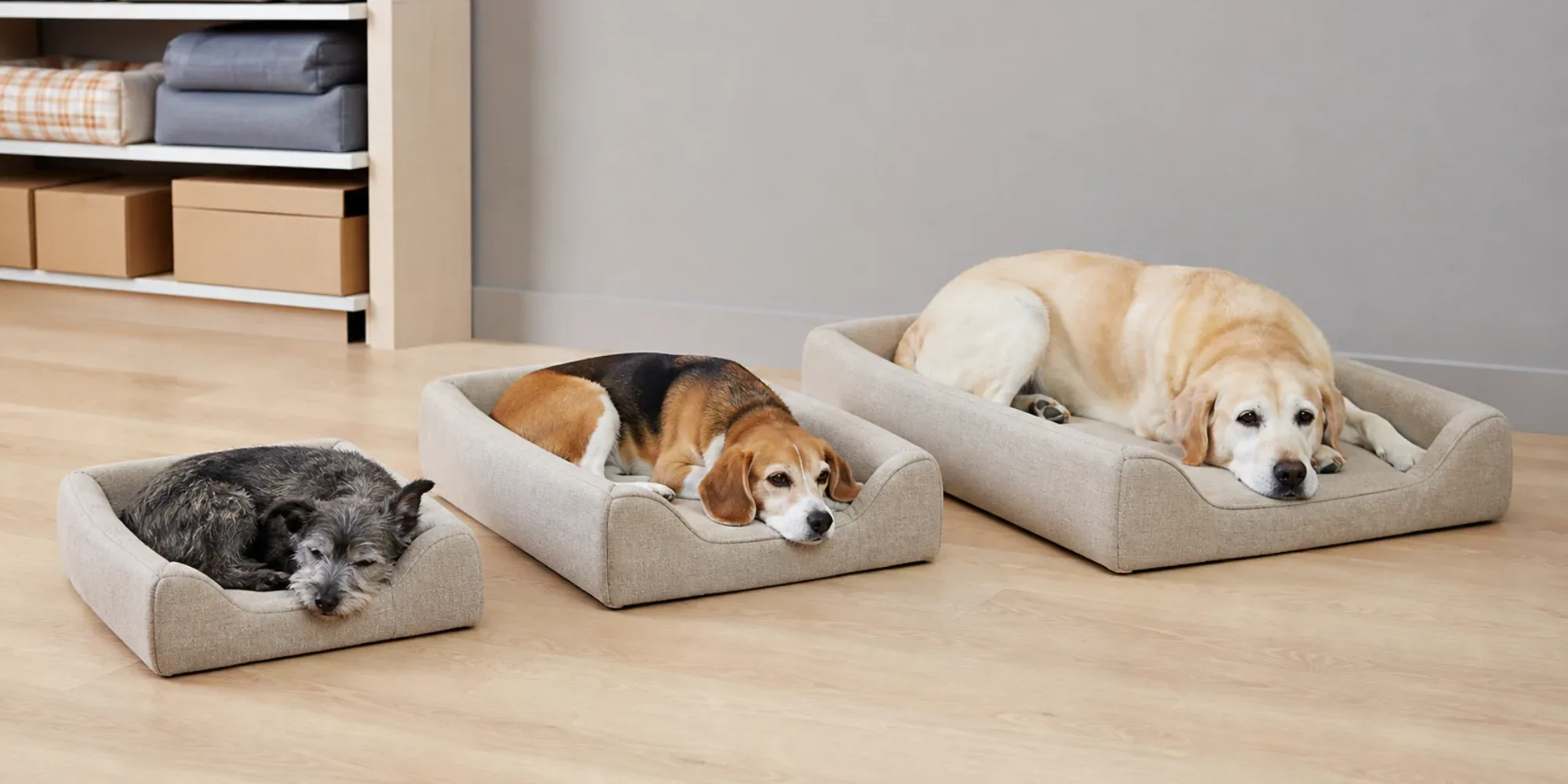
To build a senior dog bed size range, define three to four core sizes by matching the dog's weight to the required foam thickness and density to prevent bottoming out. Next, determine the surface dimensions based on sleeping style—curled sleepers fit well in structured bolster beds, while sprawlers require flat, open-sided beds with an additional 8 to 12 inches of clearance beyond their body length.
Weight Tiers: Determining Foam Thickness and Density
When developing a size range for senior dog beds, the dog's weight is the primary factor dictating the product's vertical architecture. The Z-axis, meaning the physical thickness and density of the foam base, must provide sufficient resistance to suspend the animal above the floor. Older dogs frequently experience joint degradation and stiffness. Organizations dedicated to canine arthritis emphasize that identifying mobility changes early and implementing effective care plans are essential steps in managing the condition and keeping dogs active. A bed structured to support specific weight classes serves as a physical management tool within that plan, preventing the arthritic dog from resting painful joints directly on hard surfaces. Canine Arthritis Resources & Education | Dog arthritis tips and resources
The central risk of mismatched weight capacity in a senior pet bed is a structural failure known as bottoming out. When a dog lies down, their mass does not distribute evenly across the surface. Instead, the hips, shoulders, and elbows bear the highest concentration of the load. If a heavy dog rests on a bed with inadequate vertical support, the foam compresses entirely under these specific points, leaving the dog against the rigid floor. For an aging animal with reduced mobility, this complete loss of support negates the purpose of an orthopedic product and makes rising difficult. Structuring a size range requires mapping weight tiers to foam specifications that guarantee uncompressed material beneath the heaviest parts of the dog.
Foam performance relies on balancing thickness, density, and firmness. Density measures the mass of the foam per cubic unit and largely dictates the material's capacity to support sustained weight over time without degrading. Firmness determines how much the foam yields under immediate applied pressure. Thickness provides the required travel distance to absorb the dog's anatomical profile. A lightweight senior dog placed on highly dense, exceptionally firm, and very thick foam will not generate enough downward force to compress the material. As a result, the dog receives no meaningful pressure relief. Conversely, a heavy dog resting on a thick but low-density foam bed will sink straight through the yielding material until they hit the floor beneath it.
To build an accurate weight tier system, developers must validate the physical capabilities of chosen materials rather than relying on visual bulk. Flexible polyurethane foam used in furniture and bedding is evaluated for physical property criteria through structured testing, such as the official technical guidelines detailed for CertiPUR-US certification. Relying on documented physical property testing ensures the foam base genuinely possesses the load-bearing capabilities required for the intended weight class. Without this verification, product teams risk specifying materials that look substantial on a retail shelf but lack the internal structural integrity to support a senior dog over thousands of resting hours. Technical Guidelines
Once the base materials are verified, product teams frequently utilize a dual-layer construction to balance support needs across a broader weight range. A firmer, high-density base layer acts as an uncompromising foundation to prevent bottoming out under concentrated loads. Meanwhile, a softer memory foam top layer contours closely to the dog's joints, providing necessary surface pressure relief regardless of the dog's total mass. This dual-action approach allows a single size category to comfortably accommodate dogs at both the lower and upper ends of its designated weight bracket, ensuring the heavier dog remains suspended above the floor while the lighter dog still experiences immediate joint contouring upon lying down.
Smaller senior dogs, typically weighing under thirty pounds, require beds prioritizing surface contouring over deep structural resistance. A two to three inch foam base is usually sufficient to prevent bottoming out, provided the top layer is forgiving enough to yield to a lighter load. If the overall foam assembly is too firm, the small dog will rest entirely on top of the unyielding material, causing pressure and discomfort in arthritic joints. When developing options like a Custom Calming Pet Bed Range, the base foam must be calibrated explicitly to these lighter weights so the dog can settle comfortably into the supportive structure while utilizing the surrounding plush boundaries. For company-specific information, see Lincellipet.
Medium to giant breeds present a significantly different material engineering challenge. Dogs weighing between sixty and one hundred pounds require substantial vertical travel distance to safely absorb their large joints. Beds targeting these heavy weight tiers typically necessitate four to six inches of overall foam thickness. The structural base layer must feature high density and firmness to arrest the downward movement of the hips and shoulders before they reach the floor. Simply increasing the overall thickness of a low-density foam will not suffice, as the heavy dog will still compress the weak material over time. Accurately defining these material thresholds ensures the size range legitimately supports senior dogs across all weight classes.
Sleeping Styles: Translating Posture into Surface Dimensions
While the vertical thickness of a dog bed is dictated by the animal's weight, the surface dimensions are determined entirely by how the dog occupies space during rest. A sixty-pound dog that curls into a compact circle requires a vastly different sleeping footprint than a sixty-pound dog that sleeps fully extended on its side. Product developers must establish core size matrices that accommodate these two primary sleeping styles. Translating the dog's physical length and behavioral posture into specific length and width dimensions ensures the final product provides usable space without unnecessary material waste.
When a dog curls up to sleep, they tuck their nose toward their hind legs, minimizing their exposed surface area and significantly reducing their overall length. To size a bed for this specific posture, product developers typically reference the dog's spine length from the neck to the base of the tail, then apply a modest clearance margin. Young dogs generally need only two or three inches of perimeter clearance. However, for senior dogs experiencing arthritis or spinal stiffness, holding a tight curl for extended periods becomes physically demanding. Product teams sizing beds for older curlers should calculate surface dimensions assuming a looser, modified curl. Adding four to six inches of extra width and length allows the senior dog to relax their joints and shift positions without spilling over the edge of the sleeping surface.
Sprawling presents a completely different dimensional challenge. This posture occurs when a dog lies flat on their side with their front and back legs fully extended away from their torso. Sprawling maximizes the required surface area and drastically changes the sizing equation. To determine the correct lateral extension, the required width must be measured from the dog's spine to the tips of their extended paws, rather than measuring parallel to the spine from front to back paws. This extended posture can easily double the required width of the bed compared to a curled sleeper of the exact same weight. To prevent the aging dog's limbs from hanging off the mattress and resting on the hard, unyielding floor, the bed must feature an open, flat surface. A standard calculation for sprawlers adds an eight to twelve-inch clearance margin beyond the dog's fully extended body measurements, ensuring their joints remain suspended on the foam regardless of how they stretch.
Sleeping postures are strongly linked to temperature regulation, which further influences product dimension choices. Dogs frequently curl up to conserve body heat and sprawl out to dissipate it. Because sprawling requires maximum surface exposure, these generous, open-sided dimensions are a critical consideration when designing seasonal or climate-specific products. For example, when structuring the sizing for a Custom Cooling Pet Bed Range, product developers must prioritize the sprawling footprint. A bed designed to reduce heat retention will only be effective if the dog has enough unobstructed space to fully extend their limbs across the breathable materials. If the bed is sized too conservatively, the dog will be forced into a compact, heat-retaining posture that negates the purpose of the cooling materials. For company-specific information, see Lincellipet.
Building a commercially viable size matrix requires merging these dimensional needs into standard categories. Instead of sizing for every breed, developers establish three or four broad size brackets based on the typical extended length of the breeds within each weight class. Within each defined size bracket, a brand can offer both a compact design sized for curlers and a broad, flat mat sized for sprawlers. By clearly separating the surface dimension calculations based on posture rather than weight alone, brands ensure that the physical footprint of the bed accurately matches the behavioral needs of the senior dog.
Bed Architecture: Matching Bolsters and Edges to Sleep Habits
Beyond calculating a flat footprint based on sleeping posture, developers must configure the vertical perimeter of the bed to match specific behavioral habits. The physical architecture—specifically the presence and placement of structural bolsters—fundamentally alters how an aging dog interacts with the surface. Adding padded walls restricts the available flat area but introduces necessary physical support for certain postures. Constructing an effective size range requires recognizing that perimeter structures dictate which sleeping styles the bed can accommodate.
For dogs that prefer to curl up, bolsters serve a highly functional ergonomic purpose. When a senior dog curls, they seek physical feedback against their spine to feel secure and minimize the muscular effort required to hold that posture. A raised edge provides a firm surface to lean against, supporting their aging back and hips. Many curlers also use padded bolsters as an elevated chin rest to align the neck and relieve tension. When sizing a bolster bed for a curler, developers must ensure the internal sleeping area—measured from the inside seams rather than outer dimensions—is large enough to accommodate the senior dog's looser, relaxed curl without forcing them into a tight, painful posture.
Conversely, a continuous bolster presents a significant obstacle for a dog that prefers to sprawl. Because sprawling relies on maximizing lateral extension, any raised perimeter restricts the dog's ability to stretch out. If a sprawler is placed in a heavily structured bolster bed, their legs will collide with the padded walls. To achieve their preferred posture, the dog must drape their stiff limbs over the top of the bolster, creating an awkward angle or uncomfortable elevation under their chest or joints that negates the benefits of the orthopedic foam base. Sizing for sprawlers therefore demands open-edge architectures, such as flat mattress styles, to provide unobstructed margins.
To capture a broader segment without doubling SKUs across every weight tier, developers frequently utilize hybrid bed styles. A three-sided bolster or an L-shaped bumper offers a compromise between physical containment and open space. This configuration allows a curled sleeper to tuck safely into the protected corner for back support, while a sprawler can orient their body to extend their legs across the borderless edges. When incorporating hybrid designs into a structured size range, dimensional calculations must follow the sprawling model, as open sides must be long enough to support the aging dog's fully extended limbs.
The architecture of the bed's perimeter directly impacts senior mobility. As dogs age, they frequently experience joint degradation and reduced flexibility. Organizations providing resources for canine arthritis emphasize that identifying signs early, understanding all available management options, and implementing effective care plans are vital to keeping dogs active and enjoying life. A supportive dog bed functions as one of these management options. If a senior dog with arthritic hips must repeatedly lift their hind legs over a tall, continuous perimeter bolster to access their sleeping surface, the bed becomes a physical barrier. Over time, the dog may avoid the bed entirely due to the pain of stepping into it. Canine Arthritis Resources & Education | Dog arthritis tips and resources
To resolve this mobility challenge, developers must engineer accessible entry points. This is particularly critical for large breeds. A heavy dog requires thick base foam—often four to six inches—to prevent bottoming out under concentrated loads. If a five-inch bolster is added on top of a six-inch base, the entry threshold reaches an inaccessible eleven inches. Designing a U-shaped bolster with a dropped front or a completely open entry threshold allows the arthritic dog to walk straight onto the supportive foam base without unnecessary vertical climbing. Balancing supportive edges with accessible entryways ensures the size range functions appropriately for older, heavier dogs.
Structuring the Core Size Matrix for Retail
To build a commercially viable size range, retail brands must integrate the vertical foam requirements of different weight classes with the surface dimension needs of specific sleeping styles. Offering a unique bed for every breed or minor weight increment quickly leads to unmanageable inventory and manufacturing bloat. Conversely, offering only generic small, medium, and large sizes without accounting for how a senior dog actually occupies space often results in products that fail to provide adequate orthopedic support. The solution is a structured size matrix that groups dogs into three or four core weight tiers, then splits each tier by architectural style.
The foundation of the matrix is the weight tier system, which establishes the required foam thickness and density for the base. A standard approach divides the market into small dogs under thirty pounds, medium dogs between thirty and sixty pounds, large dogs up to ninety pounds, and giant breeds exceeding ninety pounds. By defining these brackets first, product developers can standardize the base materials across multiple designs within the same tier. For example, all beds in the large tier, regardless of their outer shape, will utilize the same high-density foam base necessary to prevent a heavy arthritic dog from bottoming out. This material standardization simplifies production while ensuring consistent physical support.
Once the foam specification is established for a weight tier, the matrix branches horizontally to accommodate different sleeping postures. Because a curled sleeper and a sprawler of the exact same weight require drastically different surface areas and boundary types, a single bed shape cannot effectively serve both. Within each of the four weight tiers, brands should offer two distinct architectures: a bolstered, compact model designed to support a senior dog's loose curl, and a flat, borderless mat scaled to capture a fully extended sprawler. This approach ensures that a buyer filtering by their dog's weight is immediately presented with options that suit their dog's behavioral habits.
When defining the actual dimensions for these two architectural styles, developers must program senior-specific margins into the matrix. A traditional medium bolster bed sized for a young, highly flexible dog will likely force an older, arthritic dog into a painful, tight posture. The size matrix for a senior line must systematically increase the interior sleeping area across all units. If a standard medium bolster bed offers a twenty-four-inch internal width, the senior equivalent requires an expansion of four to six inches. Similarly, the sprawling options must account for the full extension of stiff limbs, adding eight to twelve inches of clearance beyond the average extended length of breeds in that specific weight class.
The matrix must also standardize entry thresholds across the heavier weight tiers. As the foam thickness increases to support large and giant breeds, the step-in height naturally rises. If the matrix dictates a thick base for the large tier, a continuous bolster on top of that base creates an inaccessible hurdle. Developers should document a maximum entry height rule for their senior matrix, mandating that the entry point remains low regardless of the total bed height. Consequently, all bolster beds in the large and extra-large categories must feature dropped fronts or completely open entryways, ensuring the structural design scales safely with the dog's weight.
Implementing this matrix typically results in six to eight core structural configurations—three or four weight tiers multiplied by two primary sleeping styles. While this represents a larger initial development effort than a one-size-fits-all approach, it provides a highly functional product catalog. Retailers can confidently guide a pet owner to the exact combination of foam thickness for their dog's mass and surface dimensions for their dog's posture. This systematic alignment between weight and behavior ultimately delivers the targeted physical relief required for aging dogs while keeping manufacturing variables strictly controlled.
Communicating Sizing and Support to Pet Parents
Developing a robust size matrix is only the first step; retailers must effectively communicate this matrix to consumers. Traditional dog bed sizing charts typically rely on breed generalizations or simple weight brackets, which fail to address the complex requirements of senior dogs. When a brand structures its product line around both weight-based foam thickness and dimension-based sleeping styles, the customer-facing sizing guide must capture both variables. If consumers cannot easily understand why a flat mat and a bolster bed of the same weight class have different surface dimensions, they may purchase the wrong architecture. Squeezing a heavy sprawler into a compact bolster bed negates the intended orthopedic support, simply because the buyer lacked the guidance to match the bed's physical footprint to the dog's resting behavior.
The way pet owners interact online underscores the need for comprehensive educational resources at the point of sale. Research analyzing behavior on pet-oriented social networks indicates that dog owners utilize these platforms specifically to focus on the relationship with their pet and to actively seek out advice. Because this demographic is already highly accustomed to looking for general guidance online, brands have a distinct opportunity to provide structured, behavior-based sizing tools rather than leaving buyers to guess. A well-designed sizing guide acts as a consultation. It directs the pet parent to observe their dog's habits before making a purchase, transforming a potentially confusing catalog into a supportive shopping experience. The more people I meet, the more I like my dog: A study of pet-oriented social networks on the Web | First Monday The more people I meet, the more I like my dog: A study of pet-oriented social networks on the Web | First Monday
To translate the internal size matrix into a retail sizing guide, brands should establish a two-step selection process. The first step asks the owner for the dog's current weight. This strictly determines the required foam density and thickness category, ensuring the senior dog will not bottom out. The second step requires the owner to identify their dog's primary sleeping posture. Retailers can facilitate this by providing clear visual examples of a curled sleeper and a sprawler, explaining how these postures dictate the necessary surface footprint. By framing the decision around observable behaviors, the brand steers the buyer away from arbitrary dimension guessing and toward the correct product architecture while minimizing the risk of costly returns.
Furthermore, marketing and product descriptions for senior lines must explicitly address mobility and joint limitations. If a product developer has integrated a dropped-front entryway to accommodate heavy, arthritic breeds, this feature must be highlighted in the sizing communication. Pet parents may naturally gravitate toward beds with high, plush walls because they visually appear comfortable to a human buyer. The brand's communication strategy must explain the practical tradeoff: tall continuous perimeters create physical barriers for dogs with limited hip mobility. By explaining the functional purpose behind open edges or low entry thresholds, brands help consumers align their purchase with the physical realities of an aging dog.
Ultimately, effectively communicating the size range minimizes the gap between the product's physical engineering and its practical application. When a retail listing clearly separates the vertical support needed for the dog's weight from the horizontal space required for their sleeping style, buyers can confidently navigate the available options. This structured guidance ensures the senior dog receives both the uncompressed foam foundation necessary for joint relief and the appropriate dimensional freedom required for their resting posture.
Sources
- Canine Arthritis Resources & Education | Dog arthritis tips and resources
- Technical Guidelines — 2025-03-31
- The more people I meet, the more I like my dog: A study of pet-oriented social networks on the Web | First Monday
- The more people I meet, the more I like my dog: A study of pet-oriented social networks on the Web | First Monday
