 跳到内容

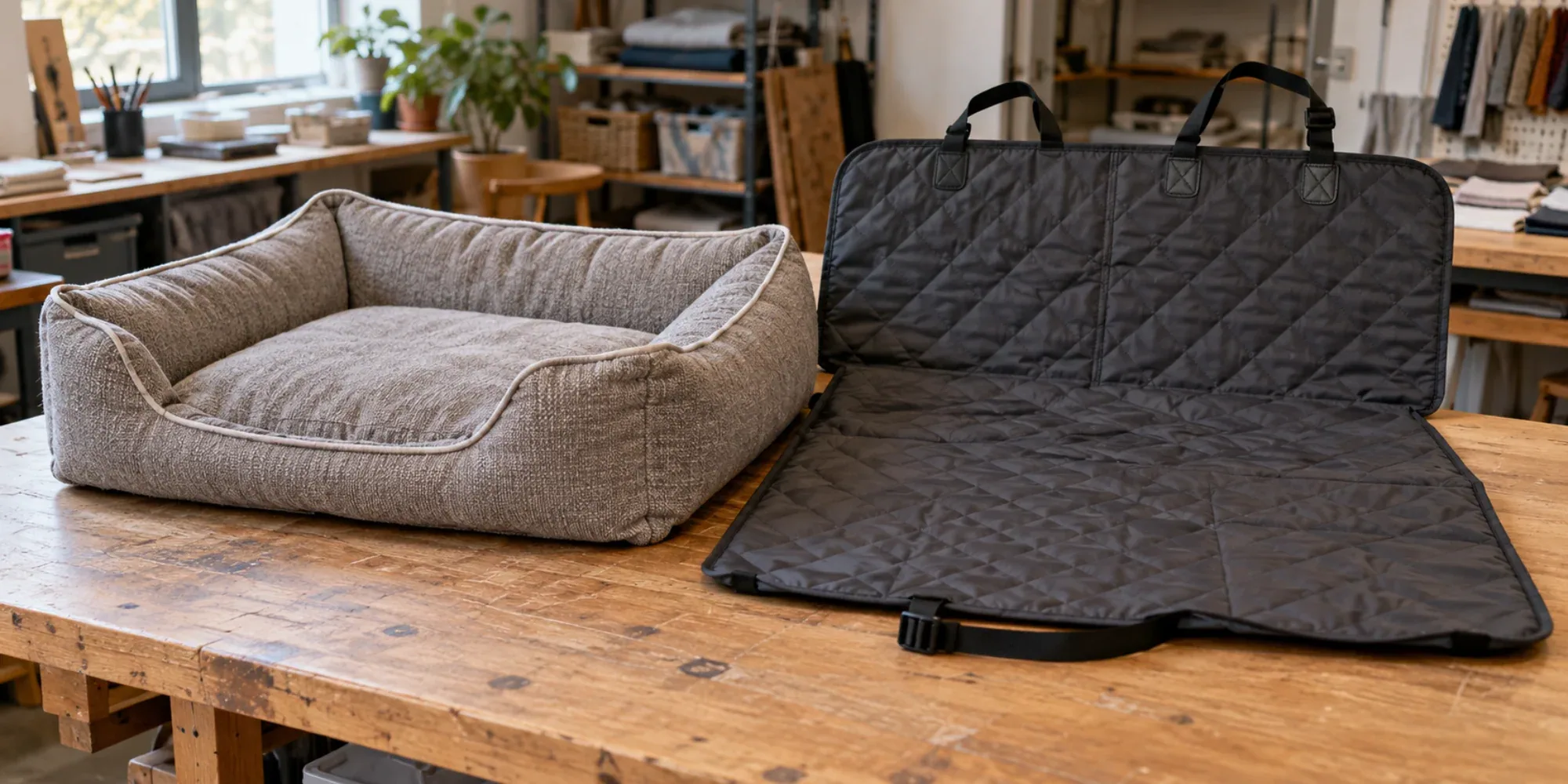
A seat cover protects your vehicle's upholstery from dirt, hair, and scratches, making it ideal for healthy, active dogs on routine trips. However, it offers no physical cushioning. A dog car bed provides structural foam support and absorbs road vibrations, which is critical for senior dogs, dogs with arthritis, or those on long-distance travel. Choose a seat cover to keep the car clean and retain passenger space, but opt for a car bed if your dog needs joint support or stability during transit.
The Primary Difference: Vehicle Protection vs. Physical Support
When traveling with a dog, pet owners generally face two distinct challenges: preventing damage to the vehicle's interior and ensuring the dog remains comfortable and physically supported in transit. Deciding between a seat cover and a car bed comes down to evaluating which of these priorities takes precedence for a given trip. While both products are installed in the same physical space within a car, truck, or SUV, their fundamental purposes, mechanical designs, and practical benefits serve entirely different ends.
A dog seat cover is fundamentally a protective barrier designed for the vehicle's preservation rather than an ergonomic support system for the animal. Typically constructed from heavy-duty fabrics, a seat cover is tensioned across the back seat and anchored to the headrests. Its primary mechanism is interception: catching mud, trapping shedding hair, and preventing sharp claws from puncturing leather or scratching cloth upholstery. Because a seat cover lies directly over the existing contours of the vehicle, it offers no additional shock absorption. The dog still experiences the stiffness of the car seat and the full mechanical impact of road vibrations. For healthy dogs taking short, routine trips, this lack of structural cushioning is rarely an issue, making the seat cover an efficient way to preserve the car's interior.
In sharp contrast, a dog car bed acts as a structural support system explicitly engineered for the dog's physical requirements. Instead of merely draping a protective fabric over the upholstery, a car bed introduces a substantial layer of cushioning—often utilizing supportive foam cores—between the animal and the vehicle seat. This structural base absorbs the continuous bumps, jolts, and high-frequency vibrations generated by the road, which can otherwise cause muscle fatigue, anxiety, or joint pain during longer journeys. Furthermore, car beds frequently incorporate raised bolsters or structured side walls. These physical boundaries give the dog a stable surface to lean against, providing crucial lateral support when the vehicle turns, accelerates, or brakes unexpectedly.
- Vehicle Preservation: Seat covers are designed to span the entire rear seating area, door panels, and sometimes footwells to capture all debris, whereas car beds generally only protect the exact physical footprint they occupy on the seat.
- Vibration Dampening: Car beds utilize dedicated foam layers to isolate the dog from harsh road shocks, while tensioned seat covers transfer all vehicle movements and mechanical vibrations directly to the dog's joints.
- Postural Stability: Structured car beds provide raised bolsters that help a dog maintain balance and feel secure during transit, whereas flat seat covers require the dog to brace itself continuously on a flat or sloped surface.
The physical volume of these products also dictates how they function inside a shared passenger vehicle. Seat covers are low-profile and adaptable; they can often be unclipped or folded back in seconds when a human passenger needs the seat. Car beds, relying on thick foam structures, demand dedicated space. A large breed will require a substantial bed that might consume the entire rear seating area. For examples of oversized structural setups, formats like a Custom Foldable Human Dog Bed demonstrate how thick cushioning can be scaled up, though utilizing such a structure means sacrificing passenger capacity. Recognizing this core division—surface protection for the car versus orthopedic support for the dog—establishes the baseline for choosing the correct travel product. For company-specific information, see Lincellipet.
When a Seat Cover is Sufficient
Seat covers excel when the primary objective is maintaining the vehicle's interior rather than managing the dog's physical limitations. For young, healthy dogs without joint issues, a standard car seat already provides an adequate, though firm, resting surface. These dogs do not typically require dedicated shock absorption or orthopedic foam to tolerate routine trips to the park, the vet, or nearby trails. Instead, the challenge for the owner is managing the collateral effects of an active dog: mud, water, shedding hair, and the mechanical wear of claws against upholstery.
When a seat cover is configured as a hammock, bridging the space between the front and rear seats, the mechanical demands on the fabric increase substantially. In this configuration, the textile is not resting on a solid base; it must support the dynamic weight of a moving animal. The material's capacity to handle this load is evaluated through tests for determining the breaking strength and elongation of textile fabrics using grab test procedures. Breaking strength dictates the maximum force the fabric can withstand before tearing, which is critical if a heavy dog steps directly into the unsupported gap. Furthermore, elongation measures how much the fabric stretches under tension. If a seat cover fabric elongates excessively, the hammock will sag under the dog's weight. This sagging creates an unstable, sloped surface that forces the dog to constantly expend energy to maintain its balance. If the product is merely a bench cover that rests entirely flush against the car seat, the breaking strength and elongation thresholds required are significantly lower, as the car's seat bears the structural load. D5034 Standard Test Method for Breaking Strength and Elongation of Textile Fabrics (Grab Test)
Once the dog is in the vehicle, its claws act as localized points of high friction. As the dog shifts its weight to brace against the vehicle's turning forces, or if it engages in natural nesting behaviors like digging or turning in circles before lying down, the surface of the seat cover is subjected to concentrated scraping. To ensure the cover does not fail under these actions, manufacturers utilize materials proven to withstand sustained friction. The evaluation of how well a material resists this type of wear involves the determination of the abrasion resistance of textile fabrics using the rotary platform abrader. A fabric with high abrasion resistance ensures that a dog's claws will not eventually pierce the protective layer, which would expose the vehicle's leather or cloth upholstery to the permanent damage the cover was purchased to prevent. D3884 Standard Guide for Abrasion Resistance of Textile Fabrics (Rotary Platform Abrader Method)
Beyond mechanical wear, seat covers are chosen for their utility in managing moisture and loose debris, making them the preferred option for outdoor excursions. An active dog returning from a hike may bring mud, burrs, sand, and water into the cabin. A seat cover acts as an impermeable or highly water-resistant catchment area. Because they lack thick foam cores, seat covers do not absorb odors or moisture deeply. They can be quickly unclipped, removed from the vehicle, and shaken out. Most covers are designed for simple wipe-downs or standard machine washing, which is a significant logistical advantage over trying to clean a saturated, multi-layered dog bed. For owners taking daily trips to a muddy trail, this ease of maintenance makes the seat cover highly sufficient.
However, recognizing when a seat cover is sufficient also means recognizing its strict limitations. A heavy-duty, highly abrasion-resistant textile is a remarkable tool for intercepting physical damage, but it provides zero structural dampening against road vibrations and offers no orthopedic cushioning for the dog's joints. If a dog is young, healthy, and physically capable of absorbing the bumps of the road, the seat cover perfectly fulfills the requirements of the trip. But if the dog begins showing signs of stiffness, hesitates to jump into the car, or struggles to balance due to age or joint conditions, the mechanical protection of a seat cover is no longer adequate.
When to Upgrade to a Dog Car Bed
While a seat cover excels at keeping a vehicle clean, it leaves the dog to cope with the physical realities of the car seat. The upholstery in modern vehicles is designed to support the weight and posture of a human, not the skeletal structure of a dog. When a dog lies on a back seat covered only by a thin layer of tensioned fabric, they absorb the vehicle's mechanical vibrations and road shocks directly through their joints. For a young, healthy dog on a quick trip, this lack of cushioning is rarely an issue. However, specific physical conditions and travel scenarios dictate when a fabric barrier is no longer sufficient, making the structural support of a dedicated car bed necessary.
The most common catalyst for upgrading to a car bed is the onset of age-related joint stiffness or canine arthritis. Organizations such as Canine Arthritis Resources & Education (CARE) provide resources to help identify early signs of arthritis and implement effective care plans. A key component of managing joint discomfort is minimizing unnecessary physical stress. When an arthritic dog rides on a standard car seat, the constant micro-vibrations from the road surface, combined with the sudden jolts of potholes, can aggravate inflamed joints. A structured car bed introduces a thick, energy-absorbing foam core between the dog and the vehicle. This foam compresses to absorb the kinetic energy of the road, dampening the harsh impacts before they reach the animal's skeletal system. Canine Arthritis Resources & Education | Dog arthritis tips and resources
Joint vulnerabilities are not exclusively limited to senior dogs, as many breeds face genetic predispositions to structural issues from an early age. The Orthopedic Foundation for Animals (OFA) focuses on improving companion animal health by reducing the incidence of inherited genetic diseases, which includes a historical and ongoing focus on hip dysplasia. For a dog living with structural vulnerabilities, maintaining stability in a moving vehicle requires constant, fatiguing muscle engagement. A flat, slippery seat cover offers no postural assistance. In contrast, a well-designed car bed often features a firm orthopedic base and raised structural bolsters. These bolsters allow the dog to lean against a supportive wall, reducing the need to actively brace their legs when the vehicle accelerates, brakes, or navigates sharp turns. About Us | OFA
- Persistent stiffness, hesitation, or a visible limp after riding in the car for standard distances.
- Anxiety or reluctance to enter the vehicle, which can sometimes stem from the anticipation of travel discomfort.
- Continuous shifting, pacing, or an inability to settle into a comfortable resting position during transit.
- The presence of diagnosed joint conditions where minimizing physical impact is a priority for daily management.
The duration of the journey also plays a critical role in deciding whether to transition from a simple seat cover to a dedicated bed. On a long-distance road trip, the physical toll of continuous travel accumulates. Even a dog without underlying joint issues will experience muscle fatigue if forced to balance on a contoured, unyielding car seat for hours at a time. By providing a flat, cushioned surface that actively isolates the dog from the car's movements, a bed transforms the back seat into a stable resting environment. For examples of structural configurations, referencing a Custom Orthopedic Memory Foam Dog Bed can provide context on the foam densities required for sustained support. For company-specific information, see Lincellipet.
Upgrading to a car bed shifts the priority from protecting the vehicle to protecting the dog, and this shift comes with practical compromises. A high-quality car bed relies on volume and density to function effectively, inherently consuming passenger space. While a seat cover can be quickly unclipped to accommodate a human passenger, a car bed is a distinct piece of physical equipment that requires dedicated seating real estate and specific anchoring to remain secure. The decision to upgrade hinges on the dog's physical requirements. If the dog is healthy and the goal is intercepting mud, the seat cover remains the most efficient tool. If the dog requires vibration dampening, orthopedic relief, or structural boundaries to travel comfortably, a foam-based car bed becomes an indispensable piece of travel equipment.
The Role of Materials: Foam Cores and Heavy-Duty Fabrics
The operational differences between a seat cover and a car bed are ultimately dictated by their material composition. While both products must survive the demanding environment of a vehicle's back seat, their material architectures diverge significantly. A seat cover is essentially a protective textile barrier. Its performance is entirely dependent on the physical resilience of its outer fabric. A car bed, on the other hand, is a composite product. It relies on a deliberate combination of an external textile shell for protection and an internal structural core for support. Understanding how these materials function helps clarify which product is capable of meeting specific travel requirements.
Regardless of whether a pet owner installs a simple suspended hammock or a structured orthopedic base, the exterior material faces the same threats: sharp claws, moisture, and friction. Both seat covers and the outer shells of car beds are typically constructed from heavy-duty synthetic textiles, such as high-denier polyester or coated canvas. These materials are selected because they can withstand the concentrated pressure of a dog pacing or digging before lying down. However, in a seat cover, the fabric is the sole line of defense for the vehicle's upholstery. It must possess enough tensile strength to span the gaps between seats without sagging excessively under the dog's weight. For car beds, the textile serves a slightly different primary function: it must protect the internal foam core from moisture and dirt. If liquid penetrates the cover of a bed, it can degrade the internal support structure and trap odors, making a durable, water-resistant textile layer essential.
The true differentiator between the two travel options is the presence of an internal structural core. While a seat cover relies entirely on the car's existing seat for physical support, a car bed replaces that surface with its own engineered cushioning. This is typically achieved through the use of flexible polyurethane foam. Unlike loose fiberfill, which can shift and flatten under a dog's weight, a solid foam core provides predictable, consistent resistance. This structural consistency is what allows a bed to absorb the kinetic energy of a moving vehicle, intercepting harsh road vibrations before they transfer directly into the dog's joints.
Not all foam provides the same level of orthopedic support, and the performance of a car bed depends heavily on the specific physical properties of the materials used. Established frameworks help evaluate these materials; for example, the official technical guidelines for CertiPUR-US certification specify the environmental and physical property testing criteria for flexible polyurethane foam used in bedding applications. Physical property testing is critical for travel beds because it ensures the foam can repeatedly compress under a dog's weight during transit and fully recover its shape. When a vehicle hits a bump, the foam must yield enough to absorb the sudden shock, yet remain structured enough that the dog does not bottom out against the hard car seat beneath. Technical Guidelines
To understand how a car bed will perform during travel, owners must consider two distinct foam characteristics: density and firmness. Density refers to the mass of the foam material per cubic unit, which directly correlates with its overall durability and resistance to breaking down over time. A high-density foam core will maintain its structural integrity over years of continuous road trips. Firmness, however, dictates how much the foam yields under immediate pressure. An older dog with joint issues may benefit from a layered approach: a softer memory foam top layer for pressure relief, supported by a high-density, firm base layer to prevent the bed from sagging during sharp turns. Seat covers avoid these complex material variables entirely, offering a straightforward, low-maintenance solution for owners who do not need to manage their dog's physical stability.
Space, Installation, and Passenger Tradeoffs
The decision between a dog car bed and a seat cover extends beyond the physical needs of the animal and the preservation of the upholstery; it fundamentally alters how the vehicle's interior volume can be utilized. Passenger cabins have fixed dimensions. Introducing any specialized travel equipment requires a compromise between pet accommodation and human utility. While the previous sections established the functional differences in structural support and fabric durability, evaluating the physical space constraints, installation requirements, and daily passenger tradeoffs is necessary to determine which product type fits a specific travel routine.
Seat covers are inherently low-profile. Because they are constructed from pliable textiles rather than rigid structures, they conform to the existing geometry of the vehicle. This two-dimensional footprint provides a distinct logistical advantage for multi-use vehicles. A standard bench cover rests flat, preserving the spatial capacity of the rear seat. Even a full hammock-style cover, which bridges the gap between the front and rear seats, can be rapidly adapted. Many hammocks feature a central zipper, allowing the owner to drop one half of the barrier to the floor. This modularity permits a human passenger to sit on one side of the vehicle while the dog remains in its designated, protected zone on the other. When the entire back seat is needed for passengers or bulky cargo, a seat cover can be unclipped from the headrests, folded, and stored in the trunk in a matter of seconds.
In contrast, the defining feature of a dog car bed—its thick, energy-absorbing foam core—makes it a high-volume object. To effectively isolate a dog from road vibrations and provide orthopedic support, the foam base must possess significant thickness, and any surrounding bolsters require substantial width. Consequently, a car bed demands a dedicated, three-dimensional footprint. A structured bed sized for a medium or large breed will easily consume fifty to one hundred percent of a standard rear passenger bench. Because the foam cannot be compressed or folded out of the way on demand without compromising its structural integrity, it permanently occupies that seating volume for the duration of the trip. If a human passenger needs to ride in the back, the bed cannot simply be pushed aside; it must be completely removed from the cabin.
The installation mechanisms for both products also reflect this difference in permanence. A seat cover relies on simple suspension and friction. It typically anchors via adjustable nylon straps looped over the vehicle's headrests, combined with plastic seat anchors pushed between the seat cushions to prevent shifting. This lightweight installation is designed for rapid deployment and removal. A car bed, having greater mass and an elevated center of gravity, requires a much more robust anchoring strategy. If a structured bed slides during a sharp turn, the dog loses the stability the bed was designed to provide. Therefore, car beds often require complex strap routing around the entire seat back or secure attachments utilizing the vehicle's lower child-seat anchor points. This rigorous installation makes moving the bed a labor-intensive process, making it less suitable for owners who frequently transition between transporting their dog and driving human passengers.
Furthermore, elevating the dog on a thick foam base complicates the use of safety restraints. When using a seat cover, the vehicle's built-in seatbelt receptacles remain flush and accessible through designated slits in the fabric. This allows the owner to easily tether the dog's travel harness directly to the seatbelt system. When a dog is positioned several inches higher on a foam bed, routing a standard tether down to the seatbelt receptacle alters the geometry of the restraint. Owners must carefully evaluate whether the car bed accommodates the safe routing of their specific harness system without creating dangerous slack or awkward tension angles.
The layout of the vehicle ultimately dictates how severe these tradeoffs will be. In a standard sedan, the rear passenger seat is the only viable location for either product, forcing a direct choice between passenger capacity and the dog's physical support. However, owners of SUVs, hatchbacks, or wagons possess a dedicated rear cargo area. Placing a structured car bed in a flat cargo space eliminates the passenger seating tradeoff entirely, converting it into a cargo capacity tradeoff instead. If the vehicle's architecture permits this separation, the logistical burden of a bulky car bed is significantly reduced, allowing the owner to prioritize the dog's joint health without sacrificing daily utility.
Sources
- D5034 Standard Test Method for Breaking Strength and Elongation of Textile Fabrics (Grab Test)
- D3884 Standard Guide for Abrasion Resistance of Textile Fabrics (Rotary Platform Abrader Method)
- Canine Arthritis Resources & Education | Dog arthritis tips and resources
- About Us | OFA
- Technical Guidelines — 2025-03-31
