 跳到内容

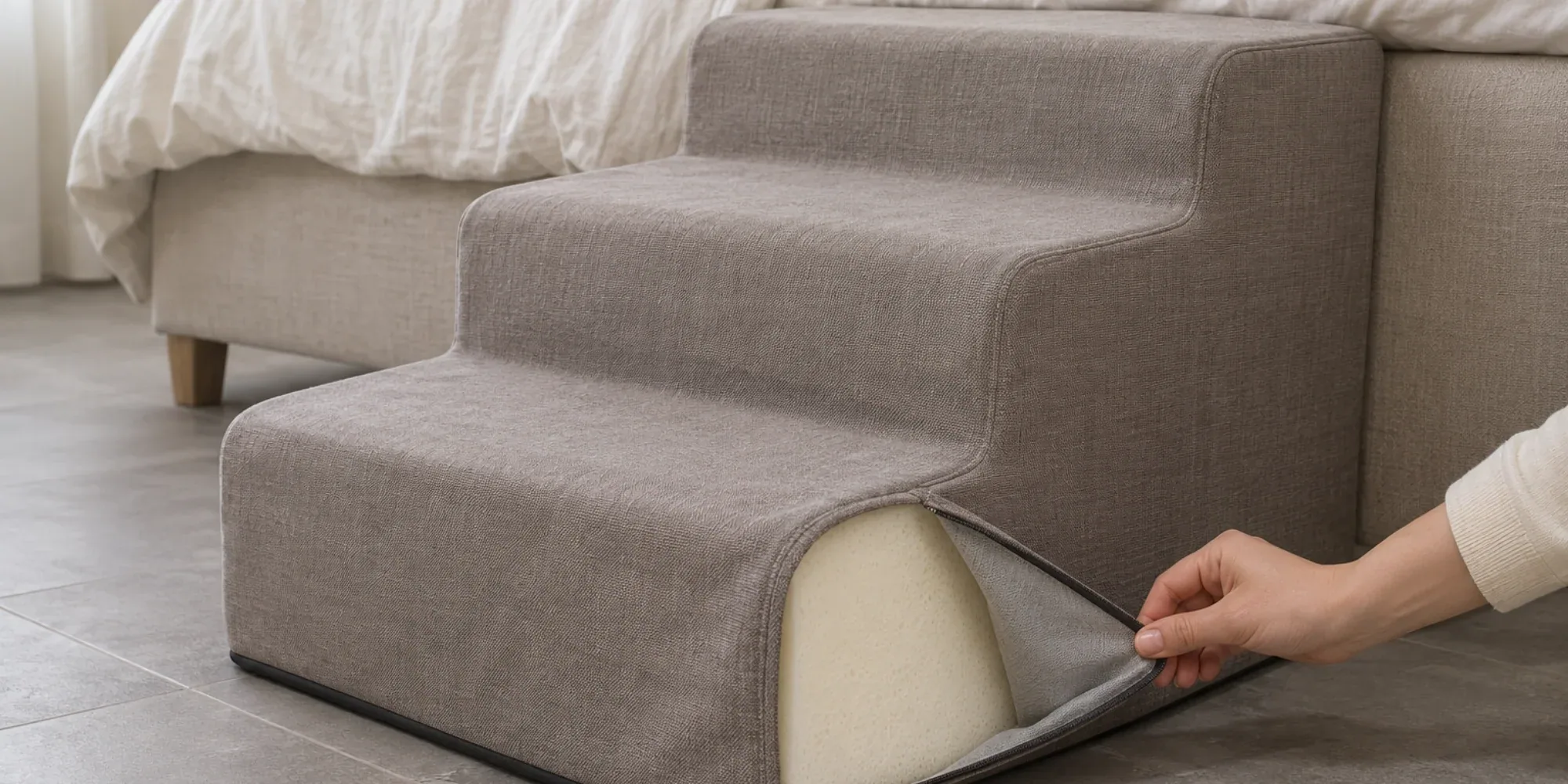
Foam pet stairs rely on high-density polyurethane foam to support a dog's weight without collapsing, paired with a fitted, durable cover that provides necessary traction. Their overall stability depends on the foam's physical load-bearing properties, a base that grips the floor, and dimensions that correctly match both the dog's stride and the height of the bed.
The Core Structure: Foam Density and Physical Properties
When a dog uses foam pet stairs to access a bed, the internal core must withstand significant localized pressure without collapsing. Unlike rigid materials such as wood or plastic, flexible polyurethane foam provides a cushioned surface that absorbs impact, which is often beneficial for dogs navigating elevation changes. However, this cushioning effect relies entirely on the foam having the correct physical properties to bear weight. If the core structure is too soft or lacks sufficient density, the stairs will compress excessively under the dog, creating an unstable surface that discourages use.
Understanding how foam supports weight requires distinguishing between two primary physical properties: density and firmness. Density refers to the mass of the foam per cubic unit, which primarily dictates the material's long-term durability and resistance to breaking down. Firmness determines how much force is required to compress the foam by a specific percentage. A high-density foam is not automatically firm, and a firm foam is not necessarily dense. For pet stairs, the foam must possess high enough firmness to resist immediate collapse under the dog's weight, while also having adequate density to survive thousands of compression cycles without developing permanent structural fatigue.
The way a dog interacts with a stair step is fundamentally different from a human sitting on a foam mattress or sofa. A dog's weight is distributed across small paw pads, creating intense point loads. When a dog steps onto the edge of a foam stair, all of that localized downward force acts on a very small surface area. If the firmness is inadequate, the front edge of the step will compress deeply, turning a flat horizontal surface into a downward slope. This changes the geometry of the stair during use, disrupting the dog's balance and potentially causing them to slip backward.
To prevent these structural failures, the flexible polyurethane foam used in load-bearing applications must be rigorously evaluated. Official technical guidelines for CertiPUR-US certification outline specific environmental and physical property testing criteria for flexible polyurethane foams intended for furniture and bedding. Applying physical property testing ensures the foam can handle repeated impacts, verifying that the internal cellular structure will rebound predictably and will not lose its necessary elasticity when subjected to the concentrated weight of a moving animal. Technical Guidelines
When selecting a core structure, the specifications must align with the size and weight of the target dog. A small terrier requires a lighter firmness to feel comfortable, while a heavy retriever demands a highly rigid foam structure that will not bottom out. For commercial buyers establishing product specifications, evaluating Custom Foam Pet Stairs and Ramps involves matching these physical foam properties to specific breed categories. A firm core ensures that the steps retain their shape and provide the necessary resistance for a heavy dog to safely reach a high mattress. For company-specific information, see Lincellipet.
Over time, foam that lacks sufficient density will suffer from fatigue. Flexible polyurethane foam consists of countless tiny microscopic cells. Every time a dog steps on the stairs, the cell walls bend and release air. In low-density foams, these thin cell walls eventually crack and break under repeated mechanical stress. Once a significant number of cell walls fracture, the foam loses its ability to push back against the load, resulting in permanent indentations or a flattened step. A high-density core prevents this mechanical breakdown, maintaining the original supportive geometry.
Beyond supporting individual steps, the density of the foam core directly influences the overall physical stability of the entire stair unit. Pet stairs are freestanding structures placed against a bed frame or mattress. When a dog climbs, they generate lateral force; when they leap onto the mattress from the top step, they push the stairs backward. A denser foam core inherently weighs more, lowering the center of gravity of the unit. This added mass helps anchor the stairs to the floor, reducing the likelihood of the unit tipping sideways or sliding away during a vigorous climb.
Addressing Mobility Limitations and Joint Health
For a healthy, young dog, jumping onto or off a mattress is a routine action. However, as dogs age or develop joint conditions, this sudden vertical movement becomes a significant source of strain. The downward force of jumping off a high bed places immense peak stress on a dog's front limbs, particularly the carpal and shoulder joints, upon landing. Conversely, leaping up requires powerful rear-leg thrusts that can exacerbate hip and stifle issues. To mitigate these jarring impacts, owners introduce foam pet stairs. By breaking a single, high-impact leap into several smaller, controlled steps, foam stairs allow dogs to navigate elevation changes using a standard walking gait rather than explosive momentum.
This transition to controlled movement is a critical component of long-term joint health. According to Canine Arthritis Resources and Education, managing canine arthritis requires implementing effective care plans that focus on keeping the dog active and enjoying life. Rather than restricting a dog entirely to the floor, careful management involves modifying their environment so they can continue their normal routines, such as sleeping on the bed, without experiencing pain. Supportive tools like structurally sound foam stairs provide the necessary environmental modification to keep aging dogs mobile without worsening their joint degradation. Canine Arthritis Resources & Education | Dog arthritis tips and resources
Because identifying the right mobility aid is not always intuitive, owners often invest significant time researching options. Research into pet-oriented online networks demonstrates that dog owners frequently use these platforms to look for advice and focus heavily on their relationship with their pets. When an owner observes early signs of joint discomfort, such as pacing beside the bed, whining instead of jumping, or a reluctance to climb down in the morning, they actively seek out shared experiences and recommendations for reliable bed access solutions. This pursuit of advice reflects a deliberate effort to manage their pet's changing physical needs. The more people I meet, the more I like my dog: A study of pet-oriented social networks on the Web | First Monday
For dogs already suffering from arthritis or muscle atrophy, the physical stability of the stairs is non-negotiable. A dog with compromised joint health has a reduced capacity to correct their balance if they slip. If they step onto a foam stair that lacks a sufficiently firm core structure, the excessive compression can cause the step to tilt or give way. This sudden loss of support forces the dog's weakened joints to rapidly compensate, which can cause acute pain. Consequently, a single negative experience on a sagging or unstable set of stairs can create a strong behavioral aversion, leading the dog to refuse the stairs entirely and attempt dangerous jumps instead.
The requirement for reliable, load-bearing support during movement aligns closely with the principles of orthopedic rest. For example, an owner might select a Custom Orthopedic Memory Foam Dog Bed to provide targeted pressure relief for an arthritic dog while they sleep. However, the benefits of that restorative rest are quickly undone if the dog must endure a painful, unsupported dismount to reach the floor. A comprehensive approach to a dog's joint health requires that the transition between the bed and the floor is as stable and supportive as the resting surface itself. The foam stairs must absorb the impact of the footfall without rebounding too sharply or bottoming out. For company-specific information, see Lincellipet.
- Predictable edge support: The front of the step must not collapse, ensuring the dog's paws do not slide forward during a descent.
- Appropriate impact absorption: The foam must cushion the footfall without creating a trampoline effect that destabilizes the dog's gait.
- Adequate width: The stairs must be wide enough to accommodate the stiffer stance often adopted by dogs with hip dysplasia or arthritis.
While a dense, firm foam core provides the necessary structural resistance against the dog's weight, the surface of the foam itself is naturally smooth and offers very little grip. A dog's paw pads require a textured surface to push off against, especially when climbing an incline. Therefore, the internal stability of the foam must be paired with an external textile that secures the dog's footing, making the durability and traction of the stair cover the next critical factor in safe bed access.
Cover Fabrics: Traction, Breaking Strength, and Abrasion Resistance
While the foam core dictates the load-bearing capacity of pet stairs, the outer textile cover serves as the primary interface between the dog and the structure. A dog relies entirely on this surface for traction when ascending or descending from a bed. Unlike humans, dogs cannot easily adapt to a slippery surface; they instinctively dig in with their claws to stabilize their center of gravity. If the cover fabric is slick or shifts underfoot, even the densest foam core will not prevent the dog from losing confidence, slipping, or refusing to use the stairs entirely. Therefore, the cover must function as a stable, grippy, and highly durable layer.
Providing adequate grip requires a fabric that can withstand continuous localized abuse. Every time a dog steps onto the stairs, their claws exert concentrated friction on the textile surface. Over time, this repetitive scraping can degrade the fibers, leading to pilling, thinning, and eventual tearing. To evaluate how well a fabric withstands this type of surface wear, standard testing procedures are applied to determine the abrasion resistance of textile fabrics using a rotary platform abrader. In this type of testing, the material is subjected to controlled rubbing to simulate the continuous wear caused by claws and paws. Fabrics that perform well under these conditions maintain their texture and grip over a longer operational life. D3884 Standard Guide for Abrasion Resistance of Textile Fabrics (Rotary Platform Abrader Method)
Abrasion resistance only addresses surface wear. The fabric must also possess sufficient tensile strength to endure the downward and lateral forces generated when a dog climbs or jumps. As a dog pushes off a step, their weight and momentum pull sharply at the fabric. This stress is particularly acute at the seams and along the front edges of each foam step. If the fabric lacks structural integrity, it will permanently stretch or tear under the strain. The breaking strength and elongation of textile fabrics can be evaluated using standard grab test procedures, which measure how much force is required to rupture the fabric and how much the material stretches before it breaks. D5034 Standard Test Method for Breaking Strength and Elongation of Textile Fabrics (Grab Test)
Elongation properties directly impact the physical stability of the stairs. Some stretch is necessary for a removable cover to fit snugly over the foam core and allow the foam to compress slightly under the dog's weight without snapping the seams. However, excessive elongation allows the fabric to stretch out of shape permanently. When a cover becomes baggy, it ceases to move in unison with the underlying foam core. Instead, the loose fabric slides across the surface of the step. When a dog steps onto baggy fabric, their paw shifts forward even if the foam beneath remains perfectly stationary. This independent movement mimics a slippery floor, causing the dog to lose their footing and compromising the stability of the entire stair unit.
The construction of the cover also plays a critical role in minimizing this shifting effect. A well-designed cover is tailored to the exact dimensions of the stair structure, often utilizing heavy-duty zippers positioned away from the primary load-bearing areas. The bottom panel of the cover frequently incorporates non-slip elements, but the interaction between the inner face of the fabric and the foam is equally important. Some fabrics possess a natural backing texture that grips the polyurethane foam, preventing the cover from rotating or slipping sideways when a heavier dog climbs at an angle. Maintaining this tight, cohesive unit is essential for reliable bed access.
Selecting the appropriate cover material involves balancing these durability requirements with maintenance needs. Because pet stairs are placed in bedrooms and used daily, the covers will accumulate dirt, dander, and oils, requiring periodic washing. The fabric must retain its breaking strength and abrasion resistance after repeated laundering. If a fabric shrinks significantly during washing, it will warp the foam core when reassembled, pulling the steps out of alignment and reducing the contact area with the floor. Conversely, if washing causes the fibers to relax and stretch, the resulting loose fit will create the sliding hazards associated with excessive elongation.
Dimensional Stability: Matching Steps to Bed Height and Stride
Even when pet stairs feature a high-density foam core and a durable cover, they will fail to provide safe access if their physical geometry is incorrect. Dimensional stability refers to how the height, depth, and overall width of the steps interact with both the dog's body mechanics and the height of the target bed. If the proportions require the dog to alter its natural walking gait, the physical stability of the structure is compromised by awkward weight distribution.
The step height, or rise, directly impacts how a dog navigates the incline. A large breed might comfortably manage a six-inch rise, but a small terrier or a senior dog with arthritic joints requires a much shorter step, often three to four inches. If a step is too tall, the dog cannot simply lift its paw; it must launch its body upward. This explosive movement defeats the purpose of the stairs, substituting one high-impact jump for a series of smaller, strenuous leaps that strain the joints.
Step depth, or the tread, must accommodate the dog's full stride and paw size. Dogs possess a natural, rhythmic walking gait. When a tread is too shallow, a dog's rear paws may not clear the lower step before its front paws are forced to move again, resulting in a cramped, unnatural posture. If the tread cannot support the entire paw pad, the dog's toes will hang over the edge. This concentrates the animal's weight on the front edge of the foam, increasing the risk of localized compression and causing the dog to lose confidence in the surface.
The ratio of rise to run determines the overall slope of the stairs. A steep incline shifts a climbing dog's center of gravity backward, and a descending dog's center of gravity forward. This steep angle makes the dog feel insecure and applies lateral force against the foam structure. When a dog pushes horizontally against a steep top step to gain momentum, a lightweight foam unit can tip backward or slide away from the mattress, suddenly removing the dog's support.
- Base width: A base wider than the top step prevents lateral tipping if a dog climbs off-center.
- Total footprint: A longer overall depth relative to the height anchors the stairs to the floor and reduces the incline.
- Mass distribution: A dense foam core lowers the center of gravity, resisting the leverage applied at the highest step.
Aligning the stairs with the height of the bed dictates the required overall height of the unit. Ideally, the top step should sit flush with or just slightly below the mattress surface. If the stairs fall significantly short, the dog is forced to leap the remaining distance, which results in a heavy, high-impact landing on the front limbs during descent. Conversely, if the top step rises above the mattress, stepping down onto the bed disrupts the dog's balance.
If dimensions fail to accommodate the dog's size or the bed's height, users often refuse the stairs entirely. A large dog on narrow, cramped stairs will feel physically constrained and unsupported, risking a fall if they attempt to turn around. A small dog faced with excessively tall steps will perceive an impassable obstacle. Evaluating pet stairs requires measuring the target mattress and observing the dog's normal stride length to select a dimensional profile that allows for a steady, confident walking motion.
Base Grip and Maintenance Considerations
A foam stair unit is only as stable as its connection to the floor. While a firm internal core supports the dog's weight and a durable cover provides paw traction, the entire assembly must remain stationary against the bedroom floor. When a dog jumps off the top step onto the mattress, they exert a strong lateral thrust backward against the stairs. If the base lacks adequate friction against hard flooring like polished wood or tile, the entire unit will slide away from the bed, creating a dangerous gap.
To counteract this backward force, the bottom panel of the cover must incorporate specialized non-slip materials, such as silicone dot patterns or textured synthetic weaves designed to maximize static friction. However, the effectiveness of these non-slip panels depends directly on the mass of the foam core. Friction is heavily influenced by downward force. A heavier, high-density foam core presses the non-slip base firmly into the floor, enhancing the grip. A lightweight foam unit might slide even with a rubberized base because there is insufficient mass anchoring it.
Maintaining a perfectly flat base over the product's lifespan introduces the challenge of maintenance. Because pet stairs are placed in living spaces, the covers require regular washing. While removable covers are essential, laundering introduces the risk of dimensional changes to the fabric. If a cover shrinks in the wash, forcing it back over the foam core will physically warp the flexible polyurethane. A shrunken cover compresses the foam edges, pulling the corners upward so the base is no longer flat. This creates a rocking effect that destabilizes the steps when the dog climbs.
Conversely, if washing degrades the fabric's structural integrity, the cover may become permanently loose. A baggy cover shifts over the foam during use, undermining the dog's footing. To prevent shrinking and bagging, the textile must resist thermal and mechanical distortion during standard machine washing. Strict adherence to care instructions is necessary, as high heat in a dryer frequently causes zipper warping and fabric shrinkage.
- Corner alignment: Ensure the foam corners are pushed entirely into the seams of the cover to prevent rounded, unstable step edges.
- Base flatness: Check that the bottom panel sits completely flush against the floor without lifting at the edges.
- Zipper placement: Verify the zipper is fully closed and tucked away from the floor to avoid scratching hard surfaces.
The hardware securing the cover also impacts long-term stability. The zipper must endure significant tension from the tight fit required to keep the fabric taut and from the dynamic load of the dog's movement. If a zipper bursts after washing, the cover loses its structural tension, compromising surface grip and foam alignment. Zippers should be located along the back or underside of the unit, avoiding the front load-bearing edges where mechanical stress is highest.
Maintaining the stability of foam pet stairs requires treating the core and cover as an interdependent system. The core provides the geometry and weight, while the cover provides friction against the floor. Careful laundering ensures the stairs continue providing safe, predictable access to the bed.
Sources
- Technical Guidelines — 2025-03-31
- Canine Arthritis Resources & Education | Dog arthritis tips and resources
- The more people I meet, the more I like my dog: A study of pet-oriented social networks on the Web | First Monday
- D3884 Standard Guide for Abrasion Resistance of Textile Fabrics (Rotary Platform Abrader Method)
- D5034 Standard Test Method for Breaking Strength and Elongation of Textile Fabrics (Grab Test)
