 跳到内容

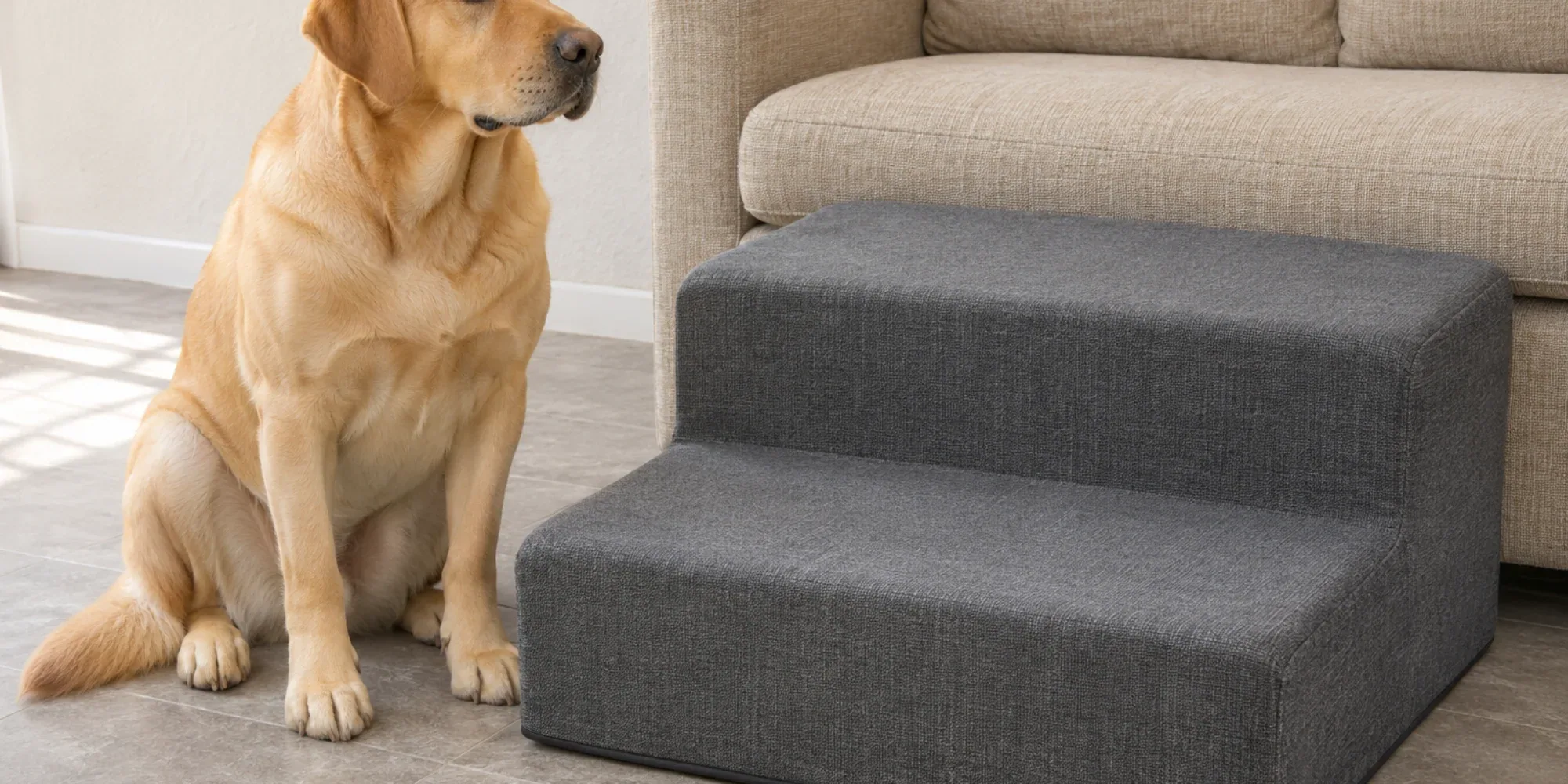
When evaluating dog steps for a large dog, the three critical checks are load capacity, step width, and base stability. First, check that the materials—such as high-density foam—will not compress entirely or bottom out under a 50-plus pound moving dog. Second, measure the width and depth of each step to ensure they accommodate the dog's natural wide stance and full stride length without forcing them to balance on a narrow ledge. Finally, check the base for anti-slip grips and a wide footprint to ensure the stairs will not slide or tip when a heavy dog pushes off or lands.
Why Large Dogs Require Stricter Tolerances
When evaluating dog steps, the physical requirements scale dramatically with the size and weight of the animal. A standard set of pet stairs designed for a small breed might theoretically hold the static weight of a larger dog, but static weight capacity is only a small part of the equation. Large dogs generate substantial dynamic forces when they step up, push off, or land. When a heavy dog descends a set of steps, their front limbs bear the vast majority of their body weight alongside the braking force required to stop their forward momentum. If the dog steps onto a structure that lacks the necessary load capacity, the material will compress excessively or bottom out entirely. If the steps lack adequate width and depth, the dog is forced into an awkward stance that compromises their balance. If the base lacks traction and stability, the entire unit will shift or tip under the lateral force of the dog in motion. These physical failures force the dog to constantly adjust their posture and balance, turning what should be a helpful mobility aid into a hazardous obstacle that demands careful, stressful navigation rather than providing relief.
This need for absolute structural stability and unyielding support is tied directly to the distinct physical vulnerabilities of large breeds. Osteoarthritis frequently affects older, overweight large breed dogs, as well as young large breed dogs suffering from developmental bone diseases. Even in dogs without a specific initial inciting cause, osteoarthritis can develop simply from the daily wear and tear exerted on their joints over time. Because excess weight compounds these issues, diet restriction has been shown to decrease the incidence of osteoarthritis in the hips, elbow joints, and shoulder joints. In humans, research has linked obesity directly to increased loads on the joint and altered physical alignment, which ultimately result in more significant joint damage and breakdown. A similar mechanical concern applies when a heavy dog is forced to use a yielding or unstable set of steps. They must alter their natural skeletal alignment to compensate for the shifting surface beneath them, potentially exacerbating the exact daily joint wear and tear the steps are intended to prevent. Osteoarthritis in Dogs – American College of Veterinary Surgeons
A large dog navigating an unstable set of stairs must heavily recruit their stabilizing muscles and joints to absorb the wobbling, sliding, or sinking motion of the steps. For a dog already managing joint pain, stiffness, or recovering from an injury, this repeated need for micro-adjustments can cause hesitation, anxiety, or a complete refusal to use the stairs entirely. To minimize unnecessary stress on the vulnerable hips, elbows, and shoulders, the step environment must remain completely unyielding under pressure. Steps that compress unevenly under a heavy paw alter the angle of the dog's limb as it bears weight, replicating the poor alignment conditions that contribute to long-term joint degradation. Therefore, ensuring strict tolerances for foam density, structural rigidity, and surface traction is not just a matter of evaluating product durability; it is an essential step in preserving the dog's daily comfort and joint health. If the dog cannot trust the surface, the steps fail to provide practical mobility support.
Recognizing and managing these physical stressors is a major component of caring for a large breed over its lifespan. Canine Arthritis Resources & Education notes that they provide resources for pet parents and veterinary teams to help identify the signs of arthritis early, offering information on management options to keep dogs active and implement effective care plans. Part of a comprehensive management plan often involves modifying the home environment to provide safe, low-impact access to elevated surfaces like beds, couches, and vehicles. However, introducing steps into the environment only fulfills this management goal if the steps themselves are physically suited to a heavy, powerful animal. If the selected steps fail basic load, width, or stability checks, they fail their primary purpose of reducing joint strain and may even introduce new risks of slipping or falling. Proper management requires steps that function as a true structural extension of the floor. Canine Arthritis Resources & Education | Dog arthritis tips and resources
Evaluating steps for a large dog means prioritizing materials and dimensions that can withstand these high downward and lateral forces without deformation. High-density foam or reinforced rigid frames are required to ensure the steps do not bottom out when seventy or more pounds of moving weight are concentrated onto a single paw during a climb. Similar principles of load distribution apply to other large-scale pet supports where dense materials function to prevent yielding under heavy pressure. When applied to mobility steps, the chosen material must offer a firm, reliable surface that gives the dog immediate, unwavering confidence. Furthermore, the width and depth of each individual tread must physically accommodate a large breed's broad chest and long natural stride, ensuring they never have to balance precariously on a narrow, shallow ledge or hesitate mid-step. For company-specific information, see Lincellipet.
Understanding exactly why large dogs require these stricter tolerances allows owners to look past generic weight ratings and focus on observable, physical performance instead. A general weight limit listed on a product box or description often refers only to the static load the frame can bear before catastrophically breaking. This static number does not guarantee that the steps will remain rigid, upright, and stable under the dynamic forces of a moving heavy dog. To ensure the product actually reduces daily wear and tear on vulnerable joints, buyers must specifically check how the core materials respond to localized heavy pressure, how the physical step dimensions align with the dog's natural standing width and stride, and how effectively the base grips the floor. Performing these specific, targeted checks ensures the chosen steps provide a genuinely supportive transition rather than a shifting, unreliable surface that the dog will eventually learn to avoid.
Load Capacity Checks: Preventing Compression
When evaluating load capacity, a static weight limit listed on a product package is only a starting point. A static rating merely indicates how much stationary weight a structure can hold before suffering structural failure. However, a large dog never places weight gently across all four paws. When climbing or descending, they transfer a significant portion of their body weight and forward momentum onto a single paw, creating a severe, dynamic load. Braking on a downward step multiplies the effective weight the structure must absorb. Buyers must distinguish between a static weight limit and a material's ability to resist localized compression. If stairs compress completely under the impact of a single heavy paw, they fail the practical load check.
For mobility steps constructed primarily from foam, evaluating load capacity requires analyzing the material's density rather than relying solely on external dimensions. Flexible polyurethane foam is widely used in soft pet steps, but performance varies drastically based on chemical formulation. According to the official technical guidelines for CertiPUR-US certification, flexible polyurethane foam used in bedding and furniture must be tested for specific physical property and environmental criteria. These physical property standards help determine how well the foam withstands repeated compression and maintains structural integrity. When selecting foam steps for a large breed, buyers must verify that the product uses high-density foam. High-density foam contains more material mass per cubic foot, meaning the internal cellular structure resists collapsing under heavy pressure far better than low-density packing foam, which flattens and permanently deforms after minimal use. Technical Guidelines
A visual inspection is rarely enough to confirm if a foam structure will support a heavy animal. The primary goal is preventing the steps from bottoming out, where the dog's localized weight compresses the material completely. To evaluate for firmness, examine the internal construction. Multi-layer foam designs often provide better dynamic load management by pairing a yielding top layer for traction with a rigid core for foundational support. A dense base layer is required in heavy-duty pet supports to stop a massive animal from sinking through to the floor. When pressing down firmly on the steps, the core must feel unyielding enough to stop downward momentum immediately. If you can easily squeeze a foam step and feel your fingers meet in the middle, it lacks the compressive resistance necessary for a large dog. For company-specific information, see Lincellipet.
If the steps are made from rigid materials like wood, metal, or plastic, the load check shifts from compression resistance to structural integrity and hardware reinforcement. Owners must inspect the joints, hinges, and underside of the individual treads. Structurally engineered hollow plastics, such as thick-walled blow-molded designs, are highly rigid and can effectively support heavy dogs without bending. However, a heavy dog stepping onto a thin or poorly constructed plastic tread may cause the surface to flex and bow inward under their paw. This sudden downward flexing unnerves the dog and weakens the plastic, leading to eventual cracking. Buyers should look for thick-walled construction, internal cross-bracing, or solid treads designed to distribute concentrated weight evenly across the frame. If the steps are foldable, the locking mechanisms require strict evaluation. A dog launching off a folding step applies severe lateral force to the hinges, meaning these pivot points must lock securely into place without rattling or shifting.
The final load capacity check occurs during practical use. Owners should observe the dog carefully the first few times they navigate the structure. Watch the material directly under their paws as they transfer full weight onto the tread. The surface should remain largely level, depressing only slightly for traction. If the tread sinks deeply and causes the dog's wrist or elbow to drop below its healthy alignment, the load capacity is inadequate for their dynamic weight. Additionally, listen to the structure. Groaning hinges, cracking plastic, or the frame buckling under stress are clear indicators of material failure. A successful load capacity check ensures the steps remain silent, firm, and structurally unchanged whether the dog is stepping up slowly or descending rapidly.
Width and Depth Checks for a Large Stance
When selecting steps for a large breed, physical dimensions are just as critical as the materials supporting their weight. Many standard pet stairs are built with compact profiles intended for small rooms and small pets. However, a large dog possesses a broad chest and a substantial overall footprint. While dogs naturally angle their limbs inward toward a center line when moving to maintain stability—a movement known as single-tracking—their body mass still requires adequate space to maneuver safely. If the treads are too narrow, the stairs fail to give the dog room to comfortably place their paws. Instead of allowing the dog to naturally dictate where their paws land, narrow steps restrict their available surface area. This forces the dog to carefully aim their steps, turning a smooth ascent into a hesitant exercise that increases the risk of slipping off the edge.
The first dimensional check focuses on the overall width of the steps. To determine an appropriate minimum width, observe your dog as they stand naturally and move across a flat floor. The step width must comfortably exceed the physical space they occupy to provide a margin of error when the dog is in motion, especially for those managing joint stiffness who may not have perfect paw placement. Standard large-breed steps typically range from fourteen to eighteen inches in width, which is generally sufficient to accommodate their footprint and allow for slight shifts in balance. If steps restrict their ability to choose comfortable footing, dogs will instinctively try to step off the sides to find solid ground. Over time, the anxiety caused by overly constrained steps often leads to complete avoidance, defeating the purpose of the mobility aid.
The second crucial measurement involves checking the depth of each individual tread. Large breeds have large paws and a naturally long stride length. When a dog steps up or down, their entire paw pad needs to make full contact with the surface to secure their footing and generate the leverage required for the next movement. If the tread depth is too shallow, the dog cannot confidently place their foot. They are forced to balance uncomfortably, leaving their metacarpal pad or rear paw pads entirely unsupported and hanging over the edge. This lack of full contact drastically reduces traction and forces their stabilizing muscles to work overtime. To evaluate tread depth, measure the length of your dog's front paw and observe their natural stepping distance. The step depth should be significantly longer than the paw itself to safely accommodate forward momentum without forcing them to cautiously tiptoe.
In addition to step width and depth, the rise, or the vertical height of each individual step, must align with the dog's physical capabilities. A common tradeoff in dog step design is balancing a gentle incline with the physical footprint the stairs occupy. Steps with deep treads and a low rise provide the safest climbing experience, but they naturally take up more floor space. Conversely, a compact set of stairs might save room but will likely feature steep, shallow steps that force a heavy dog into a sharp, physically demanding climb. For a large dog, prioritizing the physical dimensions of the steps over room aesthetics is essential. A steep rise that forces the dog to hoist their body weight excessively defeats the overall goal of providing a low-impact transition.
You can often predict how a dog will react to a set of stairs by visualizing their footprint on the stated dimensions of a product. A dog using well-proportioned steps will move in a fluid, continuous motion. If a dog stutters, pauses halfway up, or attempts to jump the remaining distance rather than taking the final step, the dimensions are likely forcing them into an uncomfortable stride. By prioritizing wide, deep steps that accommodate the dog's natural footprint without restricting their paw placement, owners ensure the dog maintains their balance. This dimensional accuracy ensures the dog never feels like they are aiming for a tiny ledge and can fully rely on the structure for safe daily access.
Stability and Traction Checks
Even if a set of dog steps meets the strict requirements for load capacity and physical dimensions, it will fail in practice if it moves during use. Large dogs generate substantial lateral and forward forces, particularly when pushing off to climb or braking as they descend. If the steps slide across a hard floor or wobble under a heavy paw, the dog will instinctively brace themselves, completely altering their natural stride. This sudden loss of footing not only increases joint stress but can also permanently shatter the dog's confidence in the mobility aid. Therefore, a thorough stability check must evaluate both how the structure anchors to the floor and how securely the dog's paws grip the treads.
The first physical check focuses on the base of the stairs, particularly when used on hard surfaces like wood, tile, or laminate. When a seventy-pound dog launches off the bottom step or lands heavily on the top step, they exert a diagonal force that naturally pushes the entire unit away from the furniture. To counteract this, the base requires substantial friction. Inspect the underside of the steps for a continuous anti-slip surface. While a few small rubber feet at the corners might keep a lightweight structure in place, they are often insufficient for a heavy breed. A dense silicone dot pattern or a full rubberized base pad that covers the entire bottom footprint is much more effective at preventing the stairs from sliding backward during a heavy push-off.
In addition to sliding, the base must resist tipping. Large dogs do not always approach their steps in a perfectly straight line. An angled approach or a misstep near the outside edge introduces significant lateral tipping forces. Check the overall footprint of the base relative to the height of the stairs. The most stable designs feature a base that is wider than the top step, creating a subtly flared profile that anchors the structure against sideways movement. If the steps are tall with perfectly vertical, narrow sides, they are highly susceptible to tipping when a heavy dog shifts their weight off-center.
Once you have verified that the base is secure, you must evaluate the traction on the treads themselves. The surface material must provide immediate grip for the dog's paw pads and claws. Avoid smooth plastics, faux leather, or slick synthetic fabrics that offer little friction, as these will cause the dog to slip forward during a descent. Instead, prioritize deeply textured materials, such as heavy-duty carpet, corduroy, or dedicated rubberized treads. These textures allow the dog's paw pads to catch and hold, providing the leverage necessary to step up and the friction needed to safely control their downward momentum.
The tension of the tread cover is just as critical as the texture of the fabric. A frequent point of failure in soft-sided or fabric-covered stairs occurs when the material bunches up or stretches under the dog's weight. Even if the internal frame or foam core remains completely rigid, a shifting cover can cause the dog's foot to slide. Because a dog's heavy downward weight naturally pins the fabric in use, testing the tension by simply pulling an empty cover sideways is inaccurate. To manually test the cover, apply significant downward pressure proportional to the dog's weight before attempting to drag the fabric laterally. If the material gathers, wrinkles, or slides easily over the core under this realistic downward load, it lacks secure anchoring.
The final stability check requires observing the steps during practical use. Position the stairs against the intended bed or couch on a hard floor. As the dog navigates the incline, carefully watch the bottom edge of the steps where it meets the floor. The unit should not creep away from the furniture or rock from side to side. Simultaneously, watch the fabric directly under the dog's paws to ensure it stays flat and tight. If the stairs shift even slightly, or if the dog has to visibly scramble to maintain their footing, the stability and traction are inadequate for their size and power.
Verifying Performance Through Owner Feedback
Even after verifying the physical dimensions, materials, and traction of dog steps, real-world performance under the dynamic weight of a large breed is best confirmed through long-term use. Manufacturers provide load capacities, but these figures often reflect static weight tests rather than the repeated impact of a heavy dog ascending or jumping down. To evaluate how a product holds up over time, buyers can cross-reference their physical checks with the experiences of other large-breed owners. Research into user behavior on pet-oriented social networks indicates that dog owners frequently utilize these sites to seek advice and focus on the relationship with their pets. Because these communities are built around sharing practical guidance, they serve as a valuable resource for identifying recurring product failures that only become apparent after months of use. The more people I meet, the more I like my dog: A study of pet-oriented social networks on the Web | First Monday
When navigating these networks to evaluate load capacity, filter discussions specifically for large dogs. A set of steps that remains perfectly stable for a small animal may compress, tip, or slide under an eighty-pound dog. Search community forums for the product name alongside terms related to structural failure, such as sinking, bottoming out, or sagging. Pay close attention to feedback regarding the foam core's longevity. If multiple large-breed owners report that a high-density foam step permanently deformed or lost its rebound after a short period, the material is failing to support a heavy dog's dynamic load. This real-world compression forces the dog to step directly toward the hard floor beneath the foam, effectively negating any intended joint support.
Online communities are equally useful for verifying base stability and step width. Large dogs frequently hesitate or refuse to use stairs that feel too narrow or wobble underfoot. Look for posts or videos showing how heavy dogs navigate the specific steps you are evaluating. A common issue highlighted in owner discussions is a base that slowly creeps away from the furniture. If owners repeatedly mention having to push the steps back against the bed or couch after use, the anti-slip grips are inadequate for the lateral force generated by a large dog. Additionally, observe if owners mention their dogs stepping off the sides. If the steps are too narrow for a wide stance, dogs will instinctively try to bypass the structure entirely, which increases the risk of slipping.
If existing community discussions lack the specific details you need, engage directly by asking targeted questions. When posting for advice, specify your dog's exact weight, their typical stride, any joint limitations they face, and the type of flooring you have in your home. Ask other owners whether the step width comfortably accommodates their large breed without requiring the dog to balance carefully. Inquire about the tread fabric, specifically whether it stretches or bunches up under heavy paws. A loose cover can cause a dog to lose traction, even if the underlying foam core remains stable. By soliciting this targeted, practical feedback, you can verify that your load capacity, width, and stability checks will hold true in a daily home environment.
