 跳到内容
跳到内容 
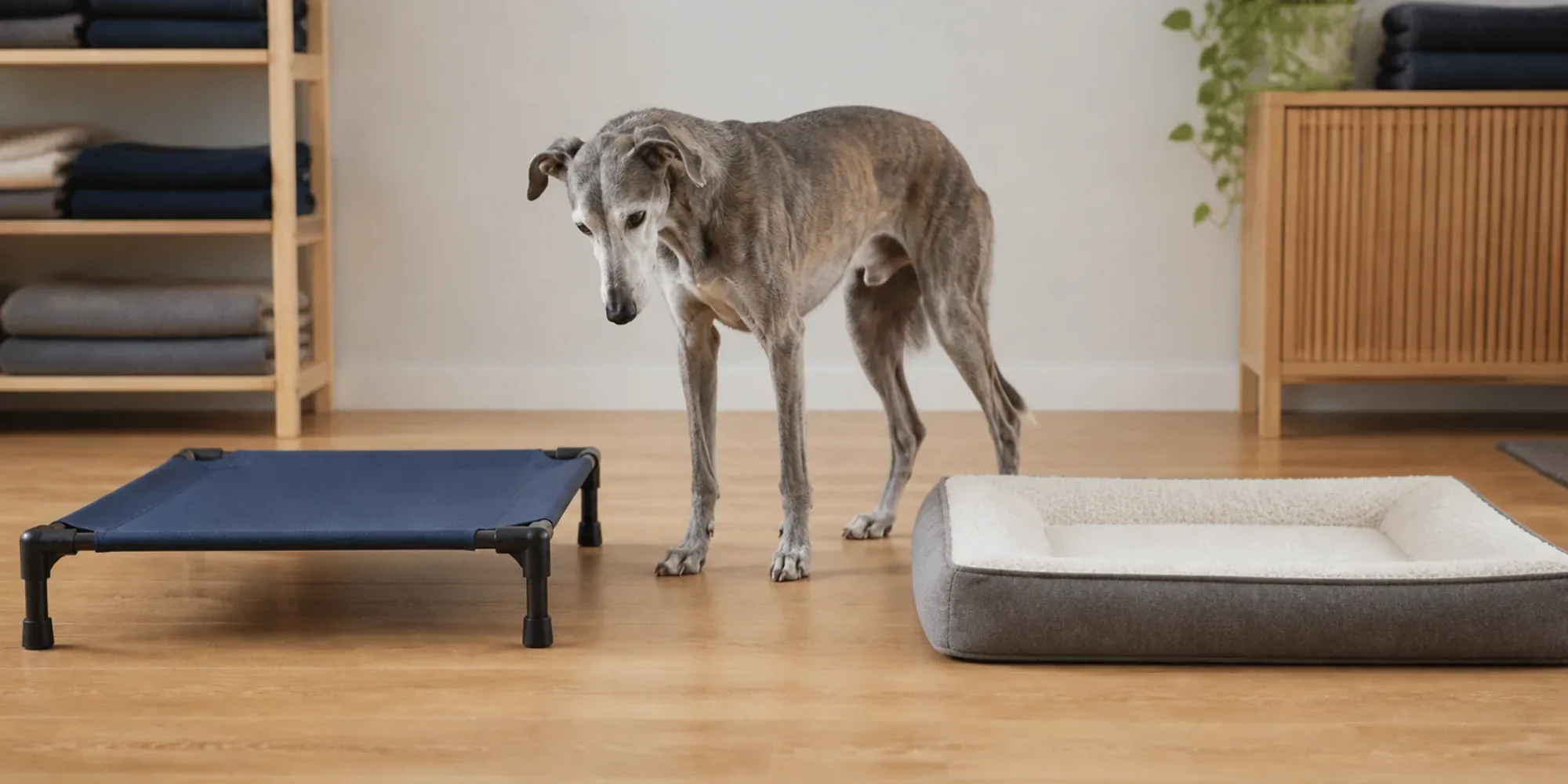
Elevated dog beds keep older dogs off cold floors and provide a firm resting plane. However, the taut fabric of a raised cot lacks the deep pressure relief necessary to cushion arthritic joints. For many older dogs, a thick, floor-level orthopedic foam bed offers superior contouring, evenly distributing their weight while providing a stable foundation to safely push against when standing up.
Understanding the Mobility and Joint Needs of Senior Dogs
As dogs enter their senior years, their daily habits gradually shift. They spend significantly more time resting and require deliberate effort to perform routine movements, such as standing up after a nap. This behavioral change is primarily driven by physical shifts in their musculoskeletal system. Understanding what happens inside an aging dog's body helps determine how to accommodate their evolving needs. For a younger dog, a bed is simply a comfortable place to sleep. For a senior dog, however, a bed functions as supportive equipment that can either ease or exacerbate physical decline. The distinction lies in the mechanical demands placed on their joints during prolonged rest and the transition back to standing.
The most common condition dictating a senior dog's mobility needs is osteoarthritis. As dogs age, the cartilage cushioning their joints fundamentally changes in composition. This aging cartilage loses its capacity to repair damaged areas, resulting in progressive cartilage breakdown and joint inflammation. Older, overweight large breed dogs are commonly affected by these osteoarthritic changes, as their joints have borne heavier loads throughout their lives. Because the underlying cartilage can no longer provide a smooth surface, everyday movements cause chronic stiffness and discomfort. Osteoarthritis in Dogs – American College of Veterinary Surgeons
Inflammation and degraded cartilage fundamentally change how a dog experiences rest. When a senior dog lies down on a hard surface or an unsupportive mat, body weight concentrates directly on protruding pressure points, such as the hips, elbows, and shoulders. For a healthy dog, this pressure is absorbed by intact cartilage and healthy muscle mass. For an arthritic dog, this concentrated pressure pushes against inflamed joints, causing discomfort and prompting the dog to shift positions repeatedly. Consequently, an older dog requires a resting surface capable of distributing weight evenly to reduce the localized physical stress that aggravates joint inflammation.
Beyond the resting phase, osteoarthritis complicates the mechanics of getting up. Transitioning from a prone position to a standing posture requires a coordinated effort. The dog must gather its limbs, brace its paws against the surface beneath them, and push upward. When cartilage is worn and joints are stiff from inactivity, this initial push-off becomes a significant physical hurdle. Furthermore, older dogs often experience muscle atrophy in their hindquarters, meaning they have less power to compensate for joint pain. To stand effectively, an arthritic dog relies heavily on the stability and structural resistance of their resting surface to provide reliable leverage.
The design of a senior dog's bed serves as a practical tool for daily pain management. An ideal resting environment must address both sides of the mobility equation. First, the surface must yield enough to contour around inflamed elbows and hips without creating painful pressure points. Second, the bed must offer enough foundational firmness to give the dog a stable base to push against when rising. While some assume a bed's elevated structural height makes standing easier, a dog pushes off from the bed itself. The muscular effort required to lift their body from a prone to a standing posture remains tied to how well the bed supports their paws, not its distance from the ground. A bed that is too soft traps the dog, while one that is too rigid creates resting pain.
These competing requirements create a practical dilemma when evaluating bed styles. Raised cots and floor-level foam beds approach senior dog mobility differently. Elevated fabric beds suspend the dog away from rigid floors but introduce distinct challenges regarding surface tension and access. Conversely, dense foam beds rely on material thickness and contouring to cushion the body, provided the foam is firm enough to prevent sinking. Evaluating which approach is better for an aging dog requires looking closely at how each specific design interacts with a stiff, arthritic body in reality.
The Mechanics of Raised Cots for Aging Dogs
A raised dog cot consists of durable fabric stretched tightly across a rigid metal or plastic frame, elevating the sleeping surface off the floor. For an aging dog, this structural departure from a traditional floor-based cushion completely alters the physical experience of resting. While the elevated design successfully isolates the dog from cold floors, it introduces unique comfort and accessibility challenges for a resting body. These tradeoffs must be carefully weighed against the dog's specific physical limitations and daily mobility habits.
Many owners assume the primary benefit of a raised cot lies in its height, mistakenly believing it functions similarly to a taller chair for an elderly human. However, this assumption relies on a flawed mechanical premise. Because a dog does not sit with their legs dangling toward the ground, the height of the bed does not actually reduce the vertical distance they must lift their body weight. When an arthritic dog transitions from a prone position to a standing posture on an elevated cot, they must gather all four paws directly on the fabric surface. The maximum flexion of stiff hips and shoulders, and the muscular effort required to push upward, remain identical to rising from the floor. Consequently, the bed's height provides no mechanical assist to lessen the strain on inflamed joints during the initial push-off.
While standing up from a cot requires the same mechanical effort as standing from the floor, navigating onto and off of the structure presents distinct accessibility hurdles. To get into the bed, the dog must lift their paws over the perimeter. The tripping hazard of a raised cot applies specifically to the rigid outer frame, which can easily catch the toe of a shuffling dog. Although some designs feature fabric that sits flush with the rails to minimize this lip, stepping up onto the elevated platform still remains an obstacle. For a senior dog with reduced spatial awareness or generalized hindquarter weakness, this transition can cause stumbling. Similarly, stepping down requires the dog to absorb the sudden impact of the drop. If the surrounding floor is smooth, this dismount can jar sensitive joints and increase the risk of falling.
Beyond accessibility, evaluating a raised cot requires understanding how its resting surface interacts with osteoarthritis. Cots rely on surface tension to support the dog's weight, keeping the animal from sinking. While this tensioned fabric is not a rigid surface—it naturally yields and slings around the dog's body to distribute pressure—it behaves very differently from a contouring mattress. A stretched mesh deflects broadly across its entire plane, unable to provide deep, localized compression. When an arthritic dog lies on their side, protruding bony prominences like the shoulders, elbows, and hips cannot sink deeply into the material. Because the fabric lacks localized foam compression, these sensitive joints can still experience uncomfortable pressure during extended naps, often prompting the dog to shift positions repeatedly to find relief.
This surface dynamic is further complicated by the structural degradation that occurs over time. With repeated use, the taut fabric of a cot begins to stretch, creating a slight sag or hammock effect in the center of the bed. While a softer, sagging center might intuitively seem comfortable, it actively works against a senior dog's skeletal alignment. The hammock shape forces the dog's spine out of a neutral position and creates a shallow depression. When the dog attempts to stand, they must push off from an uneven surface. This structural sag compromises the flat, elevated resting position, forcing the dog to exert extra muscular effort to climb out of the central pit from an awkward, unbalanced posture.
A secondary environmental effect of the raised cot design is temperature regulation, which can be either a benefit or a drawback. The open space beneath the elevated frame allows for continuous air circulation, making cots highly effective for dissipating body heat. For a thick-coated dog in a warm climate, this prevents uncomfortable overheating. However, for a senior dog managing osteoarthritis, ambient cold can exacerbate chronic joint stiffness. The constant draft beneath the elevated cot can cause muscles to tense and joints to ache during the night. Owners often attempt to resolve this by adding loose blankets, but these unstructured layers can slide around, creating unstable, slippery footing when the dog tries to stand.
Evaluating Floor-Level Foam Beds for Pressure Relief
Where elevated fabric cots prioritize standing mobility at the expense of surface contouring, floor-level foam beds flip this equation. For a senior dog dealing with the chronic stiffness of osteoarthritis, the primary appeal of a foam mattress is its ability to directly address resting pain. A thick, high-quality foam bed achieves this by compressing under the dog's localized body weight, allowing the surface to mold precisely around their physical shape rather than forcing their joints against a rigid, unyielding plane.
When an arthritic dog lies on their side, their hips, elbows, and shoulders act as concentrated pressure points. On a hard floor or taut fabric cot, these bony prominences bear the brunt of the animal's weight, restricting blood flow and aggravating joint inflammation. Dense orthopedic foam absorbs this weight differently. It yields beneath the heaviest parts of the dog's body while gently pushing upward against lighter areas, such as the waist. This continuous, contoured support maintains the spine in neutral alignment and evenly distributes the dog's overall weight across a much larger surface area, significantly reducing mechanical stress on inflamed joints during prolonged rest.
However, the very trait that makes foam comfortable—its ability to compress—becomes a serious liability if the material lacks structural integrity. The most common mistake owners make when selecting a floor-level bed for a senior dog is confusing plush softness with actual support. Beds filled with inexpensive polyfill or thin layers of low-density egg-crate foam often feel luxurious. While a highly stuffed shredded foam bed might offer adequate support initially, lightly filled or purely soft designs pose a significant risk of bottoming out. When a heavy dog settles into these less supportive structures, their weight can push entirely through the soft material, leaving their sensitive joints resting directly on the hard floor.
This bottoming-out effect creates a severe mobility trap. Older dogs frequently suffer from hindquarter muscle atrophy and rely heavily on a structurally stable surface to push against when transitioning from a prone position to a standing posture. If a bed is excessively soft, it functions much like quicksand. The dog's paws simply sink deeper into the material as they attempt to brace themselves, robbing them of the firm, reliable leverage they need to push upward. This lack of traction forces the dog to expend significantly more muscular effort, placing jarring strain on their arthritic joints just to get out of bed.
To successfully balance pressure relief with the structural stability required for getting up, an effective floor-level bed must rely on resilient and dense materials. When evaluating a Custom Orthopedic Memory Foam Dog Bed, the core support layer must be robust enough to arrest the dog's downward momentum before they sink near the floor, while the uppermost layers provide yielding comfort. The overall mattress thickness plays a crucial role in achieving this balance. A foam bed that is five to seven inches thick provides enough vertical space for the material to gently compress around protruding hips without bottoming out. This deep layer of dense material ensures that when the dog decides to stand, their paws meet a firm foundation within the mattress itself, allowing them to push off safely. For company-specific information, see Lincellipet.
Understanding actual foam quality requires looking beyond marketing descriptions of softness. Mattress performance relies heavily on the physical properties of the flexible polyurethane foam used inside. Industry guidelines, such as those established for CertiPUR-US certification, provide a structured framework for this evaluation by detailing testing criteria for the foam's physical properties and environmental standards. Assessing these physical property standards helps ensure that the material can withstand repeated compression from a heavy dog without permanently flattening or degrading structurally over time. Technical Guidelines
The necessity for firm, reliable foam extends beyond just the primary sleeping surface. The same mechanical requirement for a stable, non-yielding base applies when an owner introduces Custom Foam Pet Stairs and Ramps to help an arthritic dog navigate onto low indoor furniture, such as couches. Because these foam structures must support the dog's weight dynamically as they climb, any excessive compression underfoot can create a dangerous wobble. If this instability causes the dog to trip, they may hesitate to use the support entirely. Whether the foam is used in a thick resting mattress or an indoor mobility aid, it must provide dependable, localized resistance to give the senior dog the confidence and physical leverage required to move safely. For company-specific information, see Lincellipet.
Comparing Accessibility, Stability, and Safety
When choosing between a raised cot and a floor-level foam bed, evaluating how the dog enters and exits the space is just as important as assessing the resting surface. Older dogs with osteoarthritis often experience diminished balance, altered spatial awareness, and progressive muscle weakness. This means the mechanical transitions of stepping over an edge or shifting weight onto a new surface carry inherent safety risks. A bed that provides adequate comfort but is difficult to access creates a daily hazard that can cause further injury. Understanding these distinct accessibility profiles helps owners identify which style minimizes their dog's tripping and slipping risks.
Raised cots present specific spatial challenges regarding accessibility. Because the sleeping surface is elevated within a rigid outer frame, the dog must lift their paws a defined height to get onto the bed. For a senior dog with a shuffling gait or stiff hips, clearing that perimeter is a distinct obstacle. While some cot designs feature fabric that sits flush with the rails to minimize the prominent lip, stepping up onto the elevated platform still requires the dog to shift their balance and confidently lift their weight. If a dog with weakened legs trips while carrying their forward momentum over this threshold, they may not be able to catch themselves. The firm outer frame can also be painful if stepped on directly.
Once the dog steps onto a raised cot, the stability of the resting surface itself becomes a critical safety factor. The taut canvas or synthetic mesh used in these beds has a slight give, but typically features a much slicker texture compared to plush fabrics. When an older dog circles to lie down or shifts their weight to stand, their paw pads must find enough traction to brace firmly against the fabric. If the dog's nails are long or their pads are dry, they can easily slip on the taut material. Losing traction while elevated creates a severe risk of a jarring drop to the floor or an awkward twist to an inflamed joint.
Floor-level foam beds eliminate the steep drop of an elevated platform and the rigid tripping hazard of a frame, allowing the dog to walk directly onto the sleeping surface. However, accessibility depends heavily on the mattress's edge support. When a senior dog steps onto the perimeter of a foam mattress, their body weight is briefly concentrated on a small area at the edge. If the foam at this perimeter lacks sufficient structural density, it instantly compresses or rolls outward under the downward pressure. This unexpected shift in elevation can cause the dog to stumble inward or hesitate, leaving them unsure of their footing. A firm, supportive edge is necessary to provide a reliable transition.
Many floor-level foam beds also feature raised bolsters around their edges. While these padded walls provide an excellent headrest, they act as an obstacle course for an animal with limited mobility. The dog must lift their stiff legs entirely over the bolster to access the central sleeping area. Unlike the rigid frame of a raised cot, a foam bolster yields if stepped on, which reduces the immediate severity of a trip but creates a highly unstable surface that can easily throw a weakened dog off balance. For maximum safety, a floor-level bed for an arthritic dog should ideally feature an open front entry or a completely flat, bolster-free design.
Regardless of which bed style is chosen, the surrounding environment dictates its safety. The transition from the floor to the bed requires the dog to anchor their back legs securely. If a raised cot or a foam bed is placed directly on smooth hardwood or tile, the horizontal force of the heavy dog stepping onto or pushing off the bed can cause the entire structure to slide. For an older dog managing hindquarter muscle atrophy, this sudden loss of a stable foundational anchor often leads to splayed legs and acute joint strain. Placing a grippy mat under the bed or ensuring the structure rests on a stable rug is crucial.
Ultimately, the safety comparison between the two styles hinges on matching the bed's physical barriers to the dog's specific balance limitations. If a dog maintains steady footing but struggles with heat regulation, the cooling benefits of a highly stable raised cot might be prioritized, provided they can safely clear the outer frame. Conversely, if a dog shuffles heavily, frequently drags their toes, or is prone to stumbling, the grounded stability and immediate access of a firm floor-level foam bed without tall bolsters provides a significantly safer resting environment. By focusing on how the dog approaches the bed, owners can avoid creating new hazards.
Observing Your Dog to Make the Right Choice
Deciding between a raised cot and a floor-level foam bed requires stepping back and watching how an older dog interacts with their environment. Because every dog experiences aging differently, a universal recommendation cannot replace careful observation of a pet's unique habits. Owners should pay close attention to where their dog naturally chooses to rest and the specific physical hurdles they encounter. This approach helps clarify whether the dog's primary challenge is resting discomfort, temperature regulation, or a lack of standing leverage and traction.
Begin by observing the dog during periods of prolonged rest. If the dog frequently shifts positions, whines while settling, or refuses to lie on hard surfaces, they are likely experiencing localized joint pain. In these instances, the dog signals a clear physical need for deep surface contouring to relieve pressure on protruding hips and elbows. A floor-level foam bed with a dense core is generally the best solution for this behavior. Conversely, if the dog comfortably sleeps on flat, firm floors for hours but avoids soft plush carpets, they might prioritize a stable, supportive plane over cushioned contouring.
Next, watch the mechanics of how the dog stands up after a long nap. Observe their initial movements. Do they rely heavily on pulling themselves up with their front legs because their hindquarters are too weak? Do they repeatedly slip or stumble when trying to gain traction against the floor? If the primary struggle involves finding a firm anchor for their paws, evaluating the friction and stability of the bed's surface is vital. A taut fabric cot might offer reliable tension, but if the dog struggles with balance, stepping down from an elevated platform can be jarring. Owners must also closely note how the dog steps over everyday obstacles. If the older dog has a shuffling gait or frequently catches their toes on thresholds, the rigid perimeter frame of a raised cot introduces a severe tripping hazard. In these scenarios, a thick, open-front foam bed sitting directly on the floor provides a safer, obstruction-free entry and exit.
Environmental preferences also provide valuable clues. Notice whether the dog seeks out drafts and cool tile floors or prefers curling up near heating vents. A dog that struggles to regulate body heat and pants heavily indoors will often benefit from the continuous airflow beneath a raised cot. However, for a dog whose joints visibly stiffen in cold weather, the ground-level insulation provided by a thick foam mattress helps trap body heat and keeps arthritic joints warmer during the night. Observing these behaviors ensures the chosen bed aligns comfortably with the dog's environmental needs.
Managing a senior dog's declining mobility is an ongoing process that often requires continuous adjustments to their living space. It is common for owners facing these challenges to seek guidance from others. Research analyzing behavior in pet-oriented social networks notes that dog owners frequently use these online platforms to focus on their relationship with their pets and actively look for advice. While community support is valuable, evaluating a dog's health needs should ideally involve structured, professional insights rather than relying solely on anecdotal internet suggestions. The more people I meet, the more I like my dog: A study of pet-oriented social networks on the Web | First Monday
To effectively translate daily observations into a tangible care plan, owners can utilize structured evaluation tools. Organizations such as Canine Arthritis Resources and Education provide free evidence-based tools designed to help pet parents and veterinary teams identify and manage the signs of canine arthritis. Using these resources allows owners to recognize early warning signs of joint pain and understand the full spectrum of management options available. By combining professional resources with patient observation, owners can select a bed that genuinely addresses their dog's specific balance, strength, and comfort limitations. Canine Arthritis Resources & Education | Dog arthritis tips and resources
