 跳到内容

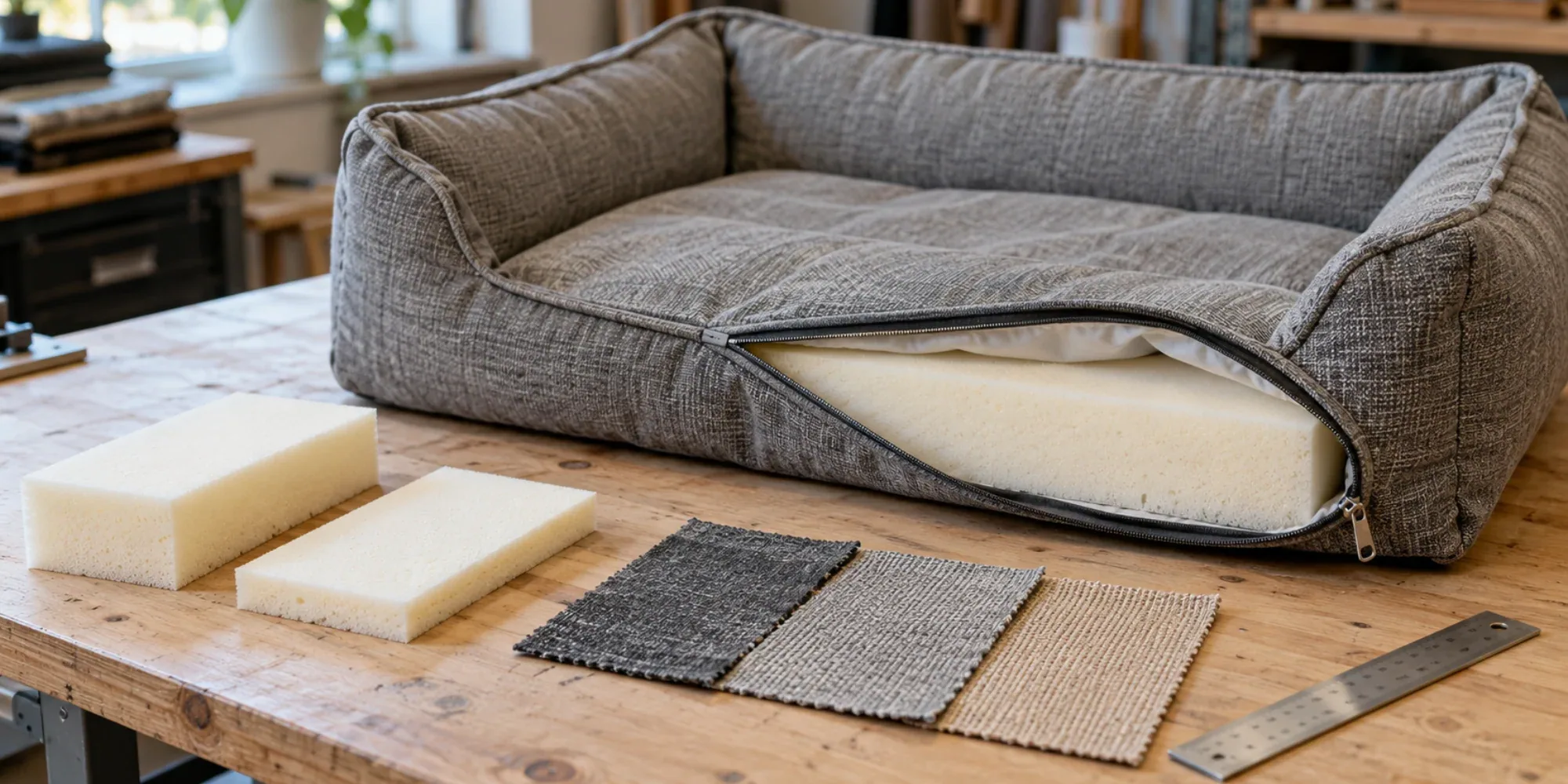
For car travel, a dog mattress should use dense, supportive polyurethane foam rather than overly soft memory foam to dampen vehicle vibrations without causing the dog to sink and lose balance. The ideal thickness is generally 2 to 4 inches, which provides joint protection while maintaining safe vertical headroom in the vehicle. The cover must be highly durable, featuring abrasion-resistant and high-breaking-strength textiles to withstand the impact of claws as the dog braces against vehicle movement.
Vehicle Dynamics and Travel Mattress Requirements
A car journey is an active physical event for a dog, fundamentally different from resting at home. Throughout transit, the vehicle subjects the animal to a complex combination of forces, including forward momentum shifts during braking, centrifugal forces during cornering, and continuous high-frequency vibrations transmitted from the road through the chassis. To maintain its balance in this dynamic environment, a dog must constantly shift its weight, brace its legs, and use its paw pads and claws to grip the resting surface. These biomechanical realities mean that a travel mattress must function primarily as a stable platform rather than just a soft resting place.
The most common mistake in selecting a travel bed is prioritizing deep, plush sinking over firm stability. While highly conforming materials are excellent for static pressure relief, they become a liability in a moving vehicle. If a dog sinks deeply into a soft, low-density cushion, it loses the firm foundation necessary to brace against sudden movements. The unpredictable yielding of the surface forces the dog to expend excessive muscular energy to correct its posture and stay upright. This constant battle for balance leads to physical fatigue and can significantly increase the animal's stress and anxiety during the trip.
To support the dog effectively, the internal structure of the travel bed must dampen road vibrations while providing a resilient surface for bracing. For a stationary home environment, a standard orthopedic memory foam dog bed typically incorporates deep, contouring layers to relieve joint pressure during prolonged sleep. However, designing for vehicle use requires transitioning to a denser, structurally robust foam base. This denser material acts as an effective shock absorber, isolating the dog from harsh chassis vibrations without allowing the dog's paws to punch through the material and hit the hard underlying vehicle floorboard. For company-specific information, see Lincellipet.
Vehicle interiors also impose strict spatial and geometric limitations that dictate the ideal thickness of the mattress. While an excessively thick mattress might seem appropriate for maximizing shock absorption, elevating the dog too high creates new problems. Raising the resting surface elevates the dog's center of gravity, which amplifies the feeling of body sway and instability during tight turns. Additionally, taller beds consume critical vertical headroom in an SUV cargo area or backseat, potentially preventing the dog from standing, stretching, or safely repositioning itself without hitting the ceiling. Therefore, the thickness must be carefully calibrated.
Finally, the active bracing behavior of a dog in a moving vehicle fundamentally changes the mechanical demands placed on the mattress cover. In a typical home setting, a resting dog applies primarily static downward pressure to the fabric. In a car, however, the dog's claws frequently dig into the material to resist lateral movement during stops and turns. This action subjects the cover to intense shear forces and elevated friction. Consequently, the textiles chosen for a travel mattress must be evaluated for exceptional abrasion resistance and breaking strength to survive these dynamic forces without tearing or wearing prematurely.
Foam Specifications: Prioritizing Support and Stability
When selecting a mattress for car travel, the physical characteristics of the internal foam determine how well the bed performs. In a home environment, owners frequently choose highly conforming materials, such as plush memory foam, to maximize pressure relief for sleeping pets. Inside a moving vehicle, however, deep conformity becomes a mechanical disadvantage. As the car navigates turns, accelerates, or brakes, a dog instinctively attempts to brace its legs and grip the resting surface to maintain balance. If the bed uses deeply yielding foam, the dog's paws sink unpredictably. This lack of a stable foundation prevents the animal from establishing a secure foothold, forcing it to expend excessive energy to remain upright.
To provide adequate support during transit, the mattress must function as an active shock absorber. A vehicle traveling at highway speeds transmits continuous, high-frequency vibrations from the road surface, through the chassis, and directly into the floorboard. If a travel bed relies on low-density or excessively soft foam, the weight of the dog combined with the downward force of a sudden bump will cause the material to bottom out. Bottoming out occurs when the foam compresses entirely under load, effectively eliminating the cushioning layer and transmitting the harsh physical impact directly into the dog's joints. Preventing this requires a material engineered to resist total compression under dynamic loads, ensuring the dog remains suspended above the hard floor.
High-density polyurethane foam is generally the most effective material for dampening road vibrations while providing a resilient surface. In foam manufacturing, density refers to the actual mass of the material per cubic foot, which is distinct from firmness. A high-density foam contains more structural polyurethane material and less air, dissipating kinetic energy more effectively than lighter foams. While a low-density foam might feel firm initially, its internal cellular structure collapses more quickly under the shifting weight of a bracing dog. Dense polyurethane foam pushes back against applied pressure, giving the dog a reliable surface to stand on without compromising the necessary shock-absorbing barrier.
The long-term performance of a travel mattress depends on the foam's ability to maintain these supportive characteristics over repeated cycles of compression. Evaluating a foam's durability involves checking its physical property benchmarks. For example, the framework for CertiPUR-US certification requires flexible polyurethane materials to undergo standardized evaluations. These tests confirm that the foam meets strict environmental benchmarks and retains the structural properties necessary for long-term use in bedding. Beyond these formal evaluations, the underlying principle for any travel bed is that the material must resist premature degradation. If a foam loses its resilience or develops permanent depressions over time, it compromises the structural push-back required to support a dog's active bracing during transit. Technical Guidelines
Designing the internal structure of a travel bed often involves combining different foam properties to optimize both grip and dampening. A common configuration is a dual-layer approach, utilizing an exceptionally dense base layer for maximum vibration isolation, topped with a responsive, moderately firm upper layer to cushion the joints without allowing deep sinking. This requirement for reliable structural push-back mirrors the mechanical principles used in generic foam pet stairs, where the internal foam must remain rigid enough to support the dynamic downward force of a dog pushing off to climb, while still offering enough surface yield for secure traction. In a vehicle, that same balance of underlying rigidity and surface traction allows the dog to safely shift its weight. For company-specific information, see Lincellipet.
- High mass-per-volume density to prevent the material from bottoming out over large road bumps.
- A firm surface structure that limits the depth a dog's paws can sink into the bed.
- Strong rebound capabilities that allow the foam to instantly recover its shape as the dog repositions.
- Resistance to physical degradation caused by repeated compression cycles.
Prioritizing physical stability in a travel mattress requires accepting a deliberate tradeoff in plushness. A mattress optimized for the dynamic environment of a vehicle will invariably feel firmer and more rigid than a traditional home pet bed. However, this firmer structure protects the dog from the continuous physical stress of absorbing road shocks and fighting for balance. By selecting dense, structurally sound polyurethane foam, owners can ensure their dog has the secure, vibration-dampened platform necessary for safe car travel.
Thickness Considerations for Car Interiors
A home dog mattress is often chosen based purely on aesthetics and perceived plushness, sometimes reaching six or eight inches in height. In a vehicle, vertical space is highly restricted by the roofline, angled hatchback glass, or the dimensions of a travel crate. Selecting the correct thickness requires balancing the dog's need for physical shock absorption against the rigid geometric limits of the car interior.
The lower limit of mattress thickness is dictated by the absolute need to protect the dog's body from the hard, vibrating surface of the vehicle floor. If a mattress is too thin, the downward force generated by a sudden bump or pothole will compress the foam entirely. This bottoming-out effect transfers harsh, localized mechanical impacts directly into the dog's joints and spine. Providing reliable support is particularly critical for aging dogs or those already experiencing mobility issues.
Educational organizations like Canine Arthritis Resources and Education emphasize that spotting joint issues promptly and implementing structured management approaches are vital for preserving an older pet's overall mobility. When an arthritic dog is on the road, a poorly cushioned ride can severely aggravate joint inflammation. Consequently, a travel bed must offer enough structural resistance and physical depth to smoothly decelerate the animal's downward momentum before its elbows, hips, or paws strike the unyielding floorboard beneath the mattress. Canine Arthritis Resources & Education | Dog arthritis tips and resources
Conversely, the upper limit of mattress thickness is governed by vehicle headroom and the dog's center of gravity. When a mattress is excessively thick, it elevates the dog's center of mass, inherently amplifying the physical sensation of body sway as the vehicle navigates corners or changes lanes. A dog resting on a tall, soft mattress will experience exaggerated lateral movement, requiring it to constantly brace and fight for balance. Keeping the resting surface as low as possible without sacrificing bottoming-out protection significantly improves stability and reduces travel-induced stress.
Furthermore, vertical clearance inside a vehicle is a rigid safety constraint. Regardless of the car type, a dog must be able to stand up, turn around naturally, and lie back down without its head or ears pressing against the roofline, the angled rear hatchback glass, or the upper wire barrier of a travel crate. If a thick mattress consumes an excessive portion of this available vertical space, the dog is forced into a hunched, unnatural posture throughout the journey. This restricted mobility can cause muscular stiffness and distress, defeating the intended orthopedic benefits of the travel bed.
To prevent this spatial conflict, owners should actively measure the total available height from the resting floor to the lowest point of the vehicle's ceiling. Subtracting both the dog's full standing height and a generous safety clearance margin from this measurement reveals the genuine maximum allowable thickness for the mattress. Providing this extra overhead buffer ensures the animal retains a comfortable, safe range of motion and does not strike its head during unexpected bumps or while adjusting its posture.
Because of these competing requirements, a thickness of two to four inches serves as a practical rule of thumb for car travel mattresses, provided the bed is constructed from appropriate high-density polyurethane foam. At two inches, a dense foam core offers sufficient suspension travel to absorb the high-frequency vibrations of highway driving for small to medium dogs, while keeping the center of gravity optimally low. For large breeds or heavier dogs that exert considerably more downward force, stepping up to a three- or four-inch thickness provides the necessary extra travel distance to prevent bottoming out over larger road impacts.
It is important to recognize that this thickness recommendation relies entirely on the foam's structural integrity rather than just its visible height. Four inches of low-density, yielding material will simply compress to a fraction of an inch under a dog's weight, failing to provide either joint protection or vibration dampening. However, four inches of firm, dense foam maintains its physical structure under dynamic loads, suspending the dog safely above the floorboards while preserving the carefully calculated headroom. By remaining within this two- to four-inch range, pet owners can successfully accommodate their dog's need for orthopedic support without introducing the spatial and biomechanical hazards of an oversized bed.
Cover Specifications: Abrasion and Breaking Strength
When a vehicle is in motion, a dog mattress ceases to be a simple resting pad and becomes a dynamic platform that the animal relies on for physical stability. The forces generated by automotive travel fundamentally change how a dog interacts with its bed. As the vehicle accelerates, brakes, or navigates turns, the dog instinctively extends its legs and digs its claws into the mattress to prevent itself from sliding. This biomechanical response transfers the kinetic energy of the dog's shifting body directly into the fabric cover. In a static home environment, a mattress cover primarily withstands the downward pressure of the dog's resting weight. In a vehicle, however, the cover must function as a resilient structural wear layer capable of surviving intense, localized friction and high-tension shear forces applied continuously throughout a journey.
Because of this demanding usage environment, standard plush fabrics that perform well in living rooms often fail rapidly in vehicles. Soft, loose-knit materials like faux fur or light fleece offer excellent tactile comfort but possess minimal structural integrity under lateral stress. When a dog braces hard on a loose knit, its claws easily penetrate the gaps between the yarns. As the dog's body shifts, the trapped claw pulls individual threads, isolating the stress onto a few fibers rather than distributing the load. This leads to rapid tearing or unraveling. To prevent this, the cover of a travel mattress must be engineered with specific physical properties, prioritizing textiles that are tightly woven and mechanically robust enough to deflect claws rather than trapping them during unpredictable physical movements.
The first critical specification to evaluate for a travel cover is breaking strength, which measures the maximum tensile force a fabric can withstand before rupturing. When a dog plants its paws firmly during a sudden stop, the fabric underneath is stretched violently between the dog's weight and the mattress. Industry testing frameworks quantify this capability, such as the grab tests described in the ASTM D5034 guidelines for measuring a textile's stretching and breaking limits. In these laboratory evaluations, a machine clamps onto a sample of the fabric and pulls it apart until it snaps, recording the force required to induce failure. For dog travel beds, fabrics demonstrating high breaking strength in such grab tests ensure that even if a claw hooks the material during an abrupt maneuver, the fibers will resist snapping under the sudden application of body weight and momentum. D5034 Standard Test Method for Breaking Strength and Elongation of Textile Fabrics (Grab Test)
The second critical specification is abrasion resistance, which dictates how well the cover will survive the repetitive, grinding friction of paws over hundreds of trips. Every time a dog shifts its weight to maintain balance on a winding road, the rough pads and hard keratin of its claws act like sandpaper against the cover. The capacity of a fabric to withstand this continuous surface wear is evaluated using established protocols like ASTM D3884, which tests how well a textile resists physical degradation when mounted on a spinning platform and exposed to abrasive wheels. Evaluating fabrics through this specialized rotational equipment helps identify materials that will not thin out or develop bald spots when repeatedly subjected to the grinding forces of canine car travel over an extended period. D3884 Standard Guide for Abrasion Resistance of Textile Fabrics (Rotary Platform Abrader Method)
Selecting a fabric that excels in both breaking strength and abrasion resistance generally requires heavy-duty synthetic or tightly woven natural textiles. High-denier polyester, ballistic nylon, and heavy cotton canvas are highly effective choices. The denier rating indicates the thickness of the individual synthetic fibers; a higher denier correlates with a thicker, more durable thread. When thick threads are woven into a tight, interlocking pattern, the fabric presents a dense barrier. Because claws cannot easily sink between the packed threads, they are forced to slide over the surface. This deflection converts a severe tearing force into a manageable surface abrasion. While heavy-duty nylons and canvases do not offer the plush texture of an indoor bed, their slightly textured, rigid surface provides better tactile feedback and physical grip for the dog's paw pads, which significantly improves the animal's confidence and overall balance while in motion.
Finally, the performance of the heavy-duty cover is inextricably linked to the foam material and overall thickness beneath it. If a travel mattress uses an overly thick layer of soft memory foam, the dog will sink unevenly during turns, prompting it to panic and dig its claws aggressively into the cover to find a foothold. Conversely, a mattress built with a moderate travel thickness of two to four inches and a dense, supportive polyurethane foam base prevents this excessive sinking. When the underlying foam provides a firm, stable platform, the dog does not need to grip the fabric as frantically. This internal stability directly reduces the shear force inflicted on the cover. By pairing an appropriately thick, dense foam core with a high-strength, abrasion-resistant textile, the mattress system can successfully withstand the rigorous physical demands of vehicle travel while keeping the pet secure.
Practical Hygiene and Maintenance for Travel
Car travel inherently exposes a dog mattress to significantly more environmental debris and moisture than an indoor bed. Frequent stops at rest areas or trails mean dogs return to the vehicle with wet, muddy paws. In the confined space of a car, shedding hair, drool, and tracked-in dirt quickly accumulate on the resting surface. Because the mattress serves as the primary barrier between the dog and the vehicle's interior, maintaining hygiene requires a practical design that facilitates regular cleaning without degrading the bed's mechanical support over time.
The foundational hygiene requirement for a travel mattress is a fully removable cover. While some lightweight home beds are designed to be thrown entirely into a washing machine, washing a dense, shock-absorbing polyurethane travel mattress whole is highly impractical. High-density foam absorbs large amounts of water that can take days to dry completely, severely risking mold growth and structural breakdown. A removable cover isolates the washable textile from the internal foam structure, allowing owners to strip the soiled exterior for routine laundering while keeping the supportive core completely dry.
For a cover to be effectively removable, its closure mechanism must withstand the same dynamic travel forces as the fabric itself. Zippers on travel beds face severe mechanical stress when a heavy dog braces against the mattress during cornering or braking. A standard zipper can easily burst under this concentrated shear force. Travel covers require heavy-duty zipper tracks, ideally positioned along the sides or bottom of the mattress rather than on the top sleeping surface. Furthermore, housing the zipper beneath a protective fabric flap prevents grit and mud from jamming the teeth.
Addressing moisture requires navigating a deliberate tradeoff between water resistance and breathability. Covers treated with polyurethane coatings provide an impenetrable barrier against wet paws, making them easy to wipe down. However, these impermeable layers trap body heat and create a slicker surface that reduces a bracing dog's traction. Conversely, tightly woven canvas offers better grip but allows standing moisture to seep through over time. To resolve this tension, many travel mattresses utilize a dual-layer strategy: a durable, breathable outer cover paired with a thin water-resistant liner fitted directly over the interior foam.
Establishing a routine maintenance schedule directly extends the operational life of the travel bed. Sand and coarse dirt act as tiny abrasives that slowly cut through textile fibers from continuous friction during transit. Regularly vacuuming or shaking out the cover between deep washes removes this grit, preserving the fabric's long-term breaking strength. By prioritizing modular components and adhering to specific washing instructions, owners ensure the bed remains fully functional and hygienic across years of road trips.
