 跳到内容

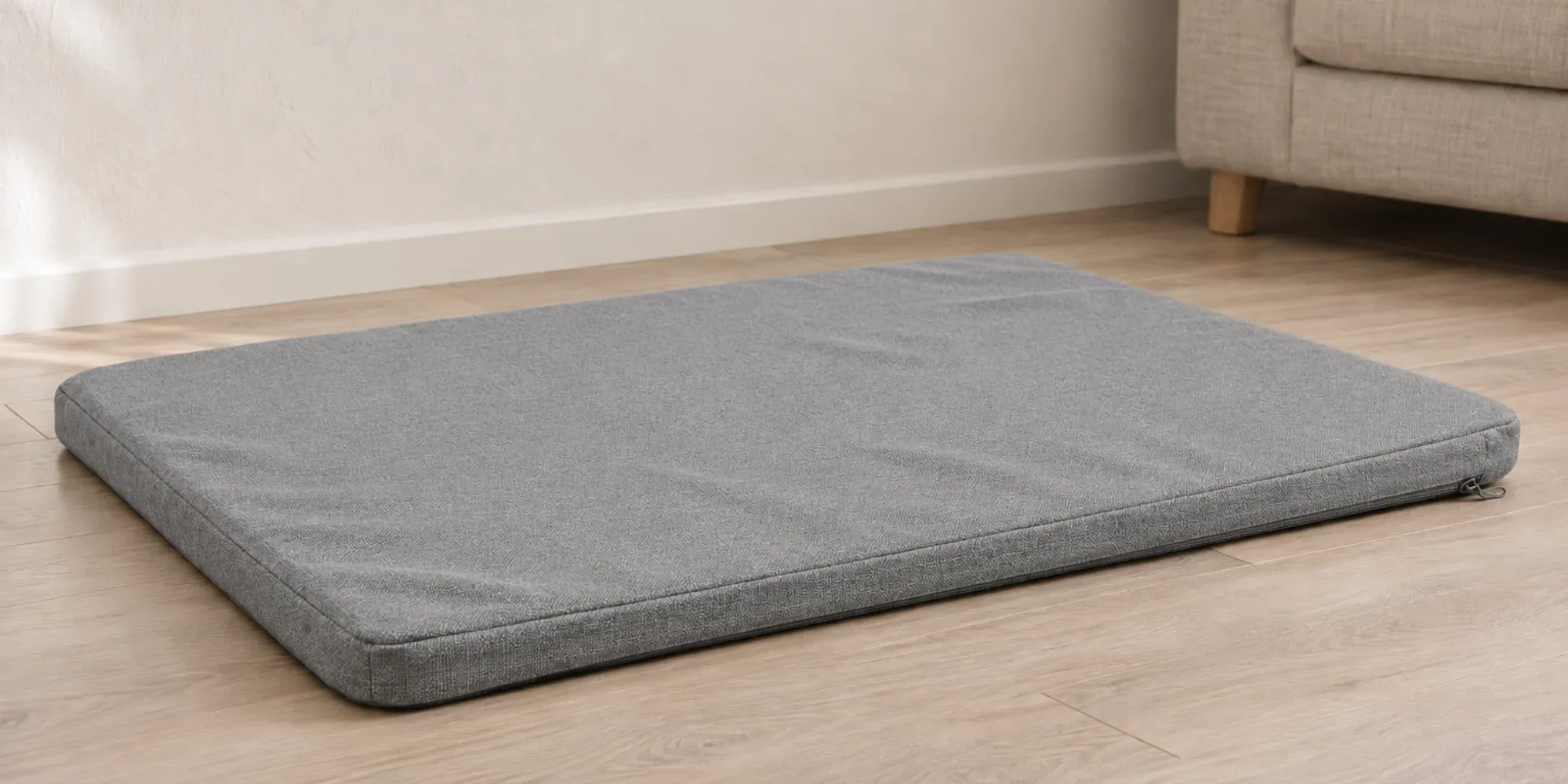
Choosing a low-profile flat dog bed involves balancing a reduced mattress height with sufficient foam firmness to prevent the dog from sinking through to the hard floor. The ideal format provides easy, step-free access for dogs with limited mobility while utilizing a supportive foam core—often layered or highly firm—that delivers the necessary resistance within a thinner profile.
The Purpose of a Low-Profile Flat Format
A flat dog bed in a low-profile format is designed with a deliberately reduced mattress height and an entirely unobstructed perimeter. For pet product managers and retail buyers, selecting this format means prioritizing physical accessibility and usable space over the deep, nest-like aesthetics of traditional high-walled beds. While thick mattresses and heavily stuffed bolsters are popular for their visual bulk and the sense of enclosure they provide, they introduce notable physical barriers for the animal. Dogs must lift their limbs significantly higher and balance on soft, uneven boundaries simply to reach the center of the cushion. A low-profile flat bed removes these daily hurdles, presenting a simple, nearly floor-level surface that dogs can walk directly onto without complex maneuvering, high stepping, or jumping.
The primary functional driver for specifying a minimal mattress height is the prevalence of joint health conditions and general mobility limitations in the pet population. Certain segments require a resting surface that minimizes physical strain during both entry and exit. Medical literature indicates that osteoarthritis frequently affects older, overweight large breed dogs, as well as young large breeds suffering from developmental bone diseases. When examining the mechanics of joint damage, research shows that in humans, obesity increases the physical load on joints and alters limb alignment, which accelerates breakdown. Applying a similar mechanical precaution to canine product design, forcing a heavy or arthritic dog to clear a tall mattress wall adds unnecessary physical stress. A low-profile format directly minimizes this effort. Osteoarthritis in Dogs – American College of Veterinary Surgeons
Addressing canine joint issues involves comprehensive daily care and thoughtful environmental modifications. Organizations such as Canine Arthritis Resources & Education provide evidence-based materials for pet owners and veterinary teams to recognize joint conditions promptly and implement effective, practical care plans. In the context of hardgoods and pet product design, offering a supportive but highly accessible low-profile bed acts as a functional management tool. By keeping the step-on height strictly limited, product designers help create a safe resting area that does not inadvertently contribute to the daily mechanical wear on compromised joints. This ease of access is crucial when dogs wake up stiff from resting and need to stand securely without stumbling over a thick bolster. Canine Arthritis Resources & Education | Dog arthritis tips and resources
Beyond strict medical accessibility, a flat, bolster-free design maximizes the effective sleeping area relative to the product's overall floor footprint. Raised edges and padded walls consume valuable square footage and restrict how a dog can position themselves. On a completely flat mattress, a dog can stretch their limbs freely over the edge without encountering a restrictive barrier, accommodating sprawlers more effectively than a nested design of the same outer dimensions. This spatial efficiency is highly scalable for different market segments. For instance, when brands develop oversized lounging products, such as a Custom Foldable Human Dog Bed, they rely on a broad, flat surface area to accommodate multiple users simultaneously. In these large-scale formats, maintaining a low profile prevents the expanded bed from becoming a towering, trip-hazardous obstacle in a home living space. For company-specific information, see Lincellipet.
When specifying a low-profile format, retail buyers and product managers must carefully weigh the clear benefits of step-free accessibility against the structural demands placed on the mattress core. A thinner bed still bears the absolute responsibility of preventing a heavy dog from bottoming out against the hard floor. The absence of bolsters also dictates that the dog's weight is distributed entirely across the primary flat foam, altering how the surface compresses and wears over time. Therefore, adopting a low-profile design establishes a strict functional baseline for the manufacturer: maximizing physical accessibility while forcing the underlying foam structure to work significantly harder within a tightly constrained height limit. This structural challenge informs all subsequent foam firmness and cover fabric specifications.
Balancing Mattress Height and Foam Density
While a low-profile format effectively removes the physical barrier of entry, it drastically reduces the vertical space available for cushioning the dog. If a mattress is too thin and too soft, a heavy dog will compress the foam entirely, resulting in their joints resting directly against the hard floor. This situation, known as bottoming out, defeats the supportive purpose of the bed. For pet product managers, the central engineering challenge of a flat bed is finding the exact intersection where the mattress is thin enough to remain highly accessible but resilient enough to support the target weight capacity without failing under pressure.
To compensate for the reduced height, the internal materials used in a low-profile bed must possess different physical properties than the softer fill used in a thick, nesting bed. Two primary metrics govern this structural behavior: foam firmness and foam density. Firmness dictates the load-bearing capacity and how much the surface yields when a dog steps onto it. In a thin mattress, sufficient foam firmness is critical to arrest the downward momentum of a dog's weight and prevent bottoming out. Conversely, density measures the mass of the polyurethane foam per cubic unit. While density strongly correlates with structural durability and resistance to permanent flattening, firmness primarily stops the dog from sinking through to the floor.
Buyers must verify these foam specifications through established testing protocols rather than relying on subjective descriptions of support. For example, the documented procedures for CertiPUR-US certification mandate that flexible polyurethane materials intended for upholstered items and mattresses must pass specific evaluations measuring both environmental safety and physical characteristics. By confirming that a chosen material meets recognized testing standards, buyers can ensure the foam possesses the structural integrity to perform in a constrained height. Without reviewing these measured physical metrics, a thin piece of foam may look appropriate on a specification sheet but compress immediately under a large breed dog. Technical Guidelines
The mechanics of how a dog interacts with the bed further complicate the low-profile format. When a dog is resting horizontally, their overall body weight is distributed across a wide surface area, making it easier for a relatively thin mattress to support them without fully compressing. However, during the transition phases when a dog steps onto the bed, pivots, or pushes off to stand up, their entire weight is concentrated on the small surface area of their paws. A successful low-profile mattress must provide sufficient structural resistance to handle these temporary, high-pressure loads without allowing the paw to punch completely through the foam to the rigid floor below.
There is no universal mattress thickness that works for all sizes; the required height must scale directly with the intended breed's weight and the selected foam's firmness. A one-inch piece of highly firm foam might adequately support a small terrier without bottoming out, keeping the step-on height practically negligible. Conversely, providing the same protective resistance for a large breed dog might require three to four inches of carefully specified foam. While three inches is higher than one inch, it still represents a significant accessibility improvement over a traditional eight-inch stuffed bed. Product development must define the minimum safe height for the targeted weight class.
To achieve this delicate balance in medium and large sizes, manufacturers often move away from a single block of material in favor of layered structures featuring varying firmness levels. When reviewing specialized formats like a Custom Orthopedic Memory Foam Dog Bed, buyers can evaluate how a high-firmness base layer acts as the primary defense against bottoming out, while a thinner, lower-firmness top layer provides a softer surface yield. This combination allows the overall thickness to remain relatively low, delivering orthopedic pressure relief for heavy dogs without relying on vertical bulk. For company-specific information, see Lincellipet.
While preventing a dog from bottoming out is critical, simply maximizing firmness introduces its own structural tradeoffs. If a low-profile bed is made excessively firm just to keep it as thin as possible, the surface may fail to conform to the dog's body. A mattress that does not yield to the pressure points of a resting dog, such as their protruding hips and shoulders, can cause discomfort and deter the pet from using the bed. Therefore, the specification process requires careful calibration. Product managers must define a foam configuration that yields enough to relieve resting pressure but firms up rapidly as compression increases, ensuring a comfortable resting area.
Evaluating Foam Structures for Thinner Beds
When designing a low-profile flat dog bed, the choice of internal foam structure dictates whether the product succeeds in its primary purpose. With the mattress height strictly limited to ensure easy step-on accessibility, product managers must decide between specifying a single, solid block of foam or utilizing a multi-layered composite structure. This decision hinges on how effectively the chosen format manages a dog's weight without compromising the physical stability or the sleeping comfort of the resting surface.
A single layer of polyurethane foam is the most straightforward specification for pet bedding. However, in a low-profile format, a solid block forces a direct compromise between surface yield and bottoming-out resistance. If the manufacturer selects a highly firm foam to guarantee heavy dogs will not sink through to the floor, the resulting bed becomes unyieldingly stiff. This rigidity can create pressure points on protruding hips and elbows. Because the surface does not contour to the animal's body, the dog experiences discomfort, reducing the likelihood that the pet will voluntarily use the product and negating the accessibility benefits.
Conversely, specifying a softer single block of foam that prioritizes immediate surface comfort introduces a severe structural flaw. When a heavy dog steps onto a soft, thin mattress, the concentrated pressure of their paws quickly overwhelms the material's compressive resistance. The foam crushes completely, leaving the dog essentially standing on the hard floor underneath. Beyond the immediate failure to support the animal, repeatedly compressing a soft foam block to its absolute limit accelerates cellular fatigue. The material breaks down and permanently flattens much faster. Relying on a solid block of foam in a restricted-height format is typically only viable for lightweight breeds.
To resolve the inherent limitations of a single foam block, pet product managers often specify layered foam architectures for medium and large-breed low-profile beds. This composite approach bonds distinct foam types together, decoupling the need for surface comfort from the requirement for deep structural support. By separating these functions into dedicated strata, the bed can remain relatively thin overall while delivering the complex mechanical response traditionally associated with a much thicker mattress.
The foundation of this layered approach is the firm base layer. This bottom section is typically composed of high-density, highly resilient polyurethane foam designed specifically to resist severe compression. Its primary job is to act as a structural backstop. When a heavy dog steps onto the bed, the base layer absorbs the residual downward force that passes through the upper section, arresting the dog's momentum and physically preventing their paws from punching through to the rigid floor. Later, when the dog lies down, this same firm foundation supports the dispersed static weight, protecting the joints from bottoming out. Because this bottom layer does not directly interact with the dog's body, it can be engineered for maximum resistance.
Above the firm base, a softer top layer is applied to provide surface yield and pressure relief. This upper stratum is often made of memory foam or a lower-firmness conventional foam that contours to the dog's shape. When the dog lies down, this layer compresses just enough to cradle protruding joints and distribute the animal's weight horizontally. In a layered structure, this softer foam does not have to bear the full responsibility of preventing bottoming out, allowing manufacturers to select materials optimized entirely for comfort and pressure redistribution.
Establishing the correct thickness ratio between the base and top layers is a critical specification exercise. A poorly balanced ratio can easily defeat the purpose of the low-profile design. As a hypothetical example, if a product manager defines a strict three-inch maximum height for a large-breed flat bed, allocating two inches to the firm base layer and one inch to the soft top layer provides a functional balance. The one-inch top allows sufficient conformity for a resting dog, while the two-inch high-density base possesses enough depth to catch and support a paw during mounting.
If that hypothetical ratio were reversed, featuring a two-inch soft top over a one-inch firm base, the bed would likely fail. The dog's paw would easily punch through the thick, soft upper layer, and the remaining one inch of base foam would lack the necessary mass to stop the downward force. Consequently, when specifying layered foam for low-profile applications, the firm structural base must generally constitute the majority of the total mattress height, ensuring the bed remains supportive despite its reduced vertical footprint.
Beyond thickness ratios, buyers must also consider how the layers are permanently joined. The adhesive used to bond the firm base to the soft top must maintain structural integrity under continuous flexing and compression. If the lamination fails, the layers can shift independently within the cover, creating an uneven, unstable surface that compromises the bed's accessibility and durability. Specifying high-quality bonding ensures the composite foam behaves as a single cohesive unit, effectively delivering the dual-action support required in a low-profile format.
Cover Design and Surface Wear on Flat Mattresses
When specifying a flat dog bed, product managers must account for how the absence of bolsters fundamentally changes surface wear. Without raised edges to contain the dog or absorb the initial impact of entry, the entire top surface of a low-profile mattress acts as the primary contact zone. Dogs step onto, pivot, and scratch directly on this exposed plane. Consequently, the top panel of the cover endures concentrated abrasion from claws and repeated friction from turning. This continuous, unmitigated contact requires fabrics engineered for direct surface wear rather than just visual or soft-touch appeal.
Selecting the appropriate material for a flat format means prioritizing abrasion resistance and tensile strength. Heavy-duty woven synthetics, such as high-denier polyester or densely constructed canvas, offer the structural integrity needed to withstand direct claw impact without tearing. While loosely woven fabrics or long-pile synthetics might present an attractive initial texture, these materials are highly susceptible to snagging, matting, and rapid thinning when deployed on a completely flat surface. If a softer texture is required for the product line, densely packed microfiber paired with a reinforced backing layer provides a practical compromise, offering a gentler feel while maintaining resistance to puncture.
The physical fit of the cover over the foam core significantly influences both the lifespan of the fabric and the orthopedic functionality of the bed. If the cover is sized too loosely, the fabric will gather and bunch as the dog moves across the surface. This bunching accelerates wear at the creases where the folds rub against each other, and creates uneven ridges that can catch the paws of dogs with limited mobility, counteracting the accessibility advantages of a low-profile bed. However, product managers must avoid making the cover excessively tight. A tailored fit is necessary to minimize bunching, but it must retain enough slack or utilize materials with sufficient stretch to allow the dog's weight to sink comfortably into the underlying contouring foam. If the fabric is permanently taut without any give, it creates a hammock effect that suspends the dog and prevents the mattress from delivering pressure relief.
Zipper placement is another essential design factor that changes when removing bolsters. Because the perimeter of a low-profile flat bed is entirely exposed, positioning a zipper along the top seam or the upper edge creates an immediate point of failure. Dogs sliding onto the bed can catch their claws on exposed zipper teeth, while the hardware itself may scratch adjacent walls, floors, or furniture. A reliable specification positions the zipper entirely underneath the bed or along the lowest bottom edge, shielded by a fabric flap. This orientation protects the closure mechanism from direct physical impact and conceals a potential chewing temptation.
When a dog steps onto a flat surface during mounting or dismounting, their momentum exerts horizontal force that transfers directly through the mattress. To prevent the bed from shifting on hard floors and creating a stability hazard, flat beds require non-slip bases that establish high-friction contact with the floor. Non-slip bottoms featuring heavy rubberized grips or dense silicone dot patterns are necessary additions. The base fabric itself must also resist tearing, as the friction generated by a heavy dog stepping onto a stationary bed applies heavy lateral strain to the bottom panel, demanding durable base construction.
The durability of the cover remains a central focus during consumer evaluation. Research analyzing online pet-oriented social networks demonstrates that dog owners actively use these platforms to discuss their relationships with their animals and seek practical guidance. Because these consumers frequently exchange advice and recommendations about how well pet products tolerate daily use, product managers should ensure that observable features like reinforced seams, protected heavy-duty zippers, and specific material compositions are prominently documented. Providing exact durability specifications and comprehensive care instructions helps these buyers validate their purchasing decisions and subsequently share accurate, informative product experiences within their online communities. The more people I meet, the more I like my dog: A study of pet-oriented social networks on the Web | First Monday
Specifying Low-Profile Mattresses for Bulk Production
A successful low-profile flat dog bed relies on precise manufacturing specifications. Moving from the initial design phase to bulk production requires product managers to translate their structural requirements into measurable parameters that a factory can consistently reproduce. Qualitative descriptions like firm or supportive are insufficient for a supplier. In a restricted-height format, the margin for error is exceptionally small. A slight deviation in foam properties during a large production run can mean the difference between a highly accessible, supportive bed and one that immediately bottoms out under a heavy dog.
The primary specification document must clearly dictate the exact foam firmness and density metrics for every layer. Because low-profile beds depend on a firm base layer to arrest the downward momentum of a dog stepping onto the surface, establishing a strict load-bearing capacity is non-negotiable. Concurrently, buyers should specify the required polyurethane foam weight per cubic volume to guarantee durability. This exact density requirement ensures the factory does not substitute a lighter, lower-grade foam that might initially feel firm but will structurally fatigue and flatten rapidly when subjected to the concentrated load of a large breed dog.
Once these metrics are defined, buyers need a reliable verification mechanism. Relying on visual inspections or simple tactile tests is inadequate for confirming long-term durability. Instead, product managers should require the foam to be evaluated against established physical property criteria. For example, the documented technical guidelines for CertiPUR-US certification outline specific physical property and environmental evaluation methods for flexible polyurethane foam intended for bedding. By incorporating similar physical testing requirements into the manufacturing agreement, buyers establish a verified standard for the structural integrity of the low-profile core. Technical Guidelines
Bulk production also introduces the logistical requirement of compression packaging. To optimize shipping space and reduce overall freight costs, large dog beds are routinely roll-packed or vacuum-compressed. While standard practice, this places immense mechanical stress on the polyurethane foam's cellular structure. A low-profile bed, which utilizes a relatively thin and highly specific core to balance accessibility and support, is particularly vulnerable to poor compression recovery. If the base layer or softer contouring top layer fails to fully expand after unpacking, the mattress loses its carefully calibrated thickness.
To prevent this failure, manufacturing specifications must dictate explicit compression and recovery expectations. Buyers should define the maximum allowable compression duration, establishing how long beds can remain vacuum-sealed in transit before permanent cellular damage occurs. Furthermore, the specification must outline the required percentage of height recovery within a specific time frame, such as demanding the foam recovers to ninety-five percent of its original thickness within forty-eight hours. Conducting pre-production compression tests on the exact layered configuration validates that the chosen materials survive the physical demands of the supply chain.
Beyond the internal foam structure, specifications must control the dimensional fit between the mattress core and the outer cover. In a flat bed without bolsters to conceal loose fabric, an imprecise fit creates immediate wear issues. The guidelines should require the foam block to fill the cover cavity appropriately. Buyers must specify a tailored fit that minimizes bunching but retains enough slack or material stretch to allow the dog's weight to sink into the contouring foam. If the fabric is designed to remain permanently taut without give, it bears the dog's weight in tension. This creates a hammock effect that prevents the dog from sinking into the soft foam beneath, defeating the bed's pressure relief.
Ultimately, specifying a low-profile dog bed for bulk manufacturing is a crucial exercise in structural risk management. By establishing rigid tolerances for foam firmness and density, requiring documented physical property testing, and validating strict compression recovery limits, product managers can effectively control the production outcome. These precise specifications ensure that the highly accessible, flat format they engineered performs consistently in the consumer's home, successfully supporting the dog's weight and joints despite the deliberately reduced mattress height.
