 跳到内容

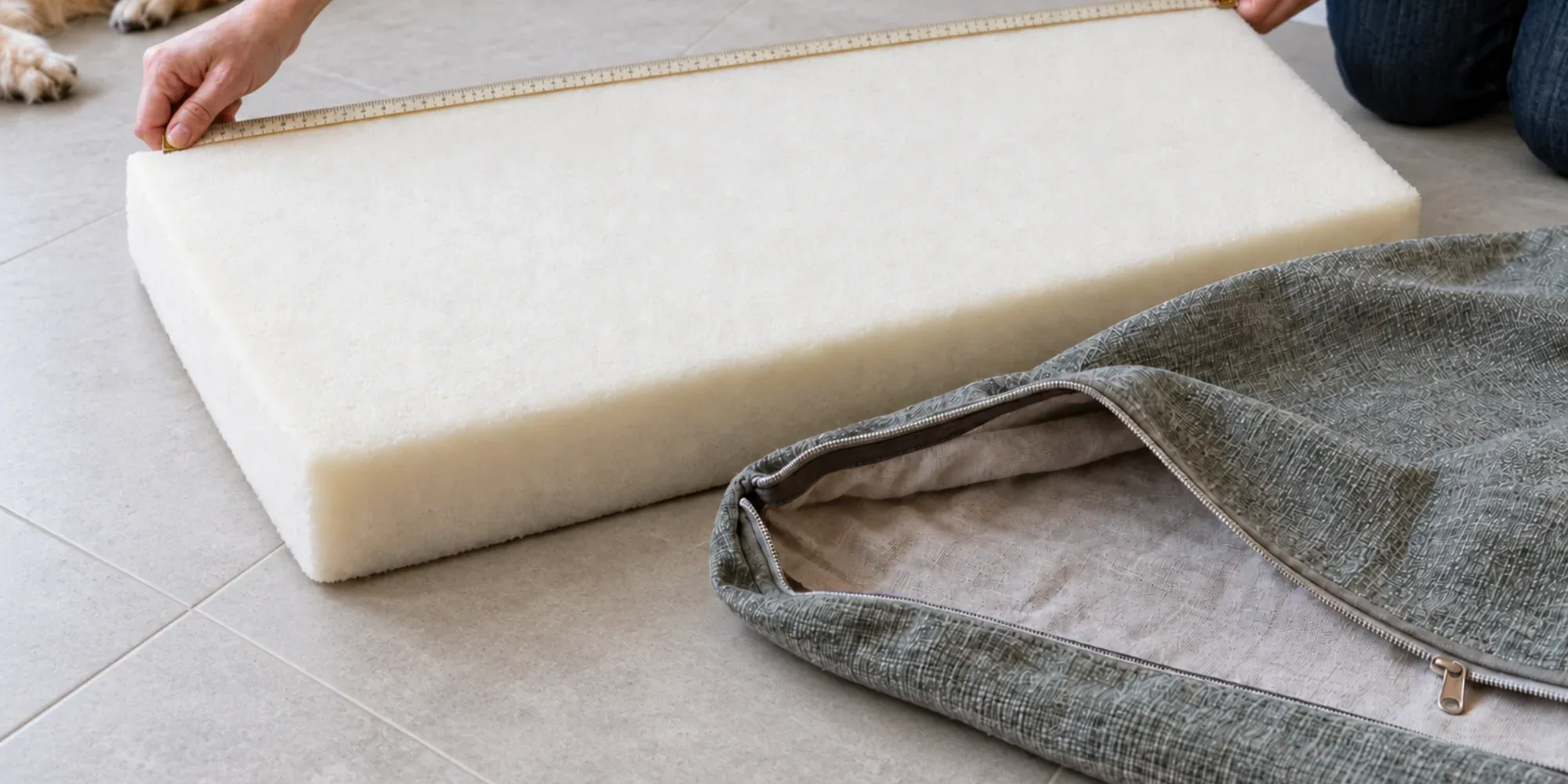
To ensure a replacement cover fits, measure the length, width, and depth of the dog bed's inner foam insert, not the old cover, as fabrics stretch and shrink over time. Choose a replacement cover with a matching zipper configuration—such as an L-shape or U-shape—so that the opening is wide enough to insert the core without folding the foam or tearing the new seams.
Why Sizing Labels Are Unreliable for Replacements
When the fabric on a dog bed wears out, the most common first step is to check the care tag for a size label. It seems logical that ordering a new cover in the same size—whether that is a medium, large, or extra large—will yield a perfect fit. However, relying on these generic sizing categories is one of the most frequent causes of poorly fitting replacement covers. Unlike human mattress sizes, which are strictly standardized across the bedding industry, pet product dimensions vary significantly from one manufacturer to another. There is no universal dimensional standard that dictates exactly how long, wide, or deep a large dog bed must be.
This lack of standardization means that different brands define their size categories based on entirely different criteria. One manufacturer might label a bed as large based on the floor space it occupies, while another might assign the same label based on the intended weight of the dog or the thickness of the foam. Furthermore, the style of the bed heavily influences how manufacturers assign these labels. A flat orthopedic foam pad labeled extra large will have entirely different dimensions than an extra large bolster bed or a nesting donut bed. Because these categories are arbitrary, matching a generic size label from your old cover to a new replacement cover is essentially a guessing game that rarely results in an exact dimensional match.
The consequences of a mismatched cover go beyond basic aesthetics, actively compromising the function and lifespan of the dog bed. If you purchase a replacement cover that is even slightly too small based on an inaccurate size label, forcing the foam core inside will cause it to buckle or warp. This distortion ruins the supportive flat surface that orthopedic beds are designed to provide, and the constant outward pressure places excessive strain on the replacement cover seams and zippers, leading to premature failure. Conversely, if the new cover is too large, the excess fabric will bunch up on the surface. These loose folds create a tripping hazard for senior dogs and are far more vulnerable to tearing when a dog digs or nests in the fabric.
To secure a functional fit that extends the life of the bed, you must abandon the size label entirely and treat the foam insert as a unique object that requires exact measurements. Evaluating the foam directly ensures that you account for all three dimensions, which is critical because many replacement covers assume a standard depth that may not match your specific bed. Generic size categories routinely fail for several predictable reasons:
- Manufacturers use different baseline dimensions for the same size categories, making brand-to-brand comparisons impossible.
- The thickness of the foam core varies widely, and standard size labels rarely account for the exact depth required to prevent zipper strain.
- Different bed styles, such as those with raised edges or contoured shapes, alter how a cover must fit over the internal structure.
- Older foam cores may have permanently compressed or spread over time, meaning the original label no longer reflects the current physical dimensions of the bed.
How to Measure the Foam Core Accurately
To find a replacement cover that fits correctly, you must base all measurements strictly on the physical foam insert rather than the original fabric shell. Once you remove the arbitrary size labels from the equation, the dog bed becomes a simple three-dimensional object. The most common mistake pet owners make at this stage is taking a tape measure to the outside of the existing bed while it is still fully assembled. Measuring the old cover will almost always result in inaccurate dimensions, setting the stage for a poorly fitting replacement that either compresses the foam or leaves excess fabric bunched on the surface.
The original fabric shell is an unreliable template because it distorts significantly over its lifespan. Through months or years of use, the fabric stretches in response to the dog repeatedly stepping, digging, and nesting in the center. Conversely, the cover may have shrunk. Repeated cycles in a washing machine and exposure to high heat in a tumble dryer cause many textiles, particularly cotton blends, to contract. If you measure a shrunken cover, you will order a replacement that is too small, which will force the foam core to warp when inserted. If you measure a cover that has stretched out at the seams, the new cover will be overly loose, creating a slippery, unstable surface that can catch a dog's claws or cause older dogs to trip.
Before measuring, strip the bed entirely and allow the bare foam core to rest on a flat surface for at least an hour. Foam is highly responsive to compression. If the old cover had shrunk and was tightly squeezing the insert, the foam needs time to relax and expand back to its original, unconstrained shape. Once the foam has settled, use a rigid steel tape measure rather than a flexible tailor's tape, as a flexible tape can easily follow contours and dips, artificially inflating the dimensions. You need to measure the absolute maximum straight-line distance of the length and the width.
When measuring the length and width of the bare core, check the dimensions both across the exact center and along the outer edges. Foam cores often spread outward over time, especially if a heavy dog consistently sleeps directly in the middle. The outward pressure displaces the foam, causing the sides to bulge. If the measurement across the center is wider than the measurement along the edge, always use the larger number. Selecting a cover based on the smaller edge measurement will result in a tight fit that squeezes the middle bulge, pushing the center of the bed upward and destroying the flat orthopedic sleeping surface.
The most critical and frequently overlooked measurement is the depth, or thickness, of the core. Many replacement covers are sold as simple rectangles with a standard two-inch or three-inch depth. If your dog's bed has a four-inch or five-inch orthopedic foam base and you attempt to force it into a shallower cover, the excess foam has nowhere to go. The sides of the bed will curve upward, creating a trampoline effect. The dog will be forced to balance on a convex mound, rendering the supportive qualities of the foam entirely useless and placing immense tension on the zipper of the new cover.
To measure the depth accurately, do not simply hold a tape measure against the side of the foam. The edges of foam beds often taper or round off with wear, making the perimeter lower than the actual peak of the bed. Instead, place a rigid, flat object such as a piece of stiff cardboard, a hardcover book, or a yardstick horizontally across the highest point of the foam. Allow this straight edge to overhang the side of the bed. Then, measure the vertical distance from the floor straight up to the bottom of the overhanging object. This method captures the true maximum thickness required for the replacement cover's side panels.
- Press firmly into the center of the foam; if your hand easily feels the hard floor beneath, the foam has lost its density and should be replaced entirely rather than covered.
- Inspect the edges for severe crumbling, tearing, or deep cracks, which indicate the material is breaking down and will soon lose its shape.
- Check for permanent indentations; if the center remains deeply compressed even after resting without a cover, a new cover will not sit smoothly over the crater.
Accounting for Bolsters and Complex Bed Shapes
Standard flat orthopedic beds are straightforward rectangular shapes, but many dog beds feature raised bolsters, U-shaped backrests, or wraparound nesting rings. Measuring these complex shapes requires breaking the bed down into its individual structural components rather than measuring a single overall footprint. If you attempt to find a replacement cover based strictly on the maximum outer length and width of a bolster bed, the new cover will lack the necessary internal fabric allowances. Consequently, the sleeping surface of the replacement will stretch tautly across the top of the bolsters like a drum. This destroys the enclosed, secure nesting space the dog prefers and creates excessive tension on the seams the moment the dog steps onto the suspended fabric.
Before taking any measurements, unzip the current cover entirely and examine the internal architecture of the bed. Complex shapes are typically constructed in one of two ways: either as a single carved piece of contoured foam, or as a modular collection of separate inserts housed within individual fabric sleeves built into the main cover. Your measuring approach must correspond exactly to this internal design. A multi-part bed requires a replacement cover with corresponding internal fabric baffles to isolate and hold the bolsters in place. Conversely, a single-piece sculpted core requires a continuous, unbaffled cover that has been patterned with extra fabric specifically designed to dip into the contours between the raised edges and the sleeping floor.
For modular beds with multiple parts, begin by removing all inserts from the old cover. Measure the central flat foam pad using the same strict length, width, and depth method applied to standard flat beds. Next, turn your attention to the bolster inserts. Because bolsters are typically cylindrical tubes stuffed with loose polyester fiberfill or shredded foam, assigning them a standard depth is impossible. Instead, measure the total length of the tube from one end to the other, and then wrap a flexible tape measure around the thickest part of the tube to determine its maximum circumference. A replacement cover designed for bolsters must feature sleeves wide enough to accommodate this exact circumference without squeezing the loose fill into a hard, uncomfortable shape that prevents the dog from resting its head comfortably.
If the bed consists of a single sculpted block of foam, such as a miniature orthopedic sofa with integrated backrests, you must carefully measure both the external boundaries and the internal sleeping area. First, record the overall maximum length, width, and the absolute highest point of the bolsters measuring upward from the floor. Then, measure the flat sleeping area located inside the bolsters, determining its exact length, width, and the vertical drop from the top of the bolster down to the sleeping deck. The replacement cover needs an adequate amount of surface fabric to trace this vertical drop accurately. If the new cover lacks this internal allowance, the fabric will pull tightly across the void, leaving an unsupported gap between the cover and the actual foam floor beneath the dog.
Beyond standard bolster beds, some oversized designs feature multiple distinct flat panels joined by fabric hinges, allowing the bed to fold into a smaller footprint or change shapes. When assessing multi-segment layouts, such as a Custom Foldable Human Dog Bed, each individual foam panel must be treated as a separate core. Measure the exact length, width, and thickness of every distinct panel, even if they appear identical at a glance, because specific sections may have compressed or deformed differently over time. The replacement cover must provide individual zippered compartments that match these specific dimensions. If the replacement pockets are too small, the fabric hinges will bind and prevent the bed from folding flat; if the pockets are too large, the foam panels will shift internally, creating uneven gaps in the sleeping surface. For company-specific information, see Lincellipet.
Round nesting beds, frequently called donut beds, present a unique measuring challenge due to their pliable nature. These beds usually consist of a heavily stuffed outer ring and a separate, lightly padded center cushion. To measure the outer ring, lay the insert flat on the floor and manipulate it into a consistent circle. Measure the exterior diameter from outer edge to outer edge, followed by the interior diameter of the open central hole. Finally, use a flexible tape to measure the circumference of the stuffed ring itself. The center cushion is measured by checking its flat diameter and its maximum loft. Because donut beds rely on a loose, forgiving fit to allow dogs to burrow and rearrange the bedding, extreme precision is slightly less critical than with firm orthopedic foam, but a replacement cover must still match the established ratio between the outer ring and the center cushion.
Matching the Zipper Configuration to the Bed Core
Even if you have taken precise measurements of the bare foam core, securing a properly fitting replacement cover also depends on the zipper configuration. The zipper layout dictates the size and shape of the opening, which directly determines how much you must manipulate the foam to get it inside. Bare polyurethane foam has a highly porous, high-friction surface that clings aggressively to most textiles. Unlike a smooth pillow insert that can slide easily into a standard pillowcase, a raw foam dog bed core will grab the fabric, making it difficult to adjust once inside. Because of this friction, the opening of the replacement cover must be large enough to allow you to position the foam correctly with minimal shifting.
A single-side zipper runs along only one edge of the cover, creating a narrow mouth. While this design minimizes the amount of hardware exposed to chewing and reduces manufacturing costs, it is structurally demanding during assembly. To insert a core into a single-side opening, you must fold, roll, or heavily compress the foam to push it past the zipper teeth. This configuration is generally only suitable for beds filled with loose polyfill in baffled liners or very thin, highly flexible foam pads. If you attempt to force a thick, rigid foam block through a single-side zipper, the immense pressure concentrated at the ends of the zipper track will routinely cause the fabric to tear or the zipper stops to blow out before the foam is fully inserted.
An L-shaped zipper, which extends down one long side and continues across one short side, offers a practical compromise. This two-sided layout creates a wider, pocket-like opening. Instead of forcing the entire core through a narrow gap, you can slide one corner of the foam deep into the unzippered corner of the cover, align the edges, and then gently fold the remaining foam inside. The L-shape significantly reduces the stress placed on the cover's seams during assembly and requires less extreme bending of the core, making it a viable choice for medium-density foam pads and moderately contoured beds.
For maximum ease of assembly, a U-shaped zipper runs along three sides of the replacement cover, allowing the top or bottom fabric panel to flip open entirely like a suitcase. This layout requires zero folding or compression. You simply lay the flat fabric open on the floor, place the bare core exactly where it needs to sit, and pull the flap over the top. This configuration is essential for high-profile beds. With heavy structures like a Custom Orthopedic Memory Foam Dog Bed, the core is often completely rigid in tension; attempting to fold such an insert would tear the foam layers apart. A three-sided zipper ensures the structural integrity of both the heavy foam and the new cover remains intact during assembly. For company-specific information, see Lincellipet.
When selecting your replacement, examine the zipper layout on the original destroyed cover. If the original manufacturer utilized a U-shaped zipper, they did so because the specific rigidity and dimensions of the internal core required it for factory assembly. Downgrading to a replacement cover with a single-side zipper for a core that originally required a U-shape will almost certainly result in damaged foam or immediate seam failure. Conversely, upgrading from a single-side zipper to a U-shaped zipper on your replacement cover is generally a safe and beneficial choice, as it will make removing the cover for routine washing significantly easier without altering the assembled fit.
Finally, the physical placement of the zipper track on the replacement cover affects both the insertion process and the longevity of the bed. Zippers positioned exactly along the middle of the side gusset are easier to reach but expose the hardware directly to digging claws. Zippers tucked beneath the bottom perimeter of the bed are protected from the dog but require you to insert the foam upside down. Regardless of the placement, verify that the new cover features a protective fabric flap or placket over the zipper teeth on the inside. This internal flap prevents the high-friction bare foam from catching in the zipper slider as you pull it closed around the corners.
Evaluating the Durability of the Replacement Fabric
Finding the precise dimensions and selecting an accommodating zipper layout ensures that the replacement cover fits over the foam core without distortion. However, structural fit is only one part of extending the lifespan of a dog bed. The replacement cover must also possess the physical durability to survive a dog's daily routines. Dogs rarely lie down gently; they circle, dig, scratch, and aggressively rearrange their sleeping surface to create a comfortable nest. This behavior subjects the fabric to intense, repeated physical stress. Pet beds also require frequent removal and washing to manage dirt, which subjects the textiles to mechanical agitation. If the fabric lacks sufficient strength and wear resistance, even a perfectly measured cover will quickly deteriorate.
The physical endurance of a textile is often evaluated through specific mechanical tests, highlighting the types of stress a dog bed cover will encounter. One critical factor is the breaking strength of the fabric, which determines how much pulling force the textile can withstand before rupturing. When a heavy dog jumps onto a bed or pulls at the fabric while nesting, it creates sudden tension. Textiles with a high breaking strength can absorb this force without tearing. A properly measured fit is essential to supporting this material strength. If a replacement cover is too small, the fabric is already stretched taut over the foam, leaving little capacity to absorb additional pulling forces. In these scenarios, the seams are placed under constant strain, and the fabric is highly likely to tear at the stitch lines under the dog's weight. A correctly fitted cover distributes the dog's weight evenly across the surface, allowing the fabric's inherent breaking strength to handle occasional spikes in tension. Standardized tests, such as grab test procedures used to determine the breaking strength and elongation of textile fabrics, help establish a baseline for how much structural stress a material can endure. D5034 Standard Test Method for Breaking Strength and Elongation of Textile Fabrics (Grab Test)
Beyond sudden tearing forces, covers must survive gradual surface wear. Dogs frequently scratch at their beds before settling down, repeatedly dragging their claws across the same central patch of fabric. Over time, this friction wears away the textile fibers, causing the fabric to thin out and develop holes. The fabric's ability to resist this continuous friction is known as abrasion resistance. Fabrics with a tight weave generally offer better abrasion resistance than loose, thin materials. When a cover is washed, the tumbling action of the machine also contributes to surface abrasion, gradually degrading the fibers and making the material more vulnerable to a dog's claws. Evaluation methods, such as utilizing a rotary platform abrader to determine the abrasion resistance of textile fabrics, provide a controlled way to measure how well a material holds up to constant rubbing. When selecting a replacement, heavy canvas or tightly woven microfiber will typically outlast loosely woven cotton or delicate plush materials that easily snag on rough paw pads. D3884 Standard Guide for Abrasion Resistance of Textile Fabrics (Rotary Platform Abrader Method)
Ultimately, replacing a dog bed cover successfully requires balancing precise measurements with appropriate material choices. Measuring the bare foam core ensures the new cover provides the correct internal volume, preventing warping and eliminating the excessive seam tension caused by an undersized shell. Matching the original zipper layout guarantees that the foam can be inserted and removed for washing without tearing the zipper stops. Finally, evaluating the replacement fabric's ability to withstand pulling forces and surface friction ensures that the properly fitted cover will not succumb to the dog's natural nesting habits. By addressing these structural and material elements, you can provide a supportive sleeping surface that withstands daily use.
