 跳到内容

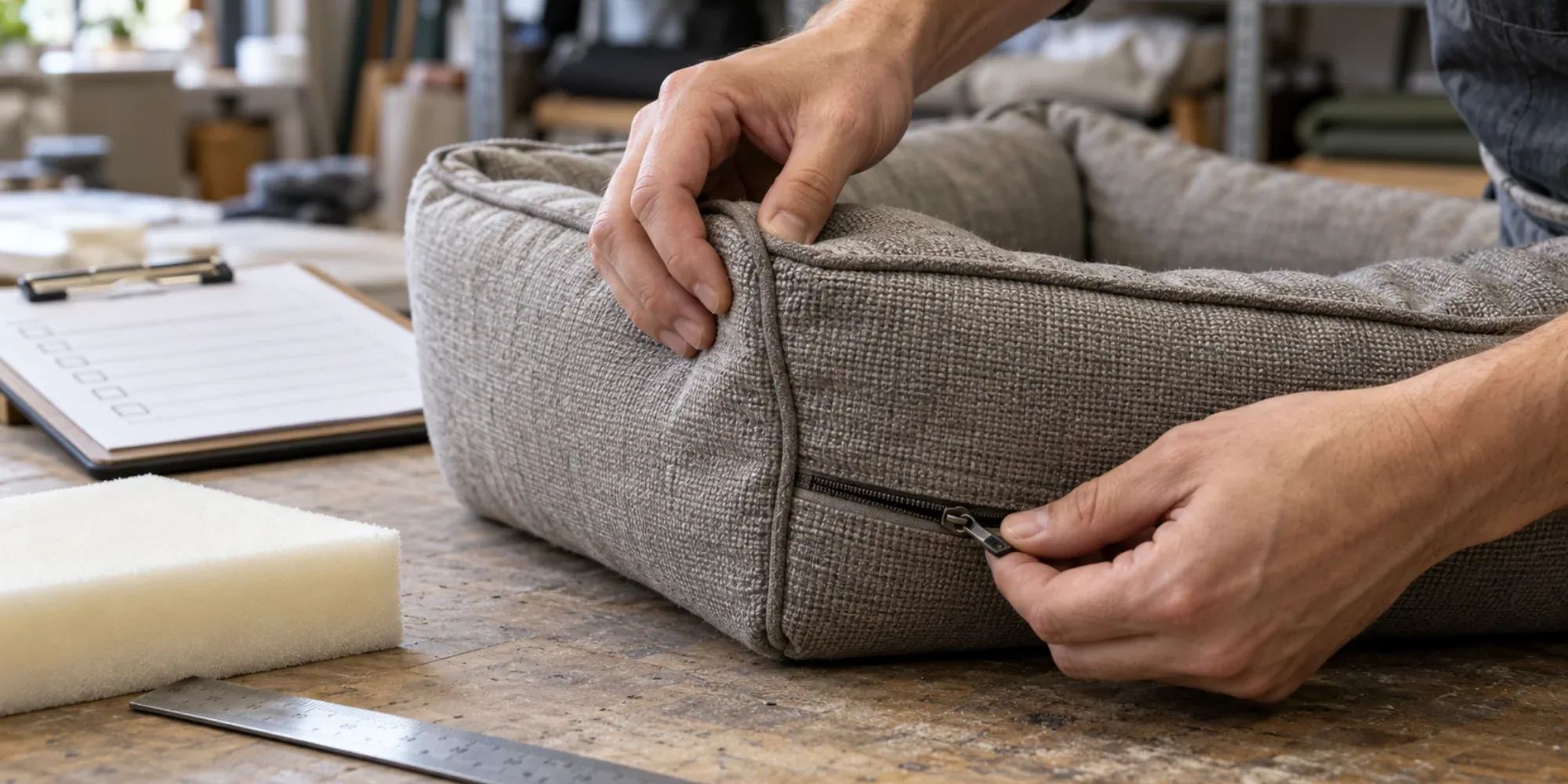
To verify the quality of dog car beds, buyers should perform physical component checks under conditions mimicking vehicle use and packaging. For seams, conduct manual pull tests and verify stitch density to ensure threads do not separate when a dog shifts or braces during transit. For zippers, evaluate slider movement while the cover is fully stuffed, and perform lateral tension tests separately on the closed track to confirm the teeth stay engaged under stress. For foam recovery, measure the specific time it takes for the insert to return to its original dimensions and firmness after unpacking from vacuum compression and following sustained load application.
Evaluating Foam Recovery and Dimensional Stability
Quality assurance checks for dog car beds must rigorously evaluate both the initial packaging recovery and the long-term, in-use resilience of core materials. Because these travel products frequently utilize flexible polyurethane foam and are typically shipped via vacuum compression to minimize transit volumes, verifying how well the foam recovers its intended dimensions is a foundational inspection step. A car bed inherently relies on precise sizing to fit securely within a specific vehicle seat or cargo area. If the foam insert fails to fully expand after unboxing, the resulting looseness in the fabric cover severely compromises the stability of the bed. This slack material creates a fall hazard and diminishes the essential cushioning provided to the animal against harsh vehicle vibrations.
The initial physical check actively evaluates the unboxing decompression rate. When unpacking a vacuum-sealed foam insert, quality assurance professionals must record the time required for the bare material to reach its specified length, width, and height. Measurements should be taken at multiple designated points across the core. Crucially, testers must avoid using tools like calipers that clamp onto the material, as applying opposing jaws inherently squeezes the highly compressible foam and skews the dimensional data. Instead, professionals should employ a non-compressing method, such as reading a rigid metal ruler against a flat reference surface. Buyers must establish a defined recovery window in their specifications, often observing the foam immediately and again at standard intervals like twenty-four or forty-eight hours. If the foam remains permanently deformed, exhibits crushed corners, or requires aggressive manual kneading to reach its nominal shape, the batch may have been compressed beyond its structural limits prior to shipment.
Assessing foam quality demands objective, measurable standards rather than subjective visual estimates. Buyers can successfully structure their internal quality checks by adopting established industry testing protocols for flexible materials. For example, published technical criteria for flexible polyurethane foam certifications—such as those outlining environmental and physical property guidelines for bedding and furniture components—provide standard frameworks for evaluation. Using these established physical testing guidelines allows a buyer to calculate the percentage of original thickness permanently lost after the foam is compressed under specific laboratory load conditions. By defining a strict maximum compression set percentage, buyers can confidently reject foam batches that lack the internal structural integrity necessary to recover from repeated, daily vehicle use. Technical Guidelines
Different pet bed configurations require specific recovery tolerances to function as intended. When evaluating a Custom Orthopedic Memory Foam Dog Bed designed for automotive use, the base layer must consistently support a dog's localized weight without bottoming out against hard seat belt buckles or the rigid contours of a car seat. Testers must verify that the dense memory foam layer rebounds predictably between regular vehicle trips. If the viscoelastic material exhibits poor dimensional stability, the bed will flatten permanently in high-traffic zones, leaving the dog unprotected from harsh vehicle structures underneath. A failure in this base layer undermines the core purpose of the travel product. For company-specific information, see Lincellipet.
In addition to basic unboxing recovery, testers must evaluate how the foam handles sustained and dynamic loads. During transit, a dog might brace its paws against a specific corner to maintain balance on winding roads, or lay heavily in a single depression during long highway drives. To simulate these concentrated stresses, quality assurance personnel should apply targeted, measured weights to the foam inserts for extended, documented periods. Instead of waiting for a depression to vanish completely—which is an impossible standard for materials that naturally experience some degree of permanent deformation—testers should use a different approach. After removing the load and allowing a standardized recovery period, inspectors must measure the depth of any remaining depression. This measurement calculates the permanent compression set. Excessive compression set indicates a lack of resilience, warning buyers of rapid functional degradation during real-world travel.
Environmental variables play a critical role in foam performance, particularly where vehicle interiors experience extreme temperature fluctuations. However, testers must recognize specific material limitations when conducting physical checks. Comprehensive quality checks for dimensional return and firmness recovery must always be conducted at a standard, controlled room temperature. While memory foam inherently becomes highly rigid in sub-zero winter temperatures, this temporary firmness change is a natural physical property of the temperature-sensitive material, not a manufacturing defect. A quality assurance protocol should not reject a standard memory foam batch simply because it stiffens in a cold car. Instead, routine firmness tests should solely verify structural behavior when the material is at typical operating temperatures.
Testing Seam Integrity for In-Vehicle Stress
When a vehicle accelerates, brakes, or navigates a turn, a dog inherently shifts its weight to maintain balance. In a dog car bed, this continuous bracing directs concentrated dynamic loads against the side bolsters and base fabric. The seams joining these components absorb the majority of this sheer stress. Fabric bolsters are not structural safety restraints capable of containing an animal during an impact, but they serve as critical comfort boundaries providing physical resistance for the dog to lean against. If the stitching fails, the bolster separates from the base, destroying the structural shape of the bed and eliminating the stable boundary the dog uses to balance itself. Quality assurance professionals must physically inspect these fabric joints to confirm they handle repetitive outward lateral pressure rather than just static downward weight.
The first phase of seam inspection involves verifying stitch density, measured in stitches per inch. Quality assurance personnel should use a rigid measuring tool to count stitches along high-stress junctions, particularly where vertical bolsters meet the horizontal base. Achieving the correct stitch density is a vital balancing act. If stitch density is too low, the seam will gap under the pressure of a bracing dog, exposing the internal foam core and creating a vulnerable point that a claw could snag. Conversely, an excessively high stitch density means the sewing needle has perforated the textile too many times along a single line. This dense perforation compromises the structural integrity of the fabric, potentially causing it to tear cleanly along the seam line like a perforated sheet of paper. A visually confirmed optimal stitch density prevents premature material failure.
Beyond counting stitches, inspectors must look for thread tension irregularities along the entire seam line. Loose top threads or bunched bobbin threads indicate poor sewing machine calibration. When thread tension is incorrect, the seam lacks the elasticity to absorb sudden vehicle movements. This causes the tighter thread to snap prematurely when a dog leans heavily against the bed wall. Testers should run their fingers along both the face and reverse side of the fabric joint to feel for tactile anomalies. They must search for loose loops, tangled thread nests, or hard knots that signify uneven stitch tension. Identifying these irregularities during visual inspection prevents the acceptance of inflexible joints that cannot endure the constant shifting weight inherent to automotive travel.
Visual checks must be followed by physical manipulation through active manual pull testing. To execute this test, a quality assurance professional should firmly grasp the fabric panels at a standardized distance from the seam line, such as two inches on either side. The tester applies a sustained lateral tension, mimicking the outward sheer force of a heavy dog pressing against the bolster on a winding road. A properly constructed seam will remain tightly closed and structurally sound. A substandard seam exhibits seam grin, a condition where the threads stretch and the fabric panels pull apart far enough to reveal the internal stitching. Excessive seam grin indicates that the selected thread is too elastic or the machine tension is too loose for the intended automotive application.
Testers must pay close attention to specific failure modes during these manual pull checks to ensure corrective actions target the correct root cause. If the thread snaps audibly while the fabric remains intact, the manufacturer may have used a weak thread. If the thread holds but the fabric fibers separate and pull away from the needle holes, this indicates yarn slippage. Yarn slippage is a fundamental material flaw showing that the fabric is too fragile or loosely woven for automotive use. In contrast, if the raw edge of the fabric escapes the stitching during the pull test, this is seam pull-out. Seam pull-out is a construction defect indicating the seam allowance is too narrow. Quality assurance professionals must distinguish between material-based yarn slippage and construction-based seam pull-out to avoid requesting pattern alterations when the solution requires rejecting deficient fabric.
Seam strength requirements scale directly with the physical dimensions of the bed and the expected weight of the canine occupant. When evaluating an oversized product, testers must account for the fact that a larger surface area and heavier load capacity inherently multiply the shear forces applied to the fabric joints. A standard single-needle seam construction that secures a small travel booster seat will fail rapidly when applied to a large-format lounge bed used by massive dogs. Quality assurance protocols must dictate significantly higher minimum pull-strength thresholds for these larger configurations, requiring reinforced sewing techniques like double-needle topstitching or heavy bar tacks at critical stress points. For company-specific information, see Lincellipet.
Internal seam finishing represents another critical quality checkpoint. Dog car beds require frequent unzipping and washing to manage the dirt and moisture accumulated during transit. The internal seams enclosing the foam must withstand both the mechanical agitation of a washing machine and the dog's physical weight. Inspectors should turn the bed covers completely inside out to examine the raw fabric edges. Unfinished edges are highly susceptible to severe fraying after just a few wash cycles. A robust quality check will verify that hidden internal seams are properly finished with overlock stitching or reinforced with fabric binding tape, which entirely encapsulates the raw textile edges and prevents the fabric from deteriorating from the inside out.
Finally, testers must rigorously evaluate junctions where multiple seams intersect, such as the bottom corners of a rectangular bolster bed. These specific intersections endure complex, multi-directional stress during travel. A dog bracing heavily into a corner during a sharp vehicle turn applies force along three distinct axes simultaneously, compounding the strain on a single localized point. Quality buyers should isolate these critical corners during physical testing, applying diagonal tension to ensure the intersecting threads do not cut into one another or sheer the adjacent fabric. Confirming the durability of these structural nodes ensures the bed maintains its intended geometric shape and provides reliable protective boundaries throughout its service life in a moving vehicle.
Verifying Zipper Track Engagement and Slider Durability
Zippers on dog car beds securely encase the supportive foam core while allowing the cover to be removed for washing. Because the fabric cover must fit tightly to prevent the dog from slipping on loose material during vehicle motion, the closed track continuously operates under lateral tension. Quality checks must evaluate whether the teeth remain fully engaged and the slider moves smoothly when the cover is stretched to its maximum designed capacity over the structural core.
The first functional check assesses lateral track strength. When a dog steps into the bed or braces against a side bolster, the localized pressure forces the internal foam to displace, transferring outward shear stress directly to the zipper teeth. To test this integrity, quality assurance personnel should zip the cover entirely closed over the intended foam insert. The tester then applies rigorous downward pressure on the foam adjacent to the zipper line while simultaneously pulling the fabric panels laterally away from the closed track. If the teeth separate, pop open in the middle of the chain, or fail to re-engage smoothly, the zipper lacks the necessary bite strength to contain the foam under dynamic automotive loads.
Quality checks must also account for the specific zipper material selected for the product design. Nylon coil zippers typically offer excellent flexibility, allowing them to smoothly follow the contoured edges of a bolster bed, and they generally provide superior lateral and burst strength compared to rigid options. Molded plastic zippers, while functioning well in linear applications, tend to be less adaptable to tight curves. Testers must visually inspect the track after lateral pull tests to ensure nylon coils remain uniformly continuous and molded plastic teeth show no signs of micro-fracturing or detachment from the zipper tape.
Cycle testing evaluates the mechanical durability of the zipper assembly. Testers should repeatedly open and close the zipper along its entire length. This cycle test must first be performed on an empty cover to establish basic mechanical function, verifying that the track and slider operate smoothly without defects. Subsequently, inspectors must repeat the test while the cover is fully stuffed with foam to simulate operational tension. Crucially, zipper sliders are not designed to pull tightly stretched fabric together entirely on their own. When cycle testing a stuffed cover, testers must manually bring the fabric edges together ahead of the slider. Forcing the slider through stretched fabric without manually assisting the track edges will cross-stress the components, causing binding and potential damage even on a high-quality zipper, leading to false failures. With proper manual assistance, a quality slider will glide uniformly.
Inspectors must also monitor the interaction between the moving slider and the internal seam allowance during the loaded cycle test. Dog car bed covers often feature internal fabric flaps or thick seam bindings designed to protect the foam core from moisture and dirt. If the manufacturer has not provided sufficient clearance between the zipper track and these internal layers, the slider will catch the loose material. Quality protocols must verify that the protective fabric remains entirely clear of the slider's path. Repeated snagging frustrates users and frequently leads to torn covers or broken slider jaws when consumers forcefully attempt to clear jams.
The anchor points at both ends of the zipper track require dedicated physical inspection. Top and bottom stops prevent the slider from derailing when the zipper is opened fully or closed forcefully. Testers should firmly grasp the pull-tab and pull it against the stops at both ends of the track. The end stops must hold securely without bending or detaching from the tape. Furthermore, the stitching that secures the raw ends of the zipper tape to the surrounding fabric must be checked for structural reinforcement. Weak anchoring at the ends remains a common, critical failure point.
Hardware integrity and concealment are critical safety considerations for automotive use. Exposed metal zipper pulls can scratch leather car seats or interior door panels during bed installation. Additionally, a dangling pull presents a distinct chewing hazard for an anxious dog confined to the back seat. For exposed zipper placements, quality assurance personnel must verify that the design features a functional zipper garage a small fabric hood where the closed slider tucks away securely. However, underside or hidden zipper placements may naturally conceal the hardware without requiring a separate hood. When a garage is present, testers should physically insert the slider to confirm the fit keeps the hardware safely enclosed.
Finally, a practical check of the pull-tab itself ensures it can withstand the leverage applied by an adult hand gripping it tightly. Testers should evaluate pull-tab strength by applying a firm tug linearly along the direction of the zipper track. Zipper pull-tabs and slider crowns are engineered to withstand this parallel force. Testers must not apply strong tugs at various angles, as introducing off-axis leverage will bend or snap standard, functional hardware. If the tab detaches from the slider crown or snaps under standard, linear manual force, the hardware is insufficiently robust. By combining these unloaded and loaded tests, lateral tension evaluations, and hardware inspections, buyers can accurately confirm whether a zipper assembly will survive the continuous structural tension of a durable dog car bed.
Correlating Component Checks with Canine Physical Needs
Quality checks on foam, seams, and zippers extend beyond basic manufacturing compliance; they dictate how a dog car bed functions as a supportive environment during travel. For a product buyer, understanding the canine occupant's physical needs transforms a mechanical test into a measure of product viability. A moving vehicle introduces constant vibration, sudden weight shifts, and prolonged bracing demands. If structural components fail under these stresses, the product no longer serves its primary purpose of stabilizing the animal.
Foam recovery dictates the bed's capacity for joint management. Senior dogs or those requiring specialized care rely on consistent structural support to absorb the mechanical shocks of the road. When flexible polyurethane foam fails to recover its full dimensions and target firmness after vacuum packing or sustained compression, it bottoms out against hard car seats. The organization Canine Arthritis Resources and Education supplies guidance designed to assist veterinary professionals and owners in recognizing joint issues and utilizing proper care strategies to maintain a dog's mobility. In a travel context, a dimensionally stable bed is a crucial management tool that supports such care strategies. Strict foam decompression testing ensures the material maintains the necessary depth to cushion vulnerable joints. Identifying insufficient firmness prevents a product from exacerbating travel fatigue. Canine Arthritis Resources & Education | Dog arthritis tips and resources
Seam integrity correlates directly with a dog's natural bracing behavior. Dogs instinctively adjust their posture and lean against elevated sides to maintain balance during vehicle acceleration, braking, and cornering. This continuous shifting places immense sheer force on the fabric joints connecting the bolsters to the base. If manual pull tests and stitch density evaluations are skipped, weak seams can rupture under the sudden weight of a heavy dog. A failed bolster seam destroys the bed's geometric shape and instantly removes the physical boundary the dog relies on for stability, potentially causing the animal to stumble. Rigorous seam testing guarantees that these boundaries remain intact, providing a reliable edge for a dog to safely press against during winding routes.
Zipper strength is equally critical for maintaining a stable surface. As established in lateral tension tests, the zipper assembly must keep the fabric cover tightly secured over the internal foam core. If a zipper track separates under pressure or a slider fails after repeated washing cycles, the cover becomes loose and prone to shifting. For a dog attempting to stand, turn around, or lie down in a moving car, a loose cover acts like a slipping rug and creates a fall hazard. Dogs with joint stiffness are particularly vulnerable to unstable surfaces. By verifying zipper track engagement and hardware durability, quality assurance professionals ensure the sleeping surface remains taut, which fundamentally reduces the animal's hesitation when entering the vehicle.
The practical consequences of physical component failures directly impact consumer trust. The demographic for specialized dog car beds includes highly engaged pet owners who research their purchases carefully. An examination of user activity on digital platforms dedicated to pets highlights that canine owners frequently prioritize the human-animal bond and proactively seek out guidance from other members within those communities. Because these owners seek recommendations for reliable travel and joint management solutions, a structural product failure is highly visible. If seams tear, zippers burst, or foam permanently flattens, owners are likely to share these functional failures with other advice-seeking consumers. Conversely, a bed that successfully passes component inspections helps protect the brand's reputation by demonstrating consistent reliability. The more people I meet, the more I like my dog: A study of pet-oriented social networks on the Web | First Monday
A comprehensive quality assurance strategy treats seams, zippers, and foam as an interconnected support system rather than isolated aesthetic features. A structurally sound foam base provides shock absorption for joint care, but it requires a tight, zipper-secured cover to prevent the dog from losing its footing. Similarly, the protective bolsters depend entirely on optimal stitch density and properly finished internal seams to withstand the sheer force of a bracing animal. Overly dense stitching over-perforates the fabric, while sparse stitching creates gaps, making balanced stitch density essential for dynamic tension. Validating all three components under simulated automotive conditions ensures genuine functional value.
Ultimately, aligning physical component checks with canine physical needs allows buyers to differentiate between a superficial vehicle seat protector and a structurally sound travel bed. The rigor applied to manual pull tests, decompression measurements, and zipper tension evaluations translates directly into physical security for the dog. By enforcing these testing parameters during incoming inspections, product buyers ensure they secure a reliable, supportive structure that meets the high expectations of relationship-focused dog owners. Quality assurance transforms from a routine defect hunt into an active validation of safety, ensuring the product reliably withstands the dynamic environment of regular vehicle travel.
