 跳到内容

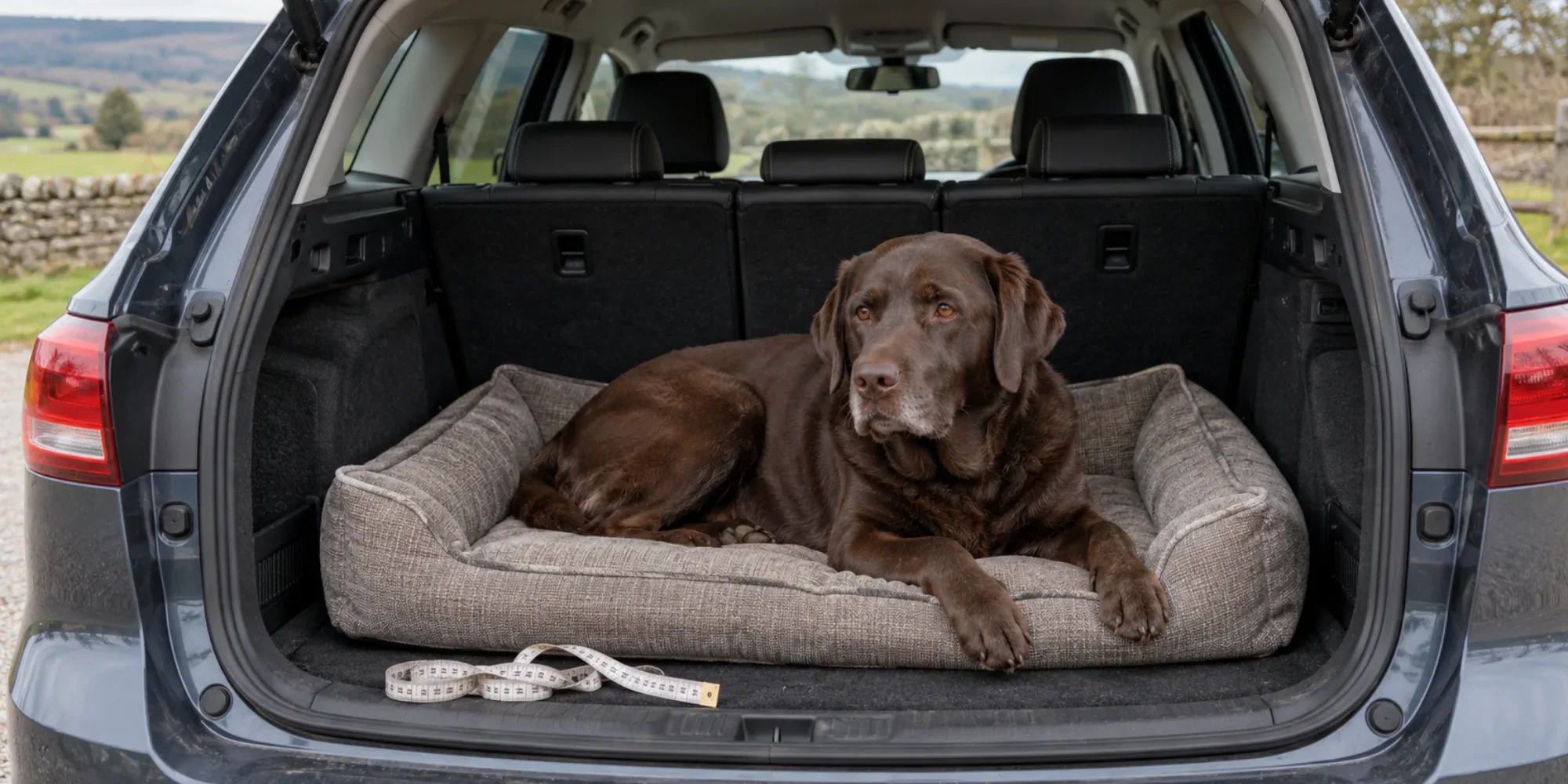
To choose a car boot bed, measure the flat floor of your cargo area between the wheel arches and from the back seat to the closed tailgate. Compare this footprint against the space your dog naturally occupies when lying down. The ideal bed fits flat without buckling, prevents sliding during transit, and provides dense foam to absorb road vibrations without compromising the vehicle's usable space.
Measuring the Usable Boot Space
Car manufacturers typically define a vehicle's boot space using total cargo volume, expressing this capacity in liters. While this volumetric metric is useful for comparing the overall hauling capabilities of different cars, it is entirely inadequate for choosing a dog car boot bed. A dog cannot occupy liquid volume; it requires a contiguous, flat surface area to lie down comfortably and safely. When preparing to travel with your dog, relying on the advertised cargo space often leads to purchasing a bed that does not fit properly. To ensure a stable and secure resting place, you must identify the true workable footprint of the vehicle by measuring the rigid physical constraints that define the functional floor space.
The most significant spatial restriction in almost all vehicle cargo areas is the protrusion of the rear wheel arches. While the boot floor might widen significantly near the tailgate or immediately behind the passenger seats, the wheel arches create a hard pinch point in the middle of the load space. Measuring the absolute widest part of the boot floor will result in selecting a bed that buckles or curls up at the sides when forced between these rigid metal arches. To find the actual functional width, you must measure the distance directly between the innermost points of the left and right wheel arches. This narrowest dimension dictates the maximum width of a rigid or structured foam dog bed that can sit perfectly flat on the floor.
After establishing the usable width, you must evaluate the front boundary of the cargo area, which is determined by the rear passenger seats. Rear seats are rarely completely vertical; they typically feature a backward rake angle to prioritize passenger comfort. If you measure the depth of the boot strictly along the floor from the base of the seat to the tailgate, the measurement will not accurately reflect the space available higher up. A thick foam bed, or one equipped with tall structural bolsters, will hit the angled seatback before it can rest flat on the floor. Account for this rake angle by measuring the cargo depth at the expected height of the bed's top edge.
The rear boundary presents a similar geometric challenge for bed placement. A vehicle's tailgate usually slopes inward toward the cabin as it extends upward from the bumper to the roofline. When the tailgate is open, the boot floor appears much longer than it actually is when closed. Placing a bed perfectly flush with the edge of the bumper can prevent the tailgate from shutting, or worse, the closing door trim might compress the bed and push the dog uncomfortably forward. To determine the true usable depth, close the tailgate and visually assess how far the glass or interior plastic trim encroaches over the floor space. Measure the available depth from the seatback to the closed tailgate at the expected height of the bed's top rear edge, rather than taking a measurement strictly along the cargo floor.
- Clear the boot entirely, removing loose mats or debris to expose the structural floor surface before taking any measurements.
- Measure the narrowest width exactly between the wheel arches to establish the maximum width for a rigid bed base.
- Identify the rake angle of the rear seats and measure the available depth at the projected height of the bed's top edge.
- Account for the inward tailgate slope by measuring depth at the expected height of the bed's top rear edge to ensure it clears all encroaching trim.
- Check for floor level changes, such as raised loading lips or uneven split-folding seat hinges, which disrupt a flat plane.
Uneven floors pose an additional structural challenge in modern hatchbacks and SUVs that feature modular cargo areas. If a floor has a sudden drop-off behind the seats or a raised lip near the bumper, a flat foam bed will bridge these gaps rather than resting securely. When a dog steps onto an unsupported section, the bed buckles under their weight, compromising stability. You must limit your footprint measurements to the completely flat section of the floor or install a rigid leveling board before taking dimensions.
Finally, consider essential access points located on the cargo floor. Vehicles often feature built-in metal tie-down rings at the outer corners of the boot space. If you plan to anchor the bed or attach a safety tether to these points, the bed cannot cover them entirely. Subtract the necessary clearance for clipping carabiners into these anchors from your available floor area. By methodically measuring the flat space between the wheel arches and factoring in the angled boundaries of the seats and tailgate, you establish the exact physical box available, ensuring the selected bed will sit flat and remain stable during transit.
Determining the Dog's Natural Travel Footprint
When evaluating the space your dog needs in a moving vehicle, prioritize their natural resting behavior over the geometric ideals of the car boot. You cannot force a dog to remain perfectly centered in a tight curl on a long journey. Dogs naturally shift positions to regulate temperature and relieve muscle tension. If you purchase a bed based solely on the smallest possible footprint, your dog will inevitably stretch out, resulting in half their body resting on unpadded plastic. A successful fit begins with understanding the space they actually occupy.
To determine the true travel footprint required, observe your dog at home after strenuous activity. Wait until they are fully relaxed and sprawling on their side with legs extended. Record the horizontal distance from their nose, or their front paws if extended forward, to the furthest tips of their extended hind legs. Next, measure the vertical spread from their spine to those outstretched paws. This sprawling footprint represents the ideal maximum flat surface area needed to fully decompress their joints. During a long drive, dogs naturally transition between a tight curl and this extended sprawl. Use this sprawling dimension as an ideal benchmark rather than an absolute rule.
Compare these sprawling dimensions against the rigid constraints of the car boot measured between the wheel arches and the closed tailgate. Often, a large dog's ideal sprawling footprint exceeds the workable flat floor space. Since you cannot physically expand structural metal arches, you face a practical tradeoff. Select the largest bed that maximizes the available flat surface without buckling. When a dog is larger than the boot's flat area, they naturally adapt by resting their head or paws against raised boundaries, but maximizing the flat deck ensures their core remains supported.
For large breeds, standard retail bed dimensions frequently fall short of providing sufficient floor coverage. Owners often look toward oversized lounge formats designed to accommodate maximum sprawling space. These expansive structures can cover a wide cargo floor, providing a uniform resting surface. However, they must still be evaluated against the strict pinch points of the wheel arches. Forcing an oversized bed into a narrow boot causes the edges to buckle, creating a permanent slope that forces the dog to constantly adjust their footing. For company-specific information, see Lincellipet.
Beyond raw dimensions, resting behavior in a moving vehicle differs from how a dog rests at home. During acceleration, braking, or cornering, the dog experiences continuous momentum shifts. To counter these forces, dogs naturally seek a boundary to brace against. A dog traveling on a completely flat, non-slip mat uses gravity and friction against their body weight to resist lateral sliding, so they do not rely entirely on muscular tension. However, without a physical boundary, they lack the additional bracing comfort that helps minimize physical effort.
A bed equipped with structural side bolsters addresses this by providing a firm boundary that a dog can actively lean against. This bracing support reduces the effort required to remain stable in a moving car. When feeling a sudden shift in momentum during a turn or deceleration, the dog can press their weight into the bolster. The solid vertical structure absorbs the lateral force, preventing them from needing to grip the floor frantically.
The effectiveness of this resting footprint relies on the structural quality of the base foam. If the center cushion is filled with loose, easily displaced fiber, the dog's heavy pressure points will sink completely through and strike the rigid boot floor on every bump. A dense foam base isolates their joints from the hard cargo deck while they lie fully extended. Press your fist heavily into the center of the cushion; if you easily feel the solid surface beneath, it lacks adequate isolation. For company-specific information, see Lincellipet.
Ultimately, the flat space within the vehicle dictates the absolute boundaries, but the dog decides how that available space is utilized. By measuring the dog in their most extended state and comparing that precise footprint against the flat area between the wheel arches, you establish a realistic baseline for selecting a bed. The goal is providing a continuous, stable plane that supports their sprawling joints and offers a secure boundary for bracing against the physical forces of the road.
Evaluating Foam Support and Road Impact
After mapping the flat floor space between the wheel arches to your dog's resting footprint, you must evaluate the bed's vertical structure. While dimensions dictate whether the bed fits, its internal materials determine its function during transit. The cargo area is highly dynamic. The floor sits directly above the rear axle, transmitting kinetic energy, road noise, and vibration. In internal combustion vehicles, the exhaust system routed beneath the boot also radiates heat. A bed placed here acts as a critical shock absorber between the dog and the moving metal, not merely a soft spot to sleep.
The standard filling used in typical home pet beds often consists of loose, spun polyester fiber. While plush and suitable for a stationary living room, this material is unsuited for the moving floor of a vehicle. Loose fiber displaces when subjected to sustained weight and horizontal movement. As a car navigates corners, accelerates, or travels over uneven pavement, the dog naturally shifts their weight to brace against the changing momentum. This continuous shifting forces loose filling outward. Consequently, the dog's heavy pressure points—specifically the elbows, hips, and shoulders—sink completely through the center and strike the unyielding boot floor. This bottoming out transfers every jolt of the road directly into the dog's skeletal system.
To prevent bottoming out during a journey, a car boot bed must incorporate a dense, solid core capable of resisting continuous dynamic compression over long trips. Flexible polyurethane foam is widely utilized in furniture and travel bedding because it possesses the structural integrity to support sustained weight while absorbing sudden impacts. The official technical guidelines for CertiPUR-US certification detail testing for physical property and environmental criteria in flexible polyurethane foam for use in furniture and bedding. When evaluating a bed for car travel, prioritizing a structured polyurethane foam base of adequate firmness over loose fill helps provide a reliable physical barrier between the dog and the hard cargo floor. Technical Guidelines
The necessity for a supportive physical barrier becomes significantly more urgent when traveling with older dogs or those managing chronic health conditions. Organizations like Canine Arthritis Resources and Education offer free, evidence-based tools for pet parents and vet teams to identify, diagnose and manage canine arthritis, providing resources to help recognize signs early and implement effective care plans. Managing joint conditions effectively requires minimizing unnecessary stress, and vehicle travel represents a major source of invisible physical strain. An arthritic dog lacks the muscular strength to continuously absorb the micro-impacts of highway driving. If forced to lie on an easily compressed bed, the resulting vibration can trigger joint inflammation and severe post-travel stiffness. A structured foam foundation acts as a practical management tool, isolating compromised joints from harsh road vibrations. Canine Arthritis Resources & Education | Dog arthritis tips and resources
However, selecting the thickest possible slab of foam introduces a strict spatial tradeoff within the cabin. Rear passenger seats feature a backward rake angle, and the tailgate typically slopes inward toward the roofline. When you increase the vertical thickness of the dog bed to maximize joint protection, you simultaneously elevate the dog higher into this narrowing upper space. A very thick block of foam might provide excellent isolation from the floor, but it reduces the available headroom for larger breeds. If the bed is too tall, a standing or sitting dog might be forced to crouch uncomfortably, or their head might press perilously close to the sloping rear glass. The ideal profile balances adequate joint isolation with the vehicle's remaining vertical clearance.
To strike this critical balance, you must distinguish between foam firmness and foam density. Firmness dictates how much immediate weight the material can support before it yields, determining whether a heavy dog will bottom out on the hard deck. Density refers to the mass of the material per cubic unit, which plays a role in how the foam responds to sustained loads. A flexible polyurethane foam base can provide high firmness in a relatively thin profile, delivering superior shock absorption compared to an overstuffed pillow of low-density fiber. By choosing a firm core, you keep the overall profile low enough to preserve crucial headroom while ensuring the dog is fully supported. Assessing firmness requires a simple check: press your closed fist heavily into the cushion's center. If you easily feel the rigid surface beneath, the firmness is insufficient for road travel.
- Prioritize solid structural foam over loose fiberfill to prevent the inner material from displacing under the dog's shifting weight.
- Seek polyurethane foam with adequate firmness to provide a physical barrier between the dog and the cargo floor.
- Verify the foam thickness does not raise the dog so high that they lose necessary headroom under the sloping tailgate.
- Perform a manual pressure test by pressing deeply into the core to ensure the dog's joints will not strike the floor.
Matching Bed Shape to Vehicle Dynamics
Unlike contoured passenger seats that naturally cradle occupants, an open cargo area offers no built-in lateral support. When a vehicle is in motion, the open boot becomes a highly dynamic environment governed by shifting momentum. The dog's bed must therefore take on the structural responsibilities that a standard vehicle seat normally provides. It must actively manage the physical forces of acceleration, deceleration, and cornering, transforming from a simple resting spot into specialized travel equipment.
The most immediate physical challenge in a moving car is surface friction. Vehicle cargo floors feature varying materials, ranging from hard plastic liners to automotive carpet. While hard plastic can allow heavy items to slide easily, standard cargo carpet is explicitly designed for durability and naturally offers some baseline grip. However, the dynamic momentum of a moving vehicle combined with the shifting weight of a large dog can easily overwhelm this standard friction. Without a specialized base, the bed acts like a sled during a sudden stop or sharp turn. When the bed moves unexpectedly, the dog loses their footing, leading to anxiety and a higher risk of joint strain. To keep the bed securely anchored under dynamic forces, it requires a heavily textured, non-slip base.
Beyond anchoring the bed to the floor, the structure should help secure the dog. When a vehicle navigates a corner, lateral forces push the dog toward the outside edge of the turn. On a flat, high-friction mat, a resting dog naturally utilizes gravity and the friction against their body weight to resist this lateral sliding. While they do not rely entirely on muscular tension to remain upright on a grippy surface, absorbing these continuous momentum shifts across a long drive still requires physical effort. Structural side bolsters supplement this baseline friction by providing a predictable physical boundary. When the dog feels a sudden shift in momentum, they can proactively brace their back or paws against the firm bolster. This allows the vertical structure to absorb the lateral force, providing essential bracing comfort and reducing overall physical exertion.
However, not all bolsters function effectively in a moving vehicle. Soft, heavily stuffed edges filled with loose fiber collapse easily under sustained horizontal pressure. If a heavy dog leans against a soft edge during a sharp turn, the bolster flattens outward, causing the dog to spill over the side and potentially strike the hard interior plastic trim of the cargo area. For a bolster to serve as a truly functional bracing wall during transit, it must be constructed from dense, rigid foam that retains its vertical shape under the dog's leaning weight.
The presence of firm structural bolsters introduces a critical interaction with the vehicle's unique spatial constraints. A flat mat might tolerate being slightly too wide by harmlessly curling up against the rear wheel arches, but a bed equipped with rigid structural bolsters cannot. If you attempt to squeeze a structurally bordered bed into a space narrower than its footprint, the rigid foam edges will buckle inward. This buckling lifts the non-slip base completely off the cargo floor, eliminating crucial friction, and distorts the sleeping surface into an unstable, uneven slope.
- Confirm the base features a high-friction, textured grip designed to resist sliding on both automotive carpet and plastic liners.
- Test the non-slip base by applying heavy downward pressure to simulate the dog's weight before pushing it laterally.
- Verify that side bolsters are built from dense, structured foam capable of supporting a leaning dog without collapsing.
- Ensure the overall rigid footprint of the bed is strictly narrower than the distance between the wheel arches to prevent buckling.
When matching a bed shape to the dynamics of a moving vehicle, the primary goal is creating a predictable environment within a space that constantly shifts. The combination of a loaded, high-friction base and rigid side walls transforms the bed into an active safety tool. By ensuring these structural elements fit perfectly within the flat footprint of the cargo floor, completely avoiding any buckling against the wheel arches or the sloping tailgate, you provide a stable platform. This integrated approach allows the dog to confidently relax their muscles and travel without experiencing continuous physical stress.
Prioritizing Fit over Aesthetics
After determining the functional dimensions between the wheel arches and identifying a foam base equipped with rigid bolsters, the final decision often requires balancing everyday utility against visual preferences. Shoppers might naturally gravitate toward a dog bed that coordinates with the car's interior trim or features an ultra-plush exterior. However, visual coordination should not compromise physical function. If an aesthetically pleasing design lacks a high-friction base, relies on easily compressed loose fiberfill, or curls upward under the inward slope of the tailgate, it will fail its primary protective purpose during travel.
An analysis of user behavior across online networks dedicated to pets indicates that canine owners generally concentrate on the bond they share with their animals and search for actionable guidance regarding daily care. Applying this relationship-first perspective to vehicle travel means placing the animal's physical stability ahead of cosmetic appeal. Instead of evaluating whether a travel mat looks proportionate in the boot, owners must assess whether the product successfully resolves the spatial tradeoff established during measurement. The ideal selection maximizes the flat floor deck without buckling against the rigid metal side panels, ensuring the dog avoids awkward, sloped postures in motion. The more people I meet, the more I like my dog: A study of pet-oriented social networks on the Web | First Monday
A properly fitted car boot bed directly addresses the inherent tension between a vehicle's strict architectural limits and the animal's natural resting habits. When the base firmly grips the cargo floor and structural boundaries hold their shape under cornering pressure, the dog can comfortably sprawl across the deck or safely lean against the rigid sides. By focusing on these observable physical realities—measuring the flat deck accurately, demanding dense shock absorption, and respecting the hard limits imposed by the tailgate and passenger seats—you ensure the chosen resting surface actively supports the dog's well-being on the road.
