 跳到内容

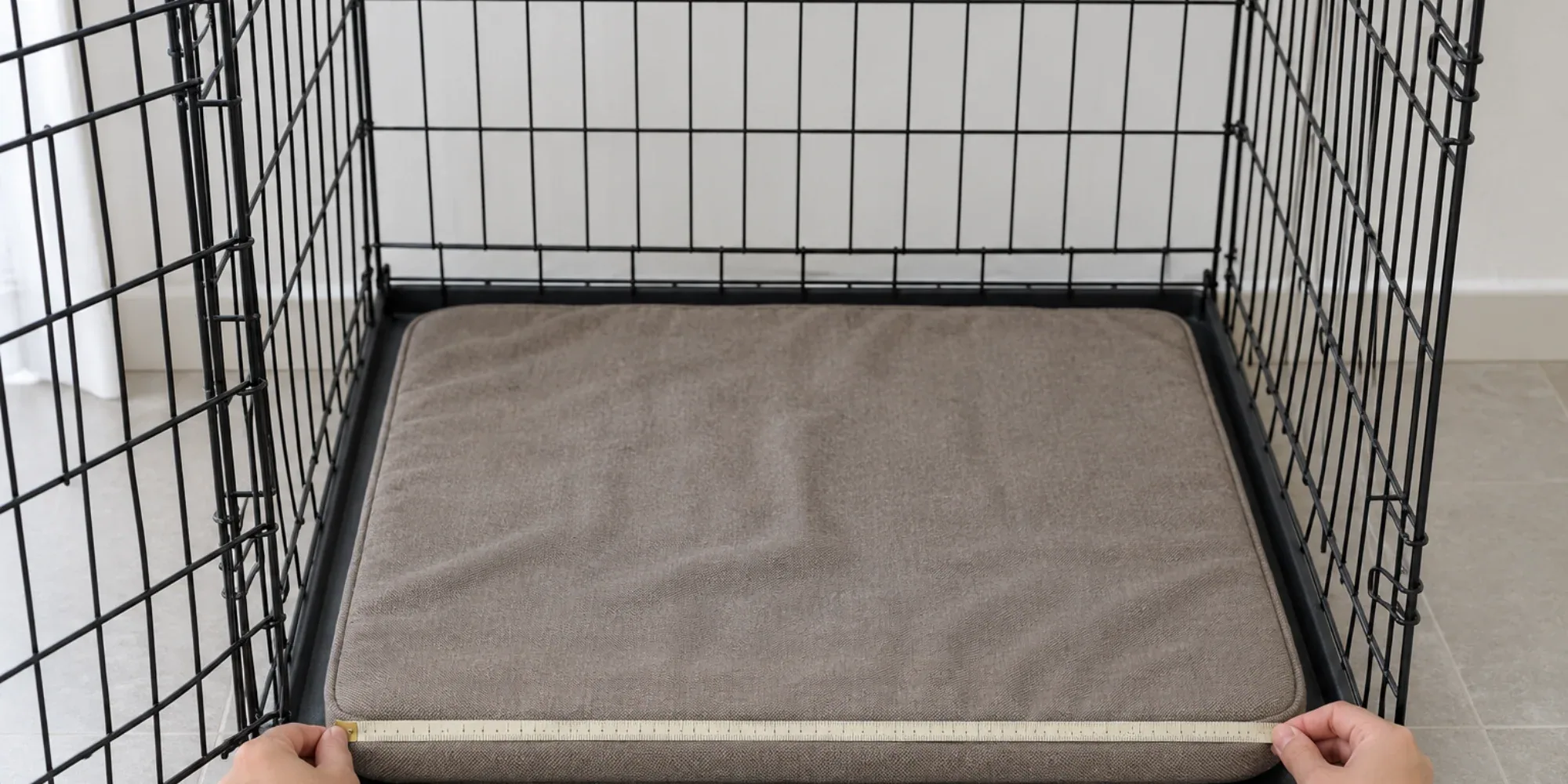
To correctly size a crate pad, measure the interior dimensions of the crate's floor pan rather than its exterior frame. Select a pad thickness that provides adequate joint support for your dog's age and health. Finally, subtract that pad's thickness from the crate's interior ceiling height to ensure the remaining overhead clearance allows your dog to stand naturally and turn around without grazing the roof.
Measuring the Interior Floor Pan for a Flush Fit
Setting up a crate requires matching the pad precisely to the usable space inside the enclosure. Many people purchase a standard-size crate, such as thirty-six inches, and assume they must purchase a thirty-six-inch pad. However, this assumption frequently leads to a poor fit because manufacturers use different reference points. A pad is measured edge to edge, while a crate is measured at its widest external points. When a manufacturer lists dimensions on retail packaging, those numbers represent the maximum exterior footprint, including the outer frame, locking mechanisms, protruding hinges, and the outward curve of the shell. None of these elements contribute to the usable sleeping area. Relying on exterior numbers inevitably results in selecting a pad that is slightly too large for the interior space.
When a pad is wider or longer than the actual interior floor, the edges curl against the walls or bunch up in the corners. This uneven surface forces the dog to lie on lumps, defeating the purpose of a comfortable resting area. Furthermore, a folded edge of fabric protruding into the living space presents an irresistible target for many dogs, introducing a risk of chewing and ingestion. Conversely, guessing interior dimensions by subtracting an arbitrary amount from exterior measurements can lead to an undersized pad. If a pad does not reach the edges, it creates gaps where a dog can slip a paw while turning. On a hard plastic or metal floor pan, an undersized pad will slide freely, making the dog feel insecure and potentially causing joint strain. The goal is a flush fit, where the pad touches the interior walls just enough to remain stationary.
The most accurate way to determine the correct size is to measure the floor pan itself. Most wire crates feature a removable plastic or metal floor pan with a raised lip to contain spills. The sides of the pan slope inward slightly from the top lip down to the flat bottom. The usable area is exclusively this flat bottom portion.
- Remove the pan completely and place it flat on the ground.
- Place a rigid tape measure flush against the inside bottom edge of one side of the pan.
- Extend the tape across the flat bottom to the inside bottom edge of the opposite side to find the exact length and width.
- Ensure the tape measure does not span the top of the lip, as measuring the wider top opening yields dimensions that the flat bottom cannot accommodate.
Plastic travel crates and heavy-duty aluminum crates feature distinct structural elements that reduce interior space differently. Plastic crates are often molded with deep indentations, and interior walls may taper significantly. You must measure the main flat floor space exactly where the pad will sit, ensuring your tape measure is not obstructed by inward-bowing walls. If a crate uses internal bolting mechanisms or reinforced corner pillars, do not measure strictly between these permanent obstacles. Doing so results in a drastically undersized rectangular bed, leaving large gaps along the main walls. Instead, measure the main flat floor space and select a flexible pad that can compress around corner pillars, or modify the pad's corners for a secure, edge-to-edge fit.
Once the exact interior dimensions are established, you can evaluate available pad sizes. Because pads are rarely manufactured to exact fractional increments, finding a perfect match is uncommon. A pad up to one inch smaller than the measured floor space is acceptable; it lies flat, and the gap is small enough to avoid slipping hazards. The physical structure of the pad dictates how strictly you must adhere to these measurements. A thin, quilt-style mat with soft batting can tolerate being slightly oversized because the excess material merely forms a soft edge. For structured beds, flexible polyurethane foam easily absorbs minor compression. A half-inch size discrepancy will not transmit enough force to buckle a thick, firm pad upward, allowing it to compress locally for a snug fit.
Measuring the inside of the crate floor pan with a rigid tape measure eliminates the frustrating guesswork that typically leads to poorly fitting setups. Disregard the standard reference dimensions printed on the retail crate packaging. Simply pull out the pan, measure the flat bottom area exclusively, account for any molded structural intrusions by selecting adaptable pads, and use those precise numbers as your optimal footprint. This direct measurement approach ensures the chosen pad will provide a highly stable, flush sleeping surface. A correct fit maximizes the dog's physical comfort while actively minimizing behavioral issues caused by sliding floor bases or chewable, bunched corners.
Selecting Pad Thickness for Joint Support
Once the flat floor dimensions are established, selecting the appropriate thickness is the next critical decision. A pad acts as the primary buffer between a dog's body and the rigid pan of the crate floor. For a healthy young dog, a simple fleece mat or a one-inch quilted bed might provide sufficient comfort. Some even push thick pads aside to sleep directly on the cool floor. However, as dogs age, gain weight, or develop joint conditions, their physical requirements change significantly. This shift demands a more structural approach to resting surfaces, moving away from thin fabric layers and toward materials designed to actively bear weight.
Joint support becomes a primary functional requirement for older dogs and large breeds. Implementing an effective care plan is vital for maintaining a dog's quality of life. For instance, Canine Arthritis Resources and Education provides evidence-based tools to help veterinary teams and pet parents identify signs early and manage canine arthritis. While veterinary guidance dictates medical treatment, owners must physically manage the dog's daily resting environment to avoid unnecessarily compounding discomfort. For a dog managing arthritis, transitioning from standing to lying down is frequently challenging. They often drop heavily onto their bed. A thin fabric mat offers virtually no resistance to this impact. When an arthritic animal collapses onto a thin pad, their elbows, hips, and shoulders can press right through the material, striking the unyielding floor pan beneath. Canine Arthritis Resources & Education | Dog arthritis tips and resources
To prevent these painful pressure points, the chosen pad needs enough structural integrity to suspend a dog's skeletal frame securely above the hard floor. Achieving this degree of suspension generally requires flexible polyurethane foam, as loose polyfill batting tends to separate and flatten rapidly under concentrated weight. The specific density and firmness of a foam layer dictate its ability to bear a dog's weight without bottoming out. For assurance regarding the material's physical properties, the official technical guidelines for CertiPUR-US certification detail testing procedures for assessing both environmental criteria and the physical properties of flexible polyurethane foam used in furniture and bedding. Foam built to withstand rigorous physical property evaluations is better equipped to maintain its supportive characteristics despite repeated compression cycles. If foam loses its structural integrity prematurely, the bed collapses entirely under the animal's weight, leaving joints unprotected against the rigid base. Technical Guidelines
For a dog requiring active joint management, the ideal thickness generally ranges from two to five inches, depending on the dog's total weight and the foam's specific density. A dense foam can provide robust, unyielding support at just three inches, while softer formulations might require five inches to achieve the same protective barrier. When reviewing structured options, it is important to evaluate how foam layers handle a target breed's weight. Layered designs often combine a firm structural base foam with a softer memory foam top, attempting to balance initial pressure relief with reliable bottom-out resistance. For company-specific information, see Lincellipet. As an example, evaluating a Custom Orthopedic Memory Foam Dog Bed involves checking how its structural base layers are designed to properly suspend a resting animal.
The concept of matching foam density and thickness to body weight extends beyond standard enclosed crate dimensions. Similar support requirements govern larger resting surfaces, whether an owner is outfitting a heavy-duty containment pen or examining the construction of a Custom Foldable Human Dog Bed designed to accommodate significant combined weight in shared spaces. The underlying physical constraint remains identical regardless of the bed's format or size: the interior material must be thick enough and dense enough to absorb downward force without allowing heavier joints to strike the rigid surface below. Proper thickness acts as a necessary shock absorber, requiring correct density to perform effectively over time. For company-specific information, see Lincellipet.
However, selecting a thicker pad for a crate introduces a mandatory tradeoff in the enclosure's internal geometry. A dog crate is a highly restricted space with a fixed ceiling height. Every inch of foam added to the floor pan directly subtracts an inch from the interior overhead clearance. While a five-inch thick orthopedic pad might offer exceptional joint support for a senior German Shepherd, inserting that tall pad into a standard wire crate fundamentally alters the usable vertical volume. Providing the necessary joint support at the bottom directly limits the headroom at the top. This spatial relationship forces owners to measure both the crate and the dog carefully.
When calculating this tradeoff, it is essential to distinguish between a pad's uncompressed thickness and how it responds when a dog stands on it. While polyurethane foam compresses into a supportive depression when a dog lies down, evaluating overhead clearance requires considering the dog in a standing posture. Because a standing dog's weight is concentrated on the small surface area of its four paws, the animal sinks significantly into a flexible foam pad. Consequently, the actual vertical space the bed consumes while the dog stands is noticeably less than the pad's uncompressed maximum thickness. Assuming the bed remains at its full height under the dog's paws falsely underestimates the available headroom, which could lead an owner to unnecessarily reject a suitable configuration.
Balancing these physical requirements means evaluating the dog's needs against the strict spatial limitations of their crate. If a dog requires a highly structured, thick polyurethane foam bed to manage joint pain or mobility issues, the owner must monitor the resulting loss of vertical space. If the required pad thickness leaves the crate too short for the dog to stand naturally, even after accounting for foam compression under the paws, a taller crate must be acquired. The thickness of the crate pad is an active physical variable that immediately redefines the crate's available interior dimensions and dictates whether the environment remains functional for the dog.
Calculating Overhead Clearance After Pad Insertion
Once the precise interior floor dimensions are established and a pad thickness is selected, the final physical constraint to evaluate is overhead clearance. A dog crate is a highly restrictive enclosure with a definitive, rigid ceiling. Any supportive material added to the floor pan inherently reduces the vertical space remaining. If an owner prioritizes a thick foam bed to cushion a heavy dog, they simultaneously reduce available headroom. Overlooking this calculation can lead to a crate environment where a dog enjoys joint support while lying down but lacks the vertical space required to stand, stretch, or change positions without grazing the roof.
Overhead clearance is not merely a matter of perceived comfort; it is a fundamental structural requirement for a dog to use the restricted space naturally. A functional crate setup must allow a dog to walk in comfortably, turn around smoothly, and stand in an unbowed posture. If the ceiling sits too low, the dog is forced to crouch to enter and maneuver. Over time, navigating a restricted overhead environment can deter a dog from entering the crate voluntarily or cause physical strain. The absolute threshold for adequate headroom is determined by comparing the dog's true standing height against the modified interior height.
To accurately determine how much headroom is required, owners must first establish the dog's maximum standing height. Measure the dog while it stands naturally on a flat surface, holding its head in a relaxed, forward-facing position. Use a rigid tape measure to find the vertical distance from the floor directly to the highest point of the dog's body. For breeds with erect ears, such as French Bulldogs, the highest physical point is typically the ear tips. For all other breeds, measure directly to the crown of the head. Because a dog's head sits higher than its shoulders when standing, measuring only to the shoulder blade yields an inaccurately low height, potentially resulting in a setup where the dog's head hits the ceiling. Adding a two-inch buffer to this final crown or ear measurement is a practical rule of thumb. This buffer accounts for minor upward shifts in posture and natural bouncing steps, ensuring the dog will not scrape against the roof.
The next step is measuring the usable vertical space inside the empty crate. Exterior height dimensions printed on retail packaging are unreliable, as they frequently include outer rims, carrying handles, or locking pins that sit above the enclosed space. To find the true interior height, place a rigid tape measure on the flat bottom of the internal floor pan, extending it straight up to the lowest protruding point of the interior ceiling. If a wire crate features thick latching bars that hang downward, or a molded plastic travel crate has a reinforced roof that dips inward, measure directly to those specific obstructions. Those lowest internal points represent the actual physical limit for the dog's head.
With the dog's buffered height and the crate's ceiling height established, you can evaluate how the chosen pad thickness changes the usable space. A common error is assuming the pad will compress entirely under the dog's paws, thereby freeing up extra headroom. However, dense orthopedic foam designed to suspend a heavy dog's joints above a hard floor will actively resist bottoming out. Even when a standing dog's weight is concentrated on its paws, a firm pad will not compress flat. Furthermore, the uncompressed sections of the pad still occupy physical space that the dog must step over. Consequently, subtracting the full uncompressed pad thickness from the interior crate height is the only safe way to calculate overhead clearance. Relying on compressed thickness falsely overestimates vertical room, leading to a cramped enclosure.
- Measure the interior crate height from the flat floor pan directly to the lowest ceiling obstruction.
- Subtract the pad's full uncompressed thickness from that measured interior height.
- Compare this remaining vertical clearance figure to the dog's buffered standing height.
- Confirm the remaining clearance is demonstrably taller than the dog to ensure natural movement.
When this calculation reveals insufficient overhead clearance, owners face a direct physical conflict between joint support and headroom. Reducing the pad thickness is one option to restore vertical space, but this compromise often defeats the purpose of adding a structured bed. For a healthy puppy, switching to a thinner fabric mat might be an acceptable adjustment. However, for senior or arthritic dogs that require significant structural foam to keep their joints properly suspended, downgrading to a thinner pad severely compromises physical comfort. If the necessary orthopedic pad consumes too much vertical space and forces the dog to crouch, the only viable solution is to acquire a taller crate. Sizing up the enclosure preserves essential medical support at the base while successfully restoring vital overhead clearance.
Owner Advice and Behavioral Preferences in Crate Rest
Despite an owner's careful efforts to calculate interior floor dimensions, select flexible foam for joint support, and evaluate overhead clearance, the success of any crate setup ultimately depends on the dog's physical acceptance of the space. Because finding the ideal balance of these physical constraints is difficult, owners invest significant time researching solutions. A study analyzing user behavior on pet-oriented social networks found that dog owners frequently use these online platforms to seek out advice and to focus on the relationship they share with their animals. While crowdsourcing general recommendations or exchanging trial-and-error experiences helps owners navigate the reality that standard products rarely fit standard crates perfectly, online consensus cannot replace direct physical observation. Every dog interacts with its environment uniquely. The dog's behavioral habits provide immediate, observable feedback on whether the chosen pad dimensions successfully align with the crate's internal geometry. When a dog repeatedly avoids a fully outfitted crate, owners must look past the theoretical measurements and observe how the dog physically negotiates the footprint, the pad's structural thickness, and the remaining vertical headroom. The more people I meet, the more I like my dog: A study of pet-oriented social networks on the Web | First Monday
The first observable check involves the pad's footprint and how the dog reacts to the floor space. If an owner relied on exterior crate dimensions and purchased a pad that is slightly too large for the interior pan, the resulting physical mismatch immediately impacts the dog's resting behavior. An oversized pad inevitably bunches up against the rigid walls or folds over in the corners. Dogs typically seek a flat, predictable surface for resting. When confronted with an uneven, lumpy floor, a dog will often begin digging at the corners or pushing the pad aside in an attempt to clear the obstruction and reach the flat plastic pan beneath. Furthermore, a folded edge of fabric protruding into the living space presents an irresistible target, frequently prompting chewing behaviors that owners might mistakenly attribute to anxiety or boredom rather than a simple dimensional error. Conversely, an undersized pad creates a different set of behavioral cues. If the pad leaves significant gaps around the perimeter, it can slide freely on the hard plastic or metal floor pan when the dog steps inside. An owner might observe the dog hesitating at the threshold or stepping in gingerly, displaying insecurity because the floor base lacks stability. If the dog slips while trying to turn around, it may become reluctant to enter the crate entirely. These specific behavioral reactions to bunched corners or sliding mats are clear indicators that the initial measurements were flawed, signaling the owner to remove the standard pad and re-measure the flat bottom of the interior pan to achieve a flush, stable fit.
Beyond the two-dimensional floor footprint, the physical thickness and structural density of the crate pad heavily influence how the dog settles into the space. An owner might assume that maximizing thickness automatically improves joint support, leading them to purchase a deeply stuffed, five-inch polyfill bed. However, observable feedback often reveals that a heavy dog feels incredibly unsteady on soft, unanchored padding. Because loose batting lacks a firm structural base, the dog's weight causes the material to sink unevenly. The owner might notice the dog struggling to maintain its footing, swaying as it attempts to turn around, or circling endlessly because it cannot find a supportive resting posture. This instability mimics the difficulty a human might experience walking across a soft, deep mattress. If the pad fails to provide stable suspension, the dog will often reject the crate in favor of a firm, predictable floor. This observable struggle prompts owners to reconsider their material choices, shifting away from sheer thickness and toward high-density flexible polyurethane foam that provides robust support without creating a wobbly surface. Observing the dog's physical transition from standing to lying down is equally critical. If a dog with arthritis drops heavily onto a thin, one-inch fabric mat, the owner might hear a thud or observe the dog groaning as its elbows and hips strike the unyielding floor pan beneath. This indicates the pad lacks the necessary thickness and density to act as an effective shock absorber. In these cases, behavioral reluctance to enter the crate is a direct response to physical pain, requiring the owner to upgrade to a structured, thicker foam base that can actively bear the animal's weight and prevent joint impacts.
The thickness of the selected pad directly dictates the remaining overhead clearance, and the dog's posture provides the most accurate check of this spatial tradeoff. A dog crate is a highly restricted environment with a definitive, rigid ceiling. When an owner inserts a thick orthopedic foam pad to properly manage a heavy dog's joints, that added floor height subtracts directly from the available headroom. To validate this clearance, owners must watch closely as the dog enters and maneuvers within the enclosure. A functional, appropriately sized environment allows the dog to walk in comfortably, turn around smoothly, and stand in a natural, unbowed posture. If the ceiling sits too low because the pad is too thick, the dog is forced to crouch to enter. An owner might observe the dog lowering its head unnaturally, tucking its neck, or hesitating at the door before stepping inside. If the dog's ears or the crown of its head continuously graze the roof, the overhead space is insufficient. Over time, navigating this physically restrictive environment can deter a dog from using the crate voluntarily, leading to increased stress or pacing. Additionally, observe how the dog turns around. If the vertical space is so limited that the dog feels trapped and prefers to back out of the crate rather than execute a natural turn, the spatial relationship has failed. Assuming the pad will compress enough under the dog's paws to restore headroom is a common error. Dense foam designed to support a heavy dog's joints will actively resist bottoming out, meaning the dog remains elevated closer to the ceiling. If behavioral cues indicate the dog is crouching, the owner faces a strict physical conflict.
Resolving this conflict between base support and overhead clearance requires practical compromises based on the dog's observed needs. If a healthy, young dog appears cramped and restless on a thick bed, replacing the structured foam with a thinner, one-inch fabric mat can instantly restore vital vertical clearance, allowing the dog to stand naturally and stretch out. However, for a senior or arthritic dog that requires thick, supportive foam to prevent joint inflammation, reducing the pad's thickness is not a viable option, as it sacrifices essential physical comfort. In these specific scenarios, a dog's reluctance to enter a cramped crate is a clear indicator that the enclosure itself is fundamentally too small for the required setup. The only effective solution is to acquire a taller crate, preserving the necessary orthopedic support at the base while successfully restoring the critical overhead room. Successfully outfitting a crate means acknowledging that floor fit, material thickness, and ceiling height are deeply interconnected variables. By rigorously measuring the true usable footprint, ensuring the pad provides stable suspension, and carefully observing the dog's natural posture to confirm adequate headroom, owners can create a functional resting space that fully supports the dog's physical requirements and natural movements.
