 跳到内容

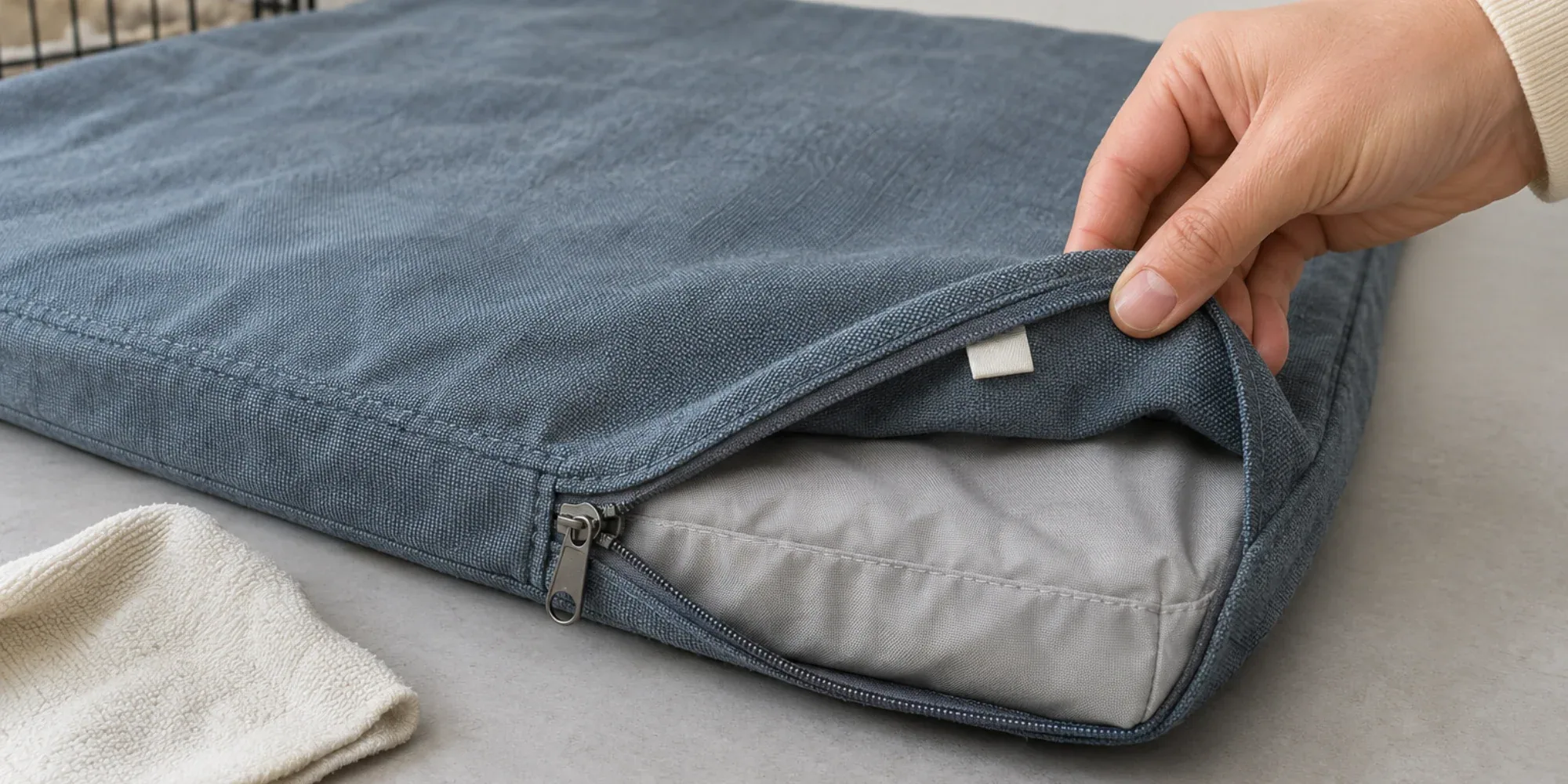
To evaluate a waterproof dog crate mat, you must inspect the internal liner, the edge construction, and the cover's cleaning requirements. First, check the liner for a continuous water-resistant barrier, such as a TPU coating, and verify that seams and zippers are covered or taped to prevent liquid from seeping through to the foam. Second, examine the edges; a proper crate mat should lie flush against the crate pan without curling. This flush fit reduces the temptation for dogs to chew on exposed corners. Finally, review the cleaning process. A reliable setup features a machine-washable outer cover paired with a wipe-clean waterproof liner, ensuring the internal core remains dry and sanitary even after heavy accidents.
Inspecting the Waterproof Liner and Seam Integrity
When evaluating a waterproof dog crate mat, the most critical defense against liquid damage is the internal liner. Many mats are marketed as waterproof when they only feature a temporary water-repellent coating on the exterior fabric. While this surface treatment causes water to bead up initially, it is not a permanent barrier. Under the sustained physical pressure of a resting dog, or when a spill is left uncleaned, liquids eventually force their way through the porous weave of a standard cover. A true waterproof system relies on a dual-layer design: a durable outer cover paired with a dedicated internal liner that entirely encases the foam core. Inspecting this internal liner is the mandatory first step in confirming the mat can withstand heavy accidents.
To verify this internal barrier, look past the outer cover and examine the inner encasement. A reliable liner typically utilizes a continuous, non-porous coating, such as thermoplastic polyurethane. Unlike chemical fabric treatments that wash away over time, a properly coated fabric provides a physical wall that blocks moisture regardless of downward pressure. When checking the liner, physically feel the material. It should feature a slightly rubberized, flexible backing bonded to the interior face of the fabric. Perform a gentle stretch test by pulling the liner slightly; the waterproof backing should stretch with the textile without cracking or separating. If the backing feels overly stiff or makes a loud crinkling noise, the coating is likely brittle. Brittle coatings are highly prone to micro-tears as the dog steps on the mat. Once micro-tears form, they inevitably allow liquid to breach the barrier.
Even the most impermeable liner fails if construction methods compromise its structural integrity. Water naturally follows the path of least resistance, making seams a common point of failure. During manufacturing, sewing needles punch thousands of tiny holes through the waterproof coating to join fabric panels. If these stitch lines are left exposed, pooled urine or spilled water will slowly seep through the needle holes and soak directly into the foam. To evaluate seam integrity, unzip the internal liner, turn it partially inside out, and inspect the stitching. Look specifically for heat-taped seams. Taping involves applying a waterproof strip directly over the interior stitch line to seal the needle holes completely. If you only see bare threads, the mat is highly susceptible to leaking along its edges.
Beyond perimeter seams, the zipper is the next major vulnerability in the protective enclosure. Standard zipper teeth do not form a watertight seal, meaning any liquid reaching the track will bypass the liner. Pay close attention to the hardware used and its integration into the surrounding fabric. A well-designed waterproof liner will utilize a specialized water-resistant zipper featuring a tightly coated track, or it will incorporate a generous fabric baffle. This baffle is a flap of waterproof material that entirely covers the zipper line, acting as an awning to divert liquid away from the vulnerable teeth.
Zipper placement is equally critical for effective spill management. Evaluate where the closure is positioned on the assembled mat. Ideally, the zipper should be located along the bottom edge or tucked securely underneath the base, keeping it as far away as possible from the primary strike zone of a spill. If a liner features a zipper running directly across the top sleeping surface without a substantial protective flap, gravity and pooling liquid will almost certainly result in a leak into the core.
To confirm the liner's performance before relying on it for an incontinent dog, conduct a practical test. Testing the liner while it is flat and empty against a hard surface artificially forces water through the zipper teeth by removing necessary three-dimensional structure and tension. Instead, leave the foam core inside the liner to provide realistic support, or use folded towels to avoid risking the actual foam. Place a dry paper towel between the liner and the core, directly beneath the zipper and a taped corner seam. Zip the fabric closed and pour a small amount of water over the exterior in these areas, applying light pressure to simulate a resting dog. After leaving the water to sit for an hour, wipe the exterior dry and check the paper towel. A perfectly dry towel confirms the seams and closures are properly sealed under realistic conditions. Any dampness indicates a structural weakness, meaning the core remains at risk of absorbing odors.
Edge Design: Crate Fit, Spill Management, and Chew Deterrence
Assessing a waterproof mat for a dog crate involves different considerations than reviewing a bed meant for an open room. Because crates contain a solid pan with raised borders, they change how liquids behave. A flexible fabric mat pressed against a rigid crate tray cannot create a watertight seal. When liquid slides off a waterproof cover, it will flow down the gap between the mat's edge and the wall, eventually pooling beneath the bedding. Examining the edge construction is therefore necessary to see how the product manages spills and discourages destructive habits.
The primary edge check focuses on the bed's physical size and how closely it matches the interior. An appropriately sized mat needs to rest completely flush against the inner walls. To confirm this fit, measure the flat floor of the pan, disregarding the crate's exterior wire cage. If the pad is visibly undersized, it leaves a broad gap around the perimeter. While a flush layout limits this gap, any moisture that makes it to the border will still drip down. Moisture trapped under a waterproof bottom cannot evaporate easily. Thus, the crate pan itself requires wiping down after an accident to avoid lingering smells.
Sustaining that proper fit becomes impossible if the borders of the pad inherently curl upward. Check the tension of the outer cover over the interior foam core. If the fabric cover shrinks during laundering or was manufactured with too tight a fit, it will constantly pull the corners up, exposing large gaps. A foam mat enclosed in fabric behaves as a single flexible body, meaning that when a dog presses heavily into the center, the material will naturally pull the edges slightly inward. However, once the dog steps off, the borders should consistently settle completely flat against the floor.
In addition to controlling gaps, the edge layout plays a major role in deterring chewing. Dogs naturally seek out protruding, loose, or easily grabbable features when they feel the urge to chew. A bulky corner or a continually curled border presents an inviting grip for a pet's teeth. When the unweighted borders sit flat and securely against the pan walls, the boundaries of the bed are effectively concealed. A flush fit encourages the animal to engage only with the flat top plane rather than accessible corners, substantially lowering the chance that they will rip into the internal layers.
Lastly, review how the perimeter of the outer cover is constructed. Numerous dog beds include decorative piping, elevated bumpers, or pronounced structural stitching along their borders. Although these additions look attractive in a living room, they create problems in a restricted crate setting. Piping and bulging seams offer highly visible points for a dog to gnaw on. The safest edge style for a crate mat is a minimalist flat seam or a waterfall edge, where the top material drapes seamlessly down the sides. Check this perimeter to confirm the stitching is tight, with no dangling threads that might encourage chewing.
Core Protection and Foam Physical Properties
Evaluating a waterproof liner ultimately comes down to protecting the structural engine of the crate mat: the foam core. The primary reason pet owners invest in a dedicated crate mat rather than using folded blankets is to provide sustained physical support over the hard plastic or metal crate pan. This support relies heavily on the integrity of the internal materials. If you are evaluating a Custom Orthopedic Memory Foam Dog Bed, the core is designed to distribute a dog's weight evenly and relieve pressure points. However, this functional support only persists if the foam remains completely dry. The outer defenses discussed previously exist solely to maintain the optimal conditions for the core material to perform. For company-specific information, see Lincellipet.
Most high-quality crate mats use flexible polyurethane foam for their interior structure. Polyurethane is inherently porous, characterized by an open-cell matrix that allows it to compress and rebound as the dog moves. While this structure is excellent for physical comfort, it acts like a sponge when exposed to liquids. If a failing zipper or a punctured liner allows moisture to bypass the waterproof barrier, the foam will rapidly absorb water, saliva, or urine. Once a fluid penetrates deeply into a thick polyurethane core, extracting that moisture completely through air drying is exceptionally difficult, setting off a chain reaction of material degradation.
The durability of a crate mat is directly tied to the environmental conditions the foam experiences. Industry benchmarks, such as the technical guidelines used for CertiPUR-US certification, specify the physical and environmental testing parameters required for flexible polyurethane foam in bedding and furniture. These established criteria evaluate how foam performs under typical indoor use, but they do not account for internal flooding caused by a failed waterproof liner. When the foam core is repeatedly soaked, it is subjected to moisture levels that fall far outside standard environmental testing parameters, which fundamentally alters the material's structural lifespan. Technical Guidelines
The physical consequences of moisture intrusion become apparent over a relatively short period. When exposed to persistent dampness, the chemical bonds within the polyurethane start to weaken. This breakdown is aggressively accelerated by urine; as dog urine decomposes, it produces high levels of alkaline ammonia. The combination of sustained moisture and strong alkalinity attacks the foam's structure, causing the core to lose its resilience, firmness, and overall load-bearing capacity. As the open cells collapse under the dog's weight, the foam suffers from permanent compression. A mat that initially kept a heavy dog comfortably suspended will flatten, leaving the pet resting directly against the unforgiving crate pan. The mat loses its primary function entirely.
Alongside physical breakdown, an unprotected core introduces severe hygiene complications. Flexible polyurethane foam cannot be effectively machine washed without risking further damage to its structure. If liquid penetrates the core, it carries organic waste compounds deep into the matrix where they cannot be scrubbed away. The damp, dark environment inside the cover becomes an ideal breeding ground for bacteria and mold. The alkaline ammonia from urine accidents becomes trapped within the cells, resulting in a persistent odor that no amount of surface cleaning can eliminate. When the foam reaches this state, the entire mat usually must be discarded.
The cost of a failed liner scales with the size and complexity of the foam product. A thin crate pad might be inexpensive to replace, but larger or specialized designs represent a significant investment. For instance, the large foam volume in an oversized resting cushion like a Custom Foldable Human Dog Bed makes internal drying nearly impossible once saturated. The same limitation applies to thick crate mats designed for large breeds. Thoroughly checking the liner's seam taping, zipper baffles, and membrane flexibility before use is the only reliable way to ensure the internal foam retains its intended physical properties and hygienic safety for the lifetime of the product. For company-specific information, see Lincellipet.
Evaluating Mats for Senior and Arthritic Dogs
When assessing a waterproof crate mat for an older dog or one with joint conditions, the standard checks for the liner, edge fit, and cleaning requirements become significantly more urgent. For a healthy puppy, a failing waterproof mat is primarily a temporary hygiene issue. For a senior dog, the mat serves as a primary physical support system. The evaluation must confirm that the internal components can sustain their structural integrity despite the increased mechanical wear, localized compression, and repeated moisture exposure typical of an aging pet.
According to Canine Arthritis Resources and Education, their organization provides resources to help owners and veterinary teams spot joint conditions early and establish effective management strategies. A supportive resting surface is a fundamental physical component of these care plans. If a crate mat's foam core is compromised by liquid damage, it loses its ability to distribute weight and cushion inflamed joints, effectively neutralizing this aspect of the dog's care. Verifying the continuous waterproof barrier of the inner liner is a required step for maintaining the aging dog's comfort and mobility. Canine Arthritis Resources & Education | Dog arthritis tips and resources
Senior dogs frequently experience incontinence or reduced bladder control, subjecting the crate mat to larger volumes of liquid and more frequent accidents. A simple water-resistant coating on the outer fabric is insufficient. You must rigorously check the internal liner for a continuous, non-porous physical coating and verify that all perimeter seams are fully taped or welded shut. If the liner relies strictly on standard stitching without a dedicated waterproof barrier covering those holes, repeated exposure to pooling urine will inevitably breach the needle holes, soaking the foam and destroying its supportive properties.
The edge design dictates both spill management and physical safety for a dog with limited mobility. An arthritic dog often drags their paws or lacks the strength to step cleanly over obstacles. If the mat's edges curl upward or fail to sit flush against the crate pan, they create a persistent tripping hazard. While a flush edge eliminates raised obstacles, a flexible fabric mat resting against a hard crate pan does not form a watertight seal. Liquid running off the waterproof surface inevitably seeps down the interface between the mat and the crate wall. Because a flush edge cannot prevent urine from pooling underneath, you must lift the mat and thoroughly clean the crate pan after major spills, preventing trapped moisture from generating persistent odors or harboring bacteria.
Because accidents are more frequent, the required cleaning routine for the chosen mat must be practical. Look for a clearly segmented cleaning process featuring a durable, machine-washable outer cover. Crucially, the waterproof internal liner should only require a surface wipe-down with mild soap or a pet-safe enzyme cleaner. You must never clean these internal layers using standard household antibacterial wipes or sprays. Antibacterial cleaners frequently contain solvents, alcohol, or bleach that aggressively dry out polyurethane coatings. Applying these harsh chemicals will cause the waterproof membrane to become brittle and crack, entirely ruining the barrier. By keeping the structural foam protected and strictly separated from the laundering cycle, you ensure the arthritic dog is not deprived of their necessary orthopedic support for hours.
To ensure the crate mat continues to perform effectively over time, pet owners should incorporate targeted physical checks into their regular cleaning routine.
- Inspect the liner's primary strike zones, usually the center and the lowest edges, for any signs of micro-tears or peeling in the waterproof coating caused by the dog's repeated weight.
- Verify that the zipper baffles remain flat and fully cover the zipper tracks, as senior dogs may shuffle and accidentally fold the protective fabric back.
- When the cover is removed, press deeply into the internal foam to confirm the material still rebounds and provides adequate resistance against the hard floor.
Even after purchasing a highly rated mat, you must routinely check the foam's physical condition. If standard flexible foam develops permanent indentations or fails to recover its shape during these checks, this flattening is frequently the result of normal mechanical wear over time. While moisture intrusion accelerates cellular degradation, permanent indentation does not automatically prove the waterproof liner has failed. Because memory foam is engineered to be dense and recover slowly, do not mistake its natural behavior for mechanical failure. Regardless of the underlying cause, if the foam feels permanently flattened to the point that the dog's sensitive joints press directly against the hard crate pan, the system must be replaced to preserve their care plan.
Establishing a Practical Cleaning and Maintenance Routine
A waterproof crate mat is only effective if its maintenance routine preserves the materials that provide protection. Cleaning a multi-layer system requires treating the outer fabric and the internal liner as distinct components with separate needs. Throwing an assembled mat directly into a washing machine is a common mistake that often destroys the internal waterproof barrier and traps moisture inside the foam core. Instead, evaluating a mat's cleaning process involves checking how easily these layers separate and understanding the specific washing protocol required for each material to ensure longevity and hygiene.
The outer cover is the first line of defense, absorbing ambient dirt, loose dander, and small surface spills before they reach the interior. Because this layer sits in direct contact with the dog, it must be robust enough for regular machine washing. When checking a mat for practical maintenance, verify that the outer cover can be completely removed via a durable zipper. A heavy-duty cover should withstand regular agitation in a standard washing machine. Using a mild detergent and a cold or warm water cycle helps prevent the fabric from shrinking. Shrinkage is a critical failure point during maintenance. A shrunken cover will compress the internal foam, permanently curl the edges upward, and compromise the flush crate fit necessary for managing spills.
Once the outer cover is removed, the internal waterproof liner requires a completely different approach. The thermoplastic polyurethane coating or similar bonded membranes that keep the underlying foam dry are highly sensitive to heat and mechanical stress. Machine washing the liner is generally detrimental to its structural integrity. The aggressive spinning of a washing machine can stretch the liner fabric, causing the non-porous backing to crack, peel, or delaminate. Furthermore, the heat from a standard dryer cycle can melt the waterproof coating and destroy the specialized tape sealing the interior seams, instantly rendering the barrier useless.
Instead of machine washing, the waterproof liner should be cleaned while it still encases the foam. When an accident occurs, remove the soiled outer cover and inspect the exposed liner. Wipe the surface using a damp cloth and an enzyme-based pet stain and odor remover. Enzyme cleaners are particularly effective for crate environments because they break down the urea and uric acid in dog urine without requiring harsh chemical solvents that might degrade the polyurethane coating. To accurately check if the barrier remains intact after a heavy spill, unzip the liner and physically feel the exposed foam inside. If the internal core feels damp, moisture has already breached the waterproof defenses.
Drying protocols are just as important as the washing phase. The outer cover must be completely dry before reassembly. Air drying the cover by hanging it in a well-ventilated area is the safest method to prevent shrinkage and maintain the integrity of the external zippers and seams. If a tumble dryer must be used, select a low-heat or no-heat setting. Simultaneously, the wiped-down liner must be left to air dry completely. Zipping a damp liner back into an outer cover creates a trapped, humid environment that promotes mold growth on the fabric surfaces, even if the internal foam remains perfectly dry.
The final step of the maintenance routine involves careful reassembly. When putting the clean outer cover back over the core, take the opportunity to visually inspect the inner liner one last time. Check the taped seams and zipper baffles for any signs of peeling, cracking, or wear. As you zip the cover closed, ensure the fabric lays flat and the corners of the foam reach the edges of the cover without requiring excessive force. A maintenance routine that separates the washing of the durable outer shell from the gentle surface cleaning of the waterproof membrane ensures the crate mat continues to provide a sanitary, dry, and supportive resting space.
