 跳到内容
跳到内容 
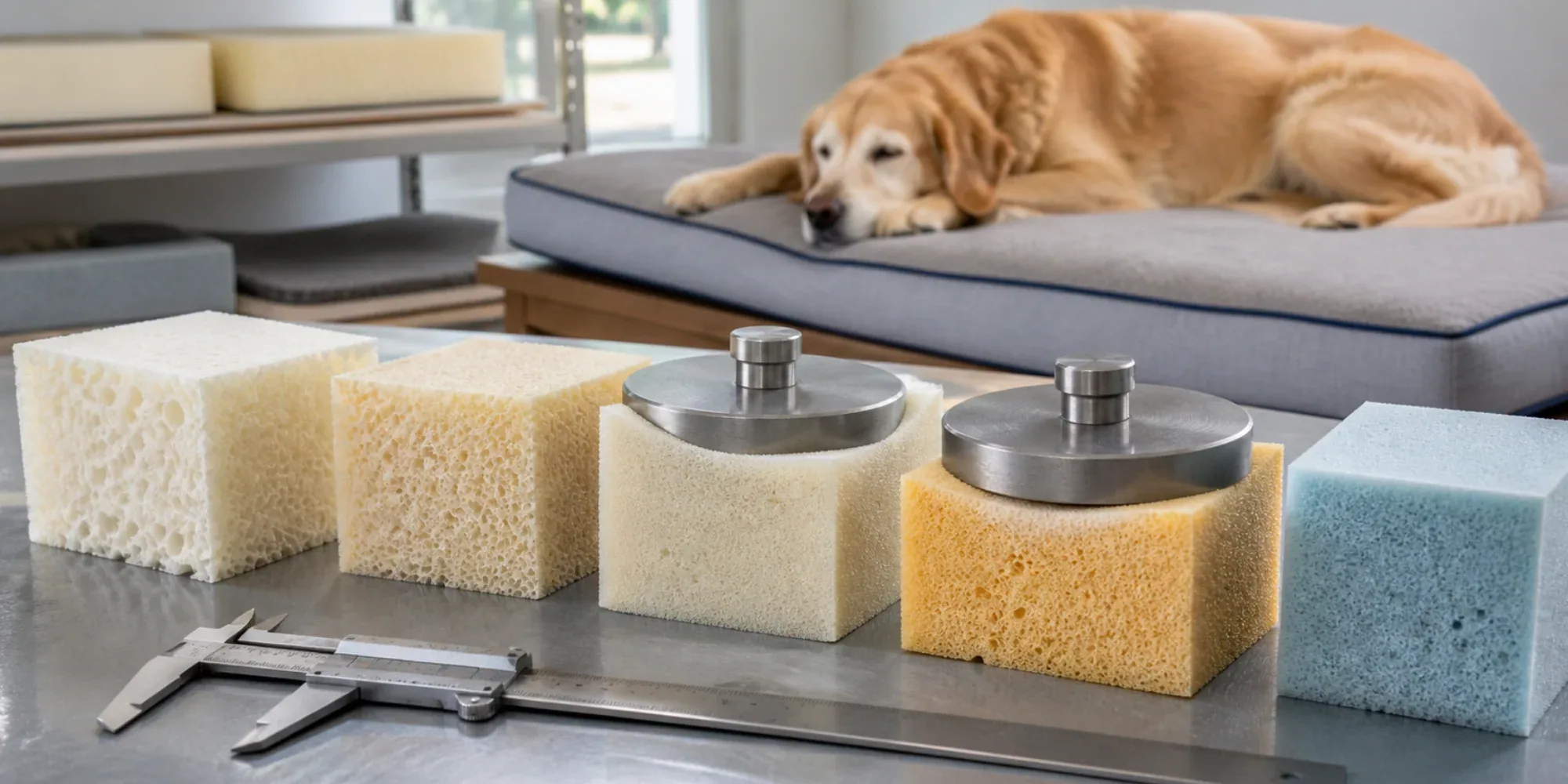
Density and firmness are independent physical properties of foam that serve different functions in a dog bed. Density measures the mass of the material per cubic unit, which determines the foam's durability, lifespan, and resistance to bottoming out under a heavy dog over time. Firmness measures how much force is required to compress the foam, which dictates the immediate feel, joint cushioning, and the structural resistance a senior dog needs to push against when standing up. Pet brands must specify both metrics to ensure a bed remains supportive long-term while accommodating the limited mobility of aging joints.
Distinguishing Density From Firmness in Foam Specifications
When pet brands develop new product lines for senior dogs, a common error in manufacturing specifications is conflating foam density with foam firmness. While both properties influence the final feel of a dog bed, they measure completely different physical characteristics. Assuming that a dense foam is automatically firm, or that a soft foam must inherently lack durability, leads to misaligned specifications and structural failures. To design a product that provides both immediate joint relief and long-term structural integrity, product buyers must decouple these two metrics and define them independently on their specification sheets.
Foam density measures the actual mass of the material within a specific volume. It is typically calculated in pounds per cubic foot or kilograms per cubic meter. This metric represents the ratio of solid polyurethane material to open air space within the foam's cellular structure. Because density dictates how much physical material is available to bear weight, it serves as the primary indicator of a bed's lifespan and overall durability. High-density foams are built with thicker, more robust cell walls that can repeatedly compress and recover without breaking down. Lower-density foams contain a higher volume of air; while they reduce shipping weight and material costs, their thinner cell walls fatigue much faster under the sustained weight of a large-breed dog, leading to rapid flattening over time.
Firmness, conversely, measures the material's immediate physical resistance to compression. In foam manufacturing, firmness is most commonly quantified through Indentation Force Deflection or Indentation Load Deflection. This standardized test measures the exact amount of force required for a standard circular indenter to compress a piece of foam by a specific percentage, usually 25 percent of its original thickness. Firmness governs the initial surface feel of the dog bed. It determines how far a dog's joints will sink into the surface upon laying down, and how much structural pushback the dog receives when trying to stand back up.
The essential takeaway for product teams is that density and firmness can be engineered independently by altering the chemical formulation during foam pouring. Manufacturers can produce a high-density foam that is exceptionally soft, such as a heavy, yielding memory foam designed for deep contouring. They can just as easily produce a low-density foam that is incredibly stiff, similar to rigid packaging materials.
If a buyer specifies a firm bed to support senior dogs but fails to set a density requirement, a factory might achieve that requested firmness using a low-density, high-resistance foam. This bed will feel sufficiently supportive in a pre-production sample but will quickly degrade and bottom out once subjected to daily use by a heavy pet. Conversely, if a buyer requests high density with the assumption that it will provide a stiff, supportive base, they may receive a heavy but overly plush material. This traps the senior dog in a deep pocket of foam, forcing them to expend painful effort to climb out. Accurate manufacturing requirements must therefore treat density as the predictor of long-term durability and firmness as the measure of immediate mechanical support.
When communicating with a foam supplier, defining exact target numbers rather than using subjective terms like supportive or premium is crucial. Product teams should provide a target density with a defined acceptable variance, ensuring the factory uses the correct raw material volume. Simultaneously, they must specify an indentation force range that guarantees the surface will resist the specific weight profile of the target breed without feeling like a hard floor. Recognizing this distinction prevents the costly mistake of approving a prototype based solely on how it feels on day one, ignoring the physical mass required to maintain that exact feel throughout the product's intended lifecycle.
Why Firmness Dictates Daily Mobility and Joint Cushioning
Firmness dictates the immediate mechanical response when a dog steps onto or lies down on a bed. For a healthy young dog, a soft, highly yielding bed might just be an appealing sleeping surface. However, for a senior dog, the physical resistance of the bed fundamentally affects their daily mobility. Buyers developing orthopedic product lines must view firmness not merely as a subjective comfort metric, but as an active component of joint care. The right specification provides a supportive environment that accommodates the restricted movements of aging pets.
Transitioning from a resting position to a standing one requires a dog to push downward to generate upward momentum. Aging dogs, particularly those experiencing muscle atrophy or age-related stiffness, often lack the strength to compensate for a sinking surface. If a bed is specified with a firmness rating that is too low, the foam compresses too easily under the dog's paws. Instead of providing a stable platform, the bed traps the dog in a deep pocket. The dog is then forced to expend significantly more energy to climb out of the depression, which increases the physical strain on compromised joints and can make the simple act of standing unnecessarily painful.
The overarching goal of managing age-related joint conditions is to maintain mobility. Organizations dedicated to canine joint health, such as Canine Arthritis Resources and Education, emphasize that effective management plans focus on keeping arthritic dogs active and enjoying life. A bed that fails to provide sufficient structural resistance hinders this objective. If the struggle to stand up discourages a senior dog from moving around the house, the product inadvertently undermines broader efforts to manage their joint health and preserve their daily activity levels. Canine Arthritis Resources & Education | Dog arthritis tips and resources
Conversely, maximizing firmness simply to assist with standing introduces a conflicting mechanical requirement: pressure point relief. When a large senior dog lies on its side, the majority of its body weight is concentrated on a few specific bony prominences, primarily the hips, shoulders, and elbows. If the foam is exceedingly firm, it will not compress enough to contour around these areas. The resulting upward pushback against the joints restricts localized blood flow and causes discomfort, prompting the dog to constantly shift positions or abandon the bed entirely in favor of a softer, though ultimately less supportive, alternative.
To successfully navigate this tradeoff between standing support and resting comfort, pet product buyers must specify a firmness level that allows for partial immersion while strictly limiting the total depth of that sink. The manufacturing goal is to achieve enough initial surface deflection to cradle the protruding joints, distributing the dog's resting mass over a wider area. At the same time, the foam must offer enough structural resistance to catch the dog's weight before they bottom out. This ensures that when the dog gathers its legs underneath itself to stand, it quickly encounters a stable base to push against.
When translating these functional needs into manufacturing specifications, product teams must establish firmness requirements based on the specific weight class of the target dog. A firmness rating that perfectly cradles a small terrier will collapse under the weight of a heavy retriever, while the ideal firmness for the retriever will feel entirely unyielding to the terrier. Buyers must clearly define the target breed size and ensure their suppliers match the foam indentation deflection metrics to the force exerted by those specific animals, guaranteeing the final product actually functions as intended for its intended user.
How Foam Density Prevents Long-Term Structural Failure
When a senior dog rests for fourteen to eighteen hours a day, they apply constant static pressure to their sleep surface. Foam density, measuring the actual mass of polyurethane material per cubic unit, determines how long the bed can endure this stress before suffering structural fatigue. Unlike firmness, which dictates the immediate feel, density acts as the foundational defense against long-term breakdown. It provides the physical endurance required to keep heavy aging dogs comfortably elevated off the ground.
Inside the dog bed, polyurethane foam resembles a three-dimensional web of microscopic cell walls. When a heavy dog lies down, these struts bend to accommodate the load. If a buyer specifies a low-density foam, they are essentially paying for empty space. Low-density materials feature thinner cell walls that lack the physical mass required to withstand repeated, heavy compression. Over months of daily use, these thin struts lose their elasticity or break entirely. The bed progressively flattens, permanently losing its original height in the center where the dog sleeps most frequently.
For an aging large breed, such as a senior Golden Retriever or German Shepherd, a flattened bed presents two distinct mechanical problems. First, it causes the dog to bottom out, meaning their joints press directly against the rigid floor beneath the foam. This eliminates the pressure relief necessary to manage stiffness. Second, a compressed, uneven surface creates a mechanical disadvantage. When the dog attempts to stand, they must push off from a sunken pocket of degraded foam, making mobility significantly more difficult than rising from a flat, consistently supportive floor.
Specifying high-density foam solves this issue by increasing the ratio of solid material to open air. High-density foams possess thicker, stronger cell struts that can absorb and recover from sustained heavy loads thousands of times without yielding. Because there is more physical material bearing the weight, the stress on any individual microscopic strut is reduced. This structural integrity ensures the bed maintains its original loft and support profile, keeping the dog elevated away from the floor throughout the product's intended lifecycle.
To achieve reliable results in bulk production, pet brand product teams must establish baseline density requirements tailored to the target dog breed's weight. A lightweight terrier might be perfectly supported by a moderate-density foam for years, whereas developing a durable Custom Orthopedic Memory Foam Dog Bed intended for giant breeds demands a substantially higher base density to prevent premature failure. Buyers should calculate the expected static load and request density figures in kilograms per cubic meter or pounds per cubic foot on their specification sheets, rather than accepting subjective reassurances about durability. For company-specific information, see Lincellipet.
Furthermore, buyers must recognize the inevitable tradeoff between density, material costs, and shipping logistics. High-density foam inherently requires more raw chemical inputs during the pouring process, making the final product heavier and more expensive to manufacture. It also increases the overall shipping weight. Brands frequently face internal pressure to reduce these costs by lowering the foam density while artificially increasing the firmness to mimic a supportive base. This strategy invariably backfires when applied to senior pet products. While a stiff, low-density foam core will feel highly supportive and durable during a quick factory sample review, its lack of actual material mass guarantees it will structurally collapse within months of real-world use under a heavy dog. Prioritizing density in the structural base layer remains a non-negotiable requirement for delivering lasting support and protecting the brand from premature warranty claims.
Layering Strategies for Senior and Orthopedic Support
Relying on a single solid block of foam to meet the complex needs of a senior dog frequently forces product teams into an unwinnable compromise. A monolithic slab that is firm enough to assist an aging dog in standing up will often be too stiff to provide meaningful relief for arthritic joints. Conversely, a single piece of soft foam that comfortably cradles painful hips will inevitably lack the structural pushback required for daily mobility. To resolve this conflict, brands must transition from single-material specifications to multi-layer constructions that independently address durability, mobility, and joint cushioning.
The foundation of an effective orthopedic dog bed relies on a structural base layer engineered specifically for load-bearing capacity and resistance. For this component, buyers should specify a high-density, firm polyurethane foam. This base layer is not designed for direct comfort; its purpose is to establish an unyielding barrier between the heavy senior dog and the hard floor. By absorbing the majority of the animal's static weight and resisting deep compression, this firm foundation provides the solid, predictable platform an aging dog needs to push against when transitioning from a resting position to a standing one.
Above this rigid foundation sits the pressure-relieving top layer, typically utilizing a memory foam or a chemically altered polyurethane with a significantly lower firmness rating. This surface layer yields immediately under pressure, contouring around the dog's prominent joints to distribute body weight evenly and prevent localized discomfort. However, product teams must remember that while this top layer requires a low firmness specification to achieve that yielding feel, it still demands a high density specification. If the soft top layer lacks sufficient material density, it will quickly and permanently compress into a flat divot, destroying the intended pressure-relieving benefits.
The functional success of a layered bed ultimately depends on the thickness ratio between these two specialized foams. A common specification error is making the soft top layer too thick in an attempt to maximize perceived premium comfort. If a heavy dog sinks through three or four inches of plush memory foam before encountering the firm base, their legs become trapped in a deep well, making standing exceedingly difficult. A practical design approach for senior mobility is limiting the yielding top layer to a thickness just sufficient to cradle the protruding joints. The remaining thickness of the mattress should be entirely dedicated to the high-density structural base, ensuring the dog engages with the firm pushback layer almost immediately after the surface contouring occurs.
Introducing multiple foam layers also requires precise manufacturing oversight regarding how the materials are bonded and encased. The high-density base and the contouring top must be securely laminated using specialized adhesives that do not harden into a rigid barrier between the foams. Furthermore, the outer fabric cover must physically accommodate the engineered layers. If a brand specifies a rigid, non-stretch fabric casing that is sewn tightly across the dimensions of the foam core, the cover will act like a taut drum. This tension entirely negates the yielding properties of the soft top layer, preventing the dog from sinking into the pressure-relieving foam regardless of how perfectly the internal densities and firmness levels were specified.
Verifying Physical Properties Through Standardized Testing
Once a product team successfully uncouples density from firmness and defines the correct target metrics for a senior dog bed, the manufacturing challenge shifts to quality control. A well-designed specification sheet is only effective if the resulting bulk production actually matches the requested physical properties. Because it is impossible to determine exact foam density or indentation deflection merely by touching a finished bed, buyers must require standardized testing documentation to verify that the factory used the correct raw materials and chemical formulations.
Verifying these properties requires distinct mechanical evaluations. To confirm density, testing facilities extract a precise geometric sample of the cured polyurethane foam and weigh it to ensure the mass aligns with the specified pounds per cubic foot or kilograms per cubic meter. This measurement confirms that the necessary volume of material is present to prevent the bed from flattening over time. Firmness verification requires specialized equipment that compresses the foam sample to a set percentage of its original height, recording the exact force needed. This ensures the surface will provide the immediate structural resistance an aging dog requires to stand up safely.
Relying on subjective vendor reassurances or manual prototype reviews leaves brands vulnerable to inconsistent production batches. Instead, buyers should reference established industry frameworks to validate their supply chain. For example, the technical guidelines associated with CertiPUR-US certification establish detailed testing procedures for evaluating the physical properties and environmental criteria of flexible polyurethane foam used in bedding and furniture. Utilizing such standards provides product teams with a verifiable baseline for assessing both the mechanical durability and the material safety of the foam before it is cut and assembled. Technical Guidelines
This rigorous approach to physical testing extends beyond flat sleeping surfaces. The same mechanical principles govern other supportive accessories designed for aging pets. For instance, when designing Custom Foam Pet Stairs and Ramps, product buyers must enforce strict density and firmness standards to ensure the steps do not compress unpredictably under the shifting weight of a heavy animal. If the foam yields too much, the dog can lose its balance, turning a mobility aid into a falling hazard. Verifying the physical mass and compression resistance of the foam is essential for maintaining safety and structural stability across the entire product line. For company-specific information, see Lincellipet.
Beyond the physical metrics of mass and compression, standardized testing also evaluates the chemical profile of the foam. Senior dogs with compromised immune systems or respiratory sensitivities spend up to eighteen hours a day in direct contact with their bedding. Testing frameworks that assess volatile organic compound emissions and screen for prohibited substances give brands a reliable mechanism to ensure the materials are appropriate for prolonged indoor use. By demanding comprehensive lab reports that cover both physical endurance and environmental criteria, buyers can confidently transition from the design phase to full-scale manufacturing while protecting the health and mobility of the end consumer.
Translating End-Consumer Research Into Manufacturing Requirements
Social networks represent a massive and rapidly growing segment of internet usage. Within these digital spaces, analysis of user behavior on pet-oriented networks demonstrates that dog owners frequently utilize these platforms to focus on their relationship with their animals and to seek specific advice from others. The more people I meet, the more I like my dog: A study of pet-oriented social networks on the Web | First Monday The more people I meet, the more I like my dog: A study of pet-oriented social networks on the Web | First Monday
When an aging dog struggles with standing or displays signs of joint stiffness, this tendency to seek online advice leads owners to research reliable interventions. By actively gathering information to manage their pet's aging process, these consumers become increasingly educated about orthopedic support. They understand that a bed must offer more than a soft surface, and they closely scrutinize whether a purchased product actually delivers on its marketed structural promises once the dog begins using it.
When buyers specify a senior dog bed, they must translate these high consumer expectations into precise manufacturing requirements. If a pet brand relies on generic requests to a factory, such as asking for a premium or supportive foam, they abdicate control over the product's actual mechanical performance. An advice-seeking pet parent expects a bed to tangibly facilitate their dog's daily routine. If the resulting product bottoms out within weeks or traps the dog in a pocket that makes standing difficult, the owner will immediately observe the failure. This disconnect between marketed benefits and physical reality quickly generates negative feedback within the same social networks where the owner initially sought advice.
To fulfill the consumer demand for lasting orthopedic support, product teams must translate the concept of durability into strict foam density metrics. Consumers interpret a prematurely flattened bed as a fundamental product failure rather than normal wear. Because density measures the actual mass of the polyurethane material per cubic volume, it serves as a primary predictor of whether the bed will withstand the continuous static load of a heavy dog over time. By specifying a high minimum density requirement and enforcing strict tolerances at the factory, buyers ensure the foam possesses the physical material necessary to prevent early structural fatigue and maintain its original loft.
Similarly, the consumer requirement for daily mobility assistance must be explicitly translated into specific firmness measurements on the factory specification sheet. An owner expects the bed to gently cushion their senior dog's joints while simultaneously providing enough stability to help the dog rise from a resting position. Achieving this careful balance requires product teams to set explicit indentation force deflection ranges tailored to the target breed's weight. The factory must formulate the foam so that it yields just enough to relieve pressure on protruding hips and shoulders, but offers enough mechanical resistance to catch the dog's weight before they sink completely.
Bridging the gap between consumer research and factory production requires treating density and firmness as entirely independent variables. Product buyers cannot assume that a heavy, dense foam will automatically provide the right surface yield, nor can they assume a stiff, firm foam will inherently last for years under a large dog. By decoupling these metrics and establishing precise numerical targets for both material mass and compression resistance, brands align their manufacturing outputs with the physical needs of aging dogs. This rigorous approach to specifications protects the brand from inconsistent batches and ensures the final bed functions as a reliable, long-term aid for senior canine mobility.
Sources
- Canine Arthritis Resources & Education | Dog arthritis tips and resources
- Technical Guidelines — 2025-03-31
- The more people I meet, the more I like my dog: A study of pet-oriented social networks on the Web | First Monday
- The more people I meet, the more I like my dog: A study of pet-oriented social networks on the Web | First Monday
