 跳到内容

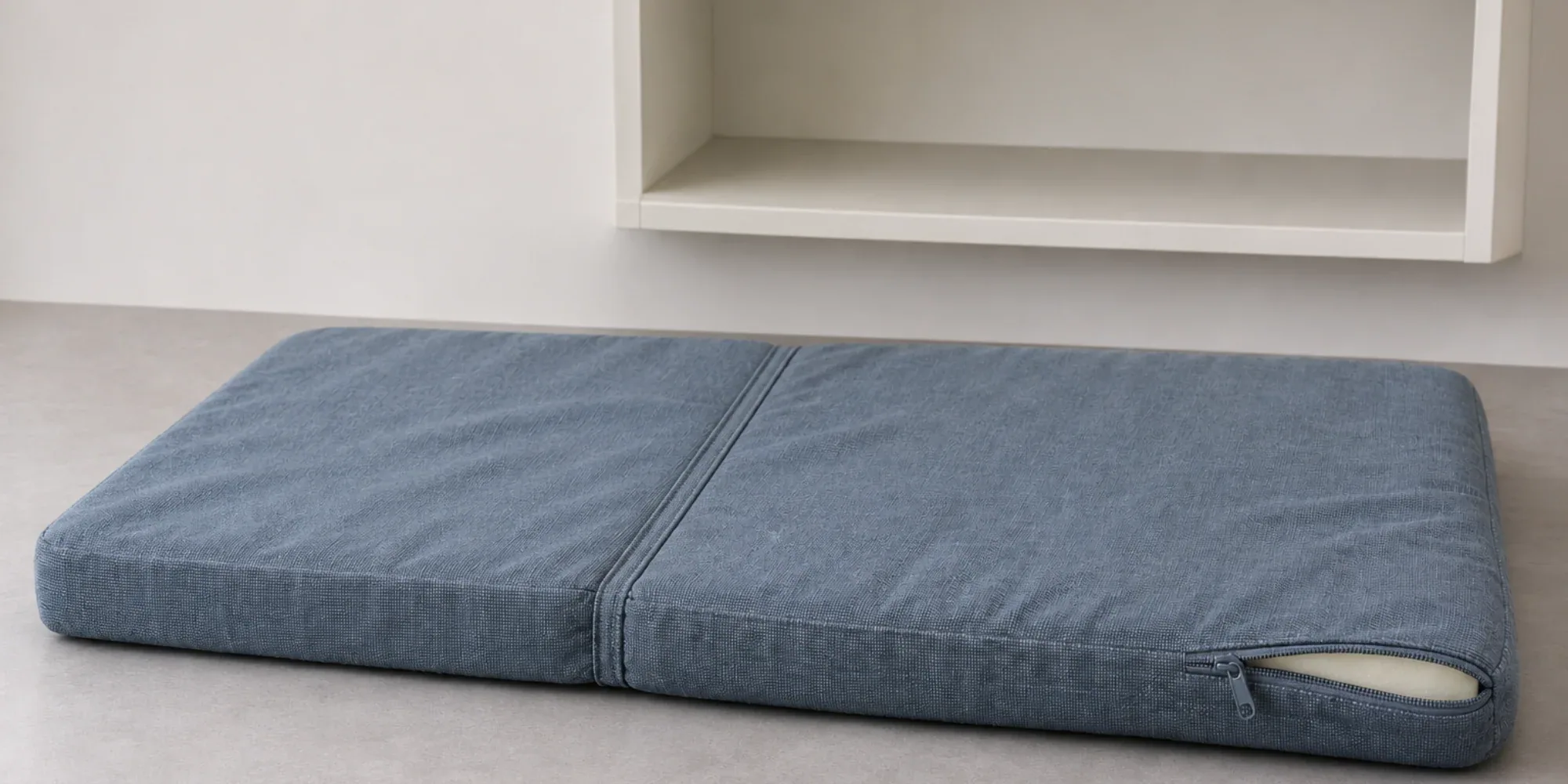
A folding dog bed balances portability with comfort by using segmented foam panels connected by fabric hinges. To ensure the bed actually supports the dog and does not bottom out at the seams, the foam must maintain sufficient density and thickness. However, thicker, supportive foam creates a significantly larger storage footprint when folded, meaning you must choose between maximum orthopedic support and ultra-compact storage.
The Mechanics of Fold Zones and Foam Gaps
A folding dog bed achieves portability by dividing what would normally be a continuous sleeping surface into distinct foam panels connected by a flexible hinge. Unlike a standard solid bed, the folding design introduces a deliberate structural break between these separate sections of foam. This separation is essential for the bed to collapse into a smaller footprint for travel or storage, but it fundamentally alters how the bed supports weight. The hinge itself is typically made of fabric, acting as a flexible bridge that dictates how the independent foam sections align and move.
The orientation and construction of this fabric hinge determine whether the structural break translates into a physical gap when the bed is in use. If a hinge is positioned at the top of the foam profile, the panels fold downward, often leaving a wedge-shaped void underneath when the bed is laid flat. However, a properly designed bottom-hinged cover can eliminate this gap entirely during use. In a bottom-hinged design, the internal foam blocks pivot inward and can sit completely flush against one another with zero gap when the bed is open and flat. Although the structural break between the independent panels remains, the lack of physical separation creates a much more cohesive resting surface.
Even when the foam sections fit flush against one another, the physical separation between the panels introduces a localized loss of structural resistance. Where one piece of foam ends and the next begins, the continuous material pushing back against the dog's weight is severed. When a dog steps, sits, or lies directly over this fold zone, their weight is concentrated specifically on this structural break. If the fabric bridge and the abutting foam edges cannot properly distribute that load across the neighboring sections, the dog's joint will push past the suspension level of the bed and make direct contact with the floor underneath.
A dog resting an elbow or hip directly into a poorly supported fold zone receives almost none of the intended cushioning, effectively negating the entire purpose of an orthopedic bed in that specific area. The risk of a dog sinking through this division scales directly with their overall weight and distinct anatomy. A small, lightweight dog might step across the seam without sinking, as their modest weight distributes safely and easily across the adjacent foam panels. However, a large, heavy dog creates significantly higher point pressure. A heavy elbow or shoulder joint acts as a concentrated point load that rapidly exploits any structural weakness in the fold zone.
The edges of the foam panels adjacent to the hinge play a crucial role in mitigating this weakness. If the foam is too soft or lacks resistance, the edges will compress outward and crush down when loaded, effectively creating a gap under the dog's weight even if the panels initially sat flush. Firmer foam maintains its vertical edge geometry much better under direct pressure. By resisting this outward deformation, firm foam edges support the fabric hinge and keep the structural void from opening up when the bed is compressed. This interaction between vertical foam firmness and hinge tension ensures a reliable and consistent suspension across the entire surface.
Evaluating the integrity of a fold zone involves observing how the bed behaves under concentrated pressure. Pressing a hand firmly into the seam between the foam panels simulates the heavy point load of a dog's joint. If the hand easily pushes through to the floor, the surrounding foam edges lack the structural resistance necessary to bridge the structural break. A properly engineered fold zone will utilize a flush fit and structurally sound adjacent foam to suspend the weight safely.
Foam Density, Thickness, and Joint Support
A folding dog bed relies entirely on its constituent foam panels to suspend the dog above the floor. While the fabric hinge controls the physical separation between these panels, the foam itself must possess the necessary physical resistance to support the dog's weight without collapsing. If the foam lacks adequate resistance, the structural integrity of the entire bed is compromised, making the fold zones extremely susceptible to bottoming out. The primary factors determining this support are the foam's overall thickness and its firmness, which work together to create a reliable resting surface.
Density refers to the mass of the polyurethane material within a given volume, which correlates with the foam's long-term durability and its ability to return to its original shape after bearing weight over time. Firmness, however, measures how much force is required to compress the foam, providing the immediate structural resistance against the dog's weight. In a folding design, the foam edges bordering the hinge must maintain their vertical geometry when a dog steps near the seam. If the foam is low in firmness, these critical edges will crush outward under a localized point load, functionally widening the gap and allowing the dog's leg or hip to strike the hard floor below.
To ensure a bed can withstand repeated use without the foam degrading, the material must meet structural baseline expectations. The physical properties of flexible polyurethane foam can be systematically evaluated for performance in furniture and bedding applications, with official technical guidelines for CertiPUR-US certification detailing specific testing for both physical property and environmental criteria. When foam panels meet standardized durability metrics, they are far less likely to suffer premature structural fatigue along the highly stressed fold lines where the dog's weight frequently transitions. Technical Guidelines
Even with firm, durable materials, a folding bed must provide sufficient thickness to accommodate the dog's anatomy. When a dog lies down, their prominent joints protrude downward, requiring physical space within the foam layer to sink and disperse the pressure. If the panels are too thin, a large dog will compress the material to its absolute limit, resulting in a hard impact against the floor. This is highly problematic across the fold zones, where the inherent lack of continuous material means the dog is already at a disadvantage regarding weight distribution.
Reliable joint suspension is a critical factor for dogs with existing mobility issues. The Canine Arthritis Resources and Education organization provides free evidence-based tools and resources to help identify, diagnose, and manage canine arthritis, emphasizing the importance of implementing effective care plans to keep dogs active. For a dog managing joint inflammation or stiffness, resting on a surface that bottoms out at the seams can exacerbate their condition by creating painful pressure points on their hips or elbows. A genuinely supportive bed must offer continuous pressure relief, meaning the segmented panels in a folding design must perform just as effectively as a solid, continuous slab of foam. Canine Arthritis Resources & Education | Dog arthritis tips and resources
To achieve continuous relief, careful material selection is required. When evaluating an orthopedic memory foam bed, buyers must ensure that folding variants replicate the thick, multi-layered support structures found in non-folding models. Often, this involves combining a highly firm support base with a softer memory foam top layer. The rigid base prevents the dog from sinking entirely through the bed, while the memory foam conforms to their shape to relieve pressure. In a folding design, both of these layers must maintain their structural integrity at the seams to prevent gaps. For company-specific information, see Lincellipet.
The requirement for robust foam structures increases significantly as the dimensions and intended capacity of the bed grow. Large-format lounge products designed for humans and dogs represent a massive increase in the expected load, as they must support not only oversized breeds but potentially a human companion sharing the space. To prevent the internal hinge structures from collapsing under this compounded weight, the foam panels must be exceptionally firm and thick. If the foam cannot withstand the combined pressure, the central fold zones will quickly deteriorate into an uncomfortable trench. For company-specific information, see Lincellipet.
Assessing the foam support of a folding bed requires a practical evaluation of how the material behaves under stress. A reliable rule of thumb is to apply firm, concentrated pressure directly to the edge of the foam panel where it meets the hinge. If the edge immediately gives way and compresses flat against the floor, it lacks the necessary structural resistance to support a heavy dog's joint. The ideal foam will push back firmly, maintaining a relatively square edge even when compressed, which keeps the adjacent fold gap as narrow as possible.
Upgrading a folding bed to feature thicker, firmer foam effectively solves the problem of joint support and bottoming out, ensuring the dog remains comfortable across the entire surface. However, this solution introduces a direct physical consequence for the bed's primary feature, which is its foldability. Firm foam fiercely resists bending, and thick foam panels inherently occupy significantly more physical space. Consequently, the very material properties required to provide maximum orthopedic support fundamentally restrict how compactly the dog bed can be stored or transported inside a vehicle.
The Trade-off Between Support and Storage Size
The physical reality of a folding dog bed is that the very characteristics making it supportive actively work against its ability to be stored compactly. While a fabric cover can fold almost flat, the foam panels that suspend the dog above the floor cannot. Polyurethane foam, especially when selected for high firmness and adequate thickness to protect joints, is a bulky material that stubbornly occupies space. This creates an unavoidable trade-off: optimizing the bed for maximum orthopedic support guarantees a significantly larger footprint when the bed is folded for travel or storage.
Understanding this trade-off begins with the basic geometry of folding. When a dog bed is folded in half, the resulting storage profile is not simply reduced; it is stacked. A bed designed with four inches of supportive foam instantly becomes at least eight inches thick when folded. Because the goal of a folding bed is often to save space in a vehicle or a closet, buyers frequently underestimate how quickly this stacked thickness accumulates, resulting in a folded product that resembles a cumbersome cube rather than a slim travel accessory.
This stacking effect is further complicated by the hinge zone. When firm foam panels are folded against one another, they rarely sit perfectly flush. The fabric hinge bridging the panels requires its own physical allowance, creating a slight wedge-shaped void at the fold line. The foam edges nearest the hinge bind against the fabric, preventing the halves from compressing flat without external force. Consequently, the actual storage thickness of a folded bed is almost always greater than the mathematical sum of its individual foam layers.
The firmness of the foam also plays a crucial role in resisting compact storage. Firm foam is necessary to maintain edge structure and prevent the fold zones from collapsing under a dog's weight. However, this same firmness means the folded panels fiercely resist being squeezed together. If an owner attempts to force a highly supportive, firm foam bed into a tight storage compartment or bind it tightly with straps, the material pushes back constantly. This tension can place excessive strain on storage straps, the fabric cover, and the hinge seams.
- The initial thickness of the foam panels required to suspend the dog's weight safely.
- The firmness of the foam, which dictates how much the panels resist being compressed together.
- The fold configuration, such as a bi-fold that doubles thickness or a tri-fold that triples it.
- The bulk of the heavy-duty fabric cover gathering at the hinge line.
The choice between a bi-fold and a tri-fold design alters the dimensions of the storage footprint but does not eliminate the bulk. A bi-fold bed halves the length of the product but keeps a relatively wide footprint, suitable for sliding behind a vehicle seat. A tri-fold bed reduces the length even further, creating a much narrower storage footprint, but it stacks the foam three layers high. A supportive four-inch tri-fold bed easily exceeds twelve inches in stacked height, making it incredibly thick and potentially difficult to fit into standard car trunks.
Because of these storage constraints, buyers might be tempted to choose a thinner folding bed to ensure it fits easily into their vehicle. While a two-inch thick bed folds into a highly manageable shape, it fundamentally compromises the bed's primary function. As overall thickness decreases, the risk of the dog sinking through the foam and bottoming out increases dramatically, particularly at the structural breaks of the fold zones. The dog is left resting on an unsupportive surface, rendering the bed largely ineffective for meaningful joint relief during everyday use.
Calculating the right balance requires evaluating the hard limitations of the intended storage space before prioritizing foam depth. If the vehicle trunk or closet has strict clearance limits, the buyer must acknowledge that the folding bed will have restricted foam thickness, making it less suitable for heavy dogs. Conversely, if maximum support is non-negotiable for the dog's health, the owner must be prepared to accommodate a substantial block of folded foam, accepting that true orthopedic support and ultra-compact portability are mutually exclusive.
Cover Tension and Hinge Durability
The fabric cover of a folding dog bed serves a much more demanding role than the cover on a solid foam slab. Rather than merely protecting the foam from dirt and moisture, the cover acts as the primary structural connector holding the independent foam sections together. The fabric creates the physical hinge that dictates the fold zones, bearing the mechanical stress of constant movement and weight distribution. Because the foam panels are completely severed at the fold line, the bed relies entirely on the cover's tension and seam integrity to function as a cohesive sleeping surface.
When the bed is laid flat for use, the fabric cover must maintain a precise level of tension to keep the segmented foam panels correctly aligned. If the cover is too loose, the dog's movements will cause the individual foam blocks to drift apart within their separate compartments. This drifting widens the structural gaps at the fold zones, directly undermining the foam support. A tight cover acts as a binding force, actively pulling the vertical edges of the foam panels flush against one another. This pressure minimizes the void between the sections, ensuring the dog's joints are suspended by the adjacent foam rather than sinking into a widened seam.
This required cover tension relies heavily on the physical resistance of the foam panels themselves. When the fabric pulls the sections tightly together, it exerts inward pressure on the foam edges bordering the hinge. If the bed uses low-density, unsupportive foam, the constant tension from the cover will gradually crush and deform these edges over time. Conversely, highly firm foam pushes back against the taut fabric, maintaining its square geometry and ensuring a tight, flush seam. The relationship between cover tension and foam firmness is a delicate balance; one cannot succeed without the other to maintain a consistent resting surface.
The mechanical demands on the cover change completely when the bed is folded to reduce its storage size. In standard folding designs, the hinge pivots at the inside edge of the fold, resting at the vertex between the folding panels. Because the fabric hinge remains on the inside of the fold, it does not need to stretch around the outside thickness of the stacked blocks. However, as the thick foam panels are stacked against each other, the inner fabric and stitching become pinched between the dense layers. Forcing a thick, firm bed into a closed position applies significant compressive pressure directly against this inner seam.
This internal pressure requires highly durable stitching to prevent the hinge from degrading. When thick foam panels resist being folded flat, they push outward against their structural restraints, transferring force back to the hinge holding them together. If an owner binds a highly supportive folding bed tightly with storage straps, this outward pressure is magnified. The fabric at the inner vertex must withstand this continuous push from the foam edges without bursting its seams or fraying over time.
The long-term durability of the fold zones depends heavily on how well the fabric and stitching manage this repeated cycle of tension and compression. Every time the bed is folded for storage or bears the dog's weight directly over the hinge, the connecting seams endure concentrated mechanical stress. Heavy point loads from a large dog can eventually stretch the fabric fibers, introducing permanent slack into the cover. As the fabric stretches, its ability to keep the foam panels tightly aligned diminishes. A bed that initially provided continuous support may gradually develop wider gaps at the fold zones due to the mechanical fatigue of the cover material. Evaluating the strength of the hinge stitching is therefore just as crucial as assessing foam thickness when determining if the bed will maintain reliable support.
Prioritizing Features Based on the Dog's Needs
Choosing a folding dog bed requires acknowledging that maximum joint support and minimal storage size cannot coexist. Because thick, resilient foam is inherently bulky and resists compression at the fold zones, buyers must weigh the convenience of a compact travel footprint against the structural requirements of their dog. Rather than searching for a design that perfectly satisfies both criteria without compromise, owners should use the dog's physical health, size, and the intended frequency of use to dictate their priorities.
For large breeds or senior dogs requiring joint management, continuous support is a mandatory requirement. If a dog has a heavy frame or mobility issues, relying on a thin, highly compact bed creates a high risk of their hips or elbows sinking through the fold gaps and striking the hard floor. Owners must prioritize thick, high-density foam panels capable of bridging the fabric hinges without bottoming out. To provide this level of care, the buyer must accept that the folded product will be bulky, likely requiring a significant portion of a vehicle's cargo area.
Conversely, prioritizing a slim storage profile is a reasonable choice for small, lightweight dogs or healthy young adults. A smaller dog exerts much lower point pressure, making them less likely to exploit the structural weakness of the fold gaps or compress a thinner foam panel entirely. If the primary use is occasional travel and the dog is physically resilient, a thinner folding bed provides adequate temporary cushioning while remaining compact enough to slide easily behind a passenger seat or into a narrow closet.
Before finalizing a choice, owners should physically measure their intended storage space and compare it against the stacked dimensions of the folded bed. If the stacked height of a supportive tri-fold bed exceeds a vehicle's available clearance, the owner faces a physical limitation. They must either allocate a larger storage area or reduce the bed's thickness. If they choose to compromise on thickness to ensure the bed fits, they must anticipate that the bed's ability to protect the dog's joints across the hinge lines will decrease proportionally.
Ultimately, the fabric hinges and segmented foam panels of a folding bed are structural compromises designed to introduce portability. By understanding how fold zones deform under pressure and how foam thickness multiplies when stacked, owners can realistically assess whether a specific bed will protect their dog or simply fit neatly into a car. The most effective choice balances the physical constraints of the bed's materials with the demands of the dog's anatomy and the owner's available space.
