 跳到内容
跳到内容 
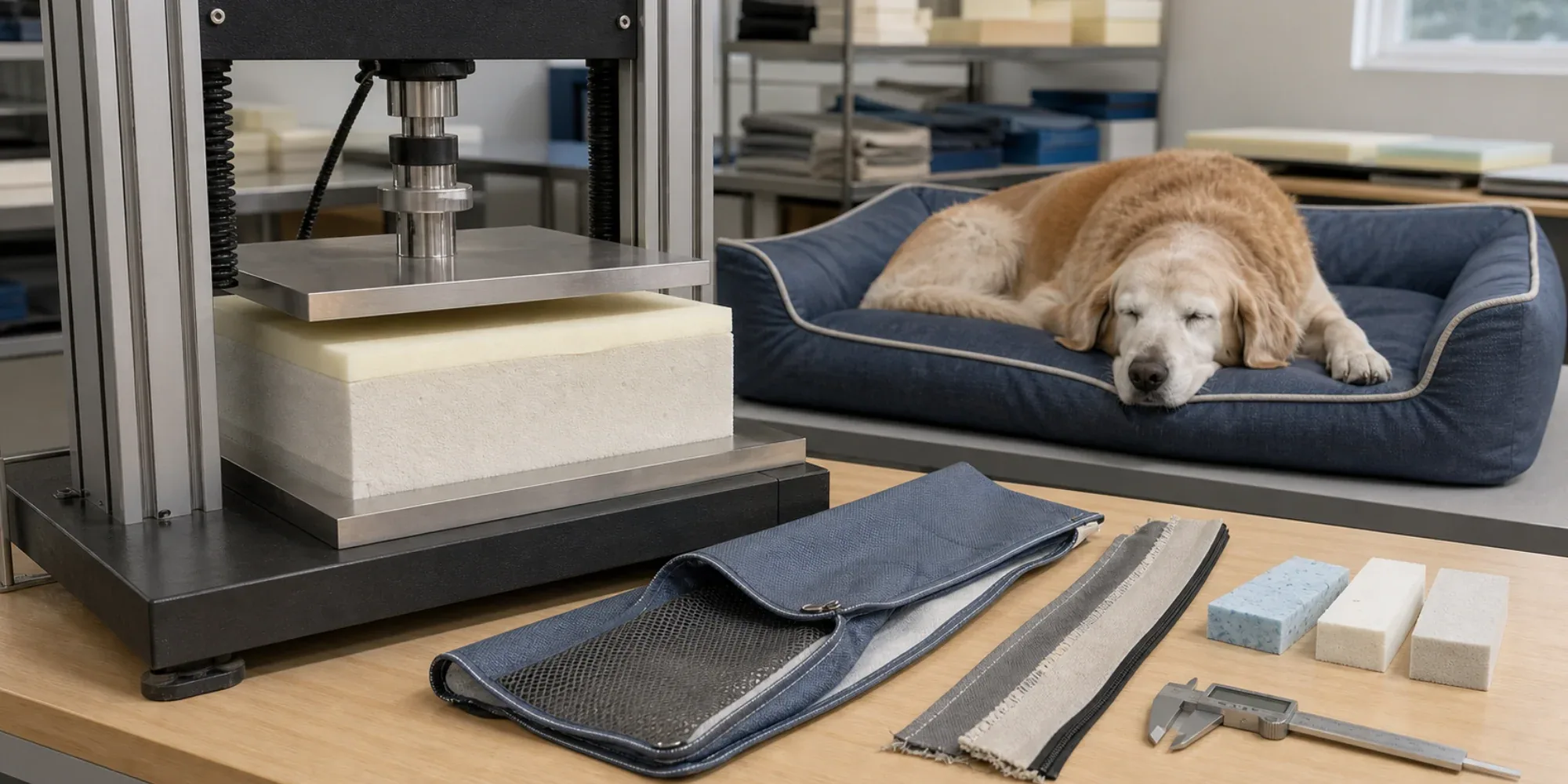
To successfully test a senior dog bed before launch, brands should evaluate the core foam for physical durability, assess structural accessibility for dogs with limited mobility, verify the fluid resistance of liners, and conduct in-home beta testing with target users. This involves applying established technical guidelines for foam properties and utilizing pet-owner networks to gather practical feedback on how the bed supports dogs managing joint issues like arthritis.
Defining the Physical Baseline for Senior Dog Testing
When product teams develop a dog bed targeted specifically at senior pets, standard comfort checks are insufficient for market readiness. Older dogs frequently experience significant physical changes, including muscle atrophy, joint stiffness, and decreased overall mobility. Consequently, the testing baseline for a senior dog bed must shift away from evaluating how soft the surface feels to systematically measuring how well the structure supports a compromised musculoskeletal system. If a bed is intended for healthy adult dogs without mobility limitations, basic durability and aesthetic checks may suffice. However, a senior designation introduces a stricter set of physical requirements focused on orthopedic management, requiring a fundamental change in how the product is evaluated before launch.
The necessity of specialized physical testing is driven by the prevalence of joint conditions in aging pets. According to the Canine Arthritis Resources and Education website, recognizing symptoms early allows owners and veterinarians to establish specific care protocols to help dogs maintain active lifestyles. Because these documented management options involve daily environmental support, product teams should view a senior dog bed as an extension of that broader care strategy. Consequently, pre-launch testing protocols must specifically evaluate how the bed helps minimize joint pressure while the dog rests, and how effectively the surface facilitates easier movement when the animal transitions from lying down to standing up. Canine Arthritis Resources & Education | Dog arthritis tips and resources
To define an accurate testing baseline, brands must establish clear evaluation criteria based directly on the physiological realities of an older dog. Unlike testing beds for puppies, where chew resistance and frequent washing are the primary concerns, senior bed testing requires evaluating the structural integrity of the base materials under sustained loads. An aging dog with stiff joints distributes its weight differently than a younger dog, often relying heavily on its front limbs and the bed's perimeter for leverage when attempting to stand. Testing parameters must account for this altered behavior by applying concentrated pressure to specific zones to verify that the bed will not compress entirely to the floor or shift unpredictably under the dog's paws.
These strict structural requirements apply across various product dimensions and formats targeted at older pets. The fundamental need for joint management and physical stability remains consistent whether a brand is finalizing a traditional rectangular foam sleeper or evaluating a shared-space concept like a Custom Foldable Human Dog Bed. In any configuration marketed for senior dogs, the testing framework must verify that the internal materials maintain their supportive properties under realistic loads. While the overarching design footprint and intended use case shape how the bed physically fits into a home environment, the testing baseline remains focused strictly on the bed's capacity to provide a secure, manageable resting surface. Evaluating these factors rigorously prevents mobility-impaired dogs from sinking unpredictably into overly plush materials. For company-specific information, see Lincellipet.
Establishing this physical baseline provides decision-makers with a concrete framework for all subsequent pre-launch evaluations. By clearly defining the mobility limitations the product must address, teams can select appropriate laboratory tests for the internal foam layers and design practical assessments for accessibility. Before moving forward to bulk manufacturing, brands must translate these physiological management needs into measurable technical specifications. This rigorous approach confirms that the final product reliably functions as a supportive tool for senior pets, rather than serving merely as a standard resting mat.
Evaluating Core Foam Integrity and Performance
When evaluating the internal support structure of a senior dog bed, flexible polyurethane foam typically serves as the primary material. Because older dogs spend significant time resting and frequently experience muscle atrophy or joint stiffness, the bed must provide reliable mechanical support rather than just a plush surface. The foam must resist bottoming out—a condition where the material compresses so deeply that the dog's joints press directly against the rigid floor. Pre-launch testing must evaluate how well the foam retains its structural integrity and firmness over an extended timeline. Subjective tactile softness does not predict how the material will behave under the sustained, localized weight of a heavier animal. Instead, product teams must evaluate the core materials against defined physical property criteria to systematically verify their performance limits before mass production.
To establish these critical physical limits, testing protocols often align with established industry methodologies. For example, the criteria used to achieve CertiPUR-US certification provide a documented framework for assessing flexible polyurethane foam. These official guidelines specify exact testing requirements for both environmental factors and physical properties in materials intended for bedding and furniture applications. Applying these rigorous tests to pet products allows developers to systematically measure how a foam block behaves under a controlled load. By adopting structured testing parameters, pet brands can accurately quantify fundamental material characteristics. This objective approach ensures the chosen core materials are structurally suited for an older dog's orthopedic requirements rather than relying on unverified estimates of support. Technical Guidelines
A comprehensive foam testing protocol systematically evaluates immediate load-bearing capacity and long-term durability. These standardized laboratory evaluations typically include:
- Density assessment: Measuring mass per cubic volume to evaluate overall durability and expected lifespan.
- Indentation force deflection: Quantifying the force required to compress the foam, indicating surface firmness and initial resistance to bottoming out.
- Compression set testing: Subjecting the foam to prolonged compression and measuring permanent height loss, simulating a dog sleeping repeatedly in the same spot.
- Fatigue testing: Repeatedly compressing the foam mechanically over thousands of cycles to observe cellular breakdown over a simulated service life.
The results of compression set and fatigue tests are critical when designing for senior dogs. If a foam core suffers from a high compression set, it gradually develops a permanent indentation where the dog usually rests. For an aging dog with limited mobility, this permanent sagging creates a physical hazard. Exiting a deep depression requires substantially more effort from the dog's stiff joints just to gain leverage and stand up. A successful testing outcome requires the foam to return completely to its original shape and resist permanent deformation after the load is removed. Demanding a rapid recovery rate is incorrect, as this unnecessarily excludes orthopedic memory foams designed specifically with a slow recovery rate to relieve joint pressure. The critical metric is complete dimensional recovery. If the foam exhibits permanent deformation, product teams must specify a more durable density before finalizing the design.
These criteria become more complex when the bed utilizes a multi-layered foam construction. Many designs bond a softer, conforming top layer to a firmer base layer to balance immediate pressure relief with underlying structural stability. When evaluating a custom orthopedic memory foam dog bed, evaluators must assess both the distinct physical properties of individual layers and the performance of the completely bonded assembly. The firm base layer must reliably prevent heavier body sections, such as hips and shoulders, from sinking too deeply, while the softer top layer must distribute weight evenly. Testing the combined structure ensures the layers function together to manage joint pressure as intended. For company-specific information, see Lincellipet.
Testing Structural Accessibility and Edge Support
While internal foam firmness—measured by Indentation Force Deflection—dictates resting support, pre-launch testing must also rigorously evaluate the dog bed as a physical structure that the animal must navigate. A senior dog with reduced muscle mass and stiff joints interacts with a bed differently than a younger pet. If an older dog cannot safely enter, turn around, and exit the resting space, the quality of the core foam becomes irrelevant. Therefore, product teams must establish testing protocols that evaluate functional clearances and structural stability under the specific movement patterns of a mobility-impaired dog.
The first critical assessment is the step-in height. Senior dogs often lose the ability to lift their limbs over high obstacles without discomfort. Teams must measure the entry point on the prototype to ensure it falls within a manageable clearance range. When evaluating this physical threshold, evaluators must distinguish between rigid and flexible barriers. Unweighted measurement applies to rigid structures to verify the absolute highest point a dog must clear. However, for beds with soft, compressible entry edges, developers must test the functional step-in clearance under simulated weight. This confirms whether the edge compresses sufficiently, allowing a dog to walk directly onto the sleeping surface without having to hike its front legs or drag its hindquarters over a stiff barrier.
Once inside the bed, the dog must be able to turn around to find a comfortable resting position. This requires a stable, relatively firm surface that does not shift unpredictably. If a top layer is excessively plush or loosely fitted, it can tangle around paws or sink deeply, forcing the dog to exert extra energy to maintain balance. To test surface stability, developers should apply concentrated lateral pressure using paw-sized weights. This simulates the rotational movement of a dog adjusting its position. The test must verify that the fabric and immediate top layer of the foam provide enough traction and resistance to prevent slipping.
Edge support and bolster stability form the next testing priority. Many senior dogs rely heavily on perimeter bolsters not just as a headrest, but as a physical brace to lean against when maneuvering. If a bolster collapses outward under partial body weight, the dog can easily lose its footing. Testing bolster stability requires applying downward and outward directional loads to the raised edges of the prototype. A successful design will hold its structural shape and offer firm resistance, preventing the edge from flattening completely to the floor when leaned upon.
The most demanding physical action for an aging dog is transitioning from a resting position back to a standing posture. This motion concentrates a significant portion of the dog's body weight onto its front limbs as it pushes off the bed's surface and edges. Testing exit mechanics requires simulating this localized pressure near the perimeter of the bed. Evaluators must verify that the base foam does not bottom out under this load, ensuring the edge provides sufficient counter-pressure to help the dog propel itself upward without stumbling.
By systematically measuring step-in heights, turning resistance, and edge stability, product teams confirm that the bed functions safely for pets with restricted mobility. Documenting these functional clearances ensures the structural design aligns with the physiological realities of aging dogs. Passing these accessibility checks confirms the fundamental architecture of the bed is sound, allowing developers to confidently advance to subsequent evaluations, such as assessing how well the materials withstand fluids and frequent laundering.
Laundering and Fluid Resistance Protocols
While structural support dictates a senior dog's physical comfort, the long-term hygiene and viability of that support depend heavily on the bed's defense against moisture. Aging dogs frequently experience urinary incontinence, gastrointestinal sensitivity, and an increased rate of everyday accidents. For product teams, this physiological reality shifts fluid resistance from an optional premium feature to a mandatory protective requirement. If liquid penetrates the outer fabric and reaches the flexible polyurethane foam, it creates an environment that traps persistent odors and fosters mold or bacterial growth. Therefore, a comprehensive pre-launch testing protocol must subject both outer covers and internal liners to rigorous fluid exposure and maintenance simulations to verify the core materials remain completely dry.
The first phase of this testing focuses on the internal waterproof liner encasing the core foam. To evaluate its efficacy, evaluators should conduct controlled pooling tests simulating overnight accidents. This involves applying a measured volume of liquid directly onto the liner and allowing it to rest undisturbed for several hours. This duration mimics a scenario where an owner might not discover an accident until morning. Evaluators must then inspect the underside of the liner and the underlying foam for moisture transfer. Testing should also target seams and zipper tracks, as stitched junctions are common failure points for liquid penetration.
Beyond the internal liner, the outer fabric cover must endure a higher frequency of laundering than beds marketed for healthy adult dogs. Pre-launch evaluations must measure dimensional stability across repeated wash and dry cycles. Shrinkage is a critical failure metric. If an outer cover shrinks significantly during laundering, it excessively squeezes the internal foam core upon reassembly. This tight compression can force the foam to buckle, compromising the stable resting surface required to support an arthritic dog. Testing teams should run prototype covers through multiple consecutive wash cycles, systematically measuring fabric dimensions to verify the cover retains its necessary footprint.
Because the cover will be removed and replaced frequently, the mechanical hardware requires dedicated fatigue testing. Zippers and closures undergo substantial physical stress when an owner wrestles a heavy foam block back into a freshly laundered cover. Testing protocols must include repeated opening and closing cycles applied under tension to verify that the zipper teeth do not separate and the stitching anchoring the zipper tape to the fabric does not tear. If the closure hardware fails under typical maintenance strains, the protective system breaks down entirely. A broken zipper renders the washable design useless, leaving the foam completely vulnerable to the next accident.
Finally, practical maintenance testing must account for realistic drying times and material recovery. When a senior dog has an accident, the owner needs to wash, dry, and reassemble the bed quickly so the dog is not left without its necessary orthopedic support. Product teams must evaluate how long the fabrics retain water and whether they require specialized, low-heat drying cycles that delay reassembly. Establishing these practical maintenance metrics ensures the product is actually manageable for the pet owner, setting a clear physical baseline before developers transition into monitoring real-world behavioral trials.
Conducting In-Home Beta Testing with Pet Owners
While laboratory evaluations for foam firmness, structural accessibility, and fluid resistance establish a mandatory physical baseline, controlled environments cannot fully replicate the unpredictable nature of a home setting. Mechanical tests confirm that a foam core can support a defined weight, but they cannot verify whether a dog with muscle atrophy will actually choose to sleep on it. A senior dog's behavior—how it approaches a bolster, whether it circles excessively to find balance, or if it avoids the bed entirely—reveals usability factors that machines cannot simulate. Therefore, pre-launch testing must transition from the laboratory into the living room, requiring product teams to conduct structured in-home beta trials with real users to capture practical behavioral and maintenance data.
Recruiting the appropriate demographic for these trials is essential, as the feedback is only valuable if it comes from the target audience: owners of senior dogs managing age-related physical limitations. To find these specific candidates, brands can tap into established online communities. Research highlights that digital platforms dedicated to pets constitute a major, rapidly expanding area of internet activity, connecting massive groups of highly engaged pet owners. By sourcing testers through these specialized digital networks, product teams can effectively filter candidates by dog breed, age, weight, and specific orthopedic conditions. This targeted recruitment ensures that the prototypes are tested by dogs whose physiological realities match the bed's intended design, providing a reliable stream of qualitative data. The more people I meet, the more I like my dog: A study of pet-oriented social networks on the Web | First Monday The more people I meet, the more I like my dog: A study of pet-oriented social networks on the Web | First Monday
Once prototypes are distributed to the selected beta testers, product developers must establish clear criteria for the data they expect owners to collect. Testers should be instructed to observe and document the dog's physical interaction with the bed over several weeks. Critical observations include whether the dog hesitates before stepping into the resting area, if it struggles to find stable footing when turning, and how much effort is required to stand up after a long period of rest. If multiple owners report that their dogs stumble when exiting or frequently slide off the edge, the team may need to reconsider the surface traction or the perimeter support structure. Capturing these small behavioral cues highlights ergonomic friction points that standardized laboratory weights cannot detect.
In-home trials also provide the only true assessment of practical maintenance requirements. Because senior dogs have a higher likelihood of accidents, owners will inevitably need to launder the bed. Beta testers should wash covers and liners exactly as they would in a normal routine, reporting the physical effort required to disassemble and reassemble the product. If an owner notes that a waterproof liner traps odors, or that wrestling a heavy foam block into a tight cover causes a zipper to jam, developers must adjust manufacturing tolerances. Lab tests measure fabric shrinkage, but only an in-home trial reveals if the required reassembly effort frustrates a typical owner.
Ultimately, distributing prototypes to real-world users bridges the gap between technical specifications and daily usability. A bed that performs perfectly in a mechanical compression test may still fail in a household if the cover is too difficult to clean or the surface texture makes an arthritic dog anxious. By systematically gathering observational feedback from pet owners and combining it with earlier laboratory results, brands gain a comprehensive understanding of the product's performance. This thorough evaluation process allows decision-makers to correct practical design flaws before committing to bulk manufacturing, ensuring the final release actually supports the specific physical needs of aging pets and preventing costly post-launch returns.
Finalizing Specifications for Bulk Production
Once laboratory evaluations and in-home behavioral trials conclude, product teams must consolidate the resulting data to finalize the product specification. Pre-launch testing generates a broad spectrum of observations, ranging from precise mechanical compression metrics to qualitative owner feedback regarding how easily an arthritic dog navigates the resting surface. This combined intelligence serves a specific purpose: identifying exactly which prototype variables require adjustment before the brand commits to bulk manufacturing. Transitioning from a prototype to a scalable product requires developers to translate all observed physical failures and usability friction points into concrete material and dimensional directives for the factory.
The core support structure often requires the most precise final adjustments following prototype evaluation. If beta testers report that heavier senior dogs sink too close to the floor, developers must specify a firmer flexible polyurethane foam, defined by a higher Indentation Force Deflection rating, to prevent bottoming out. This distinguishes surface firmness from foam density, which measures mass per volume and dictates long-term durability. Conversely, if the base layer holds up but dogs hesitate to settle because the surface feels too unyielding, teams might adjust the bonded top layer to a softer specification. These final firmness parameters must be locked into the manufacturing documentation. Leaving foam performance open to factory interpretation risks producing a bed that lacks the targeted orthopedic management capabilities.
Dimensional tolerances and structural clearances must also be formalized based on accessibility testing outcomes. If in-home feedback indicated that older dogs frequently stumbled over the bolster or had to hike their legs uncomfortably high to enter, the step-in height must be reduced in the final pattern. Decision-makers should set strict manufacturing tolerances for these critical clearances rather than relying on rough estimates. Because flexible materials can shift during cutting and sewing, the final specifications must explicitly state the maximum allowable deviation for the entry height and the minimum acceptable width for the flat sleeping area. This ensures physical dimensions remain consistent across bulk production.
Material choices for covers and internal liners require equal scrutiny during finalization. If laundering tests demonstrated that the outer fabric shrank and excessively compressed the internal foam, the final specification must mandate pre-shrunk textiles or appropriately scaled cover dimensions that account for standard household wash cycles. Additionally, if beta testers encountered zipper binding or thread breakage when wrestling the foam back into the cover, teams must upgrade the closure hardware or reinforce the stitching requirements before mass production. The waterproof liner specification should also be finalized based on the pooling tests, ensuring the chosen fabric and seam construction protect the underlying foam core from accidents common in aging pets.
Consolidating these adjustments culminates in the creation of an approved reference standard for the manufacturing facility. By systematically applying the outcomes of structural, environmental, and behavioral testing, product teams eliminate guesswork from the production phase. The final product specification outlines exact foam firmness ratings, minimum density guidelines, textile requirements, hardware grades, and strictly bounded physical dimensions. This comprehensive alignment of testing data with manufacturing requirements guarantees that every unit replicates the performance of the successful prototype, ensuring the senior dog bed provides the verified support necessary for its specialized audience.
Sources
- Canine Arthritis Resources & Education | Dog arthritis tips and resources
- Technical Guidelines — 2025-03-31
- The more people I meet, the more I like my dog: A study of pet-oriented social networks on the Web | First Monday
- The more people I meet, the more I like my dog: A study of pet-oriented social networks on the Web | First Monday
