 跳到内容

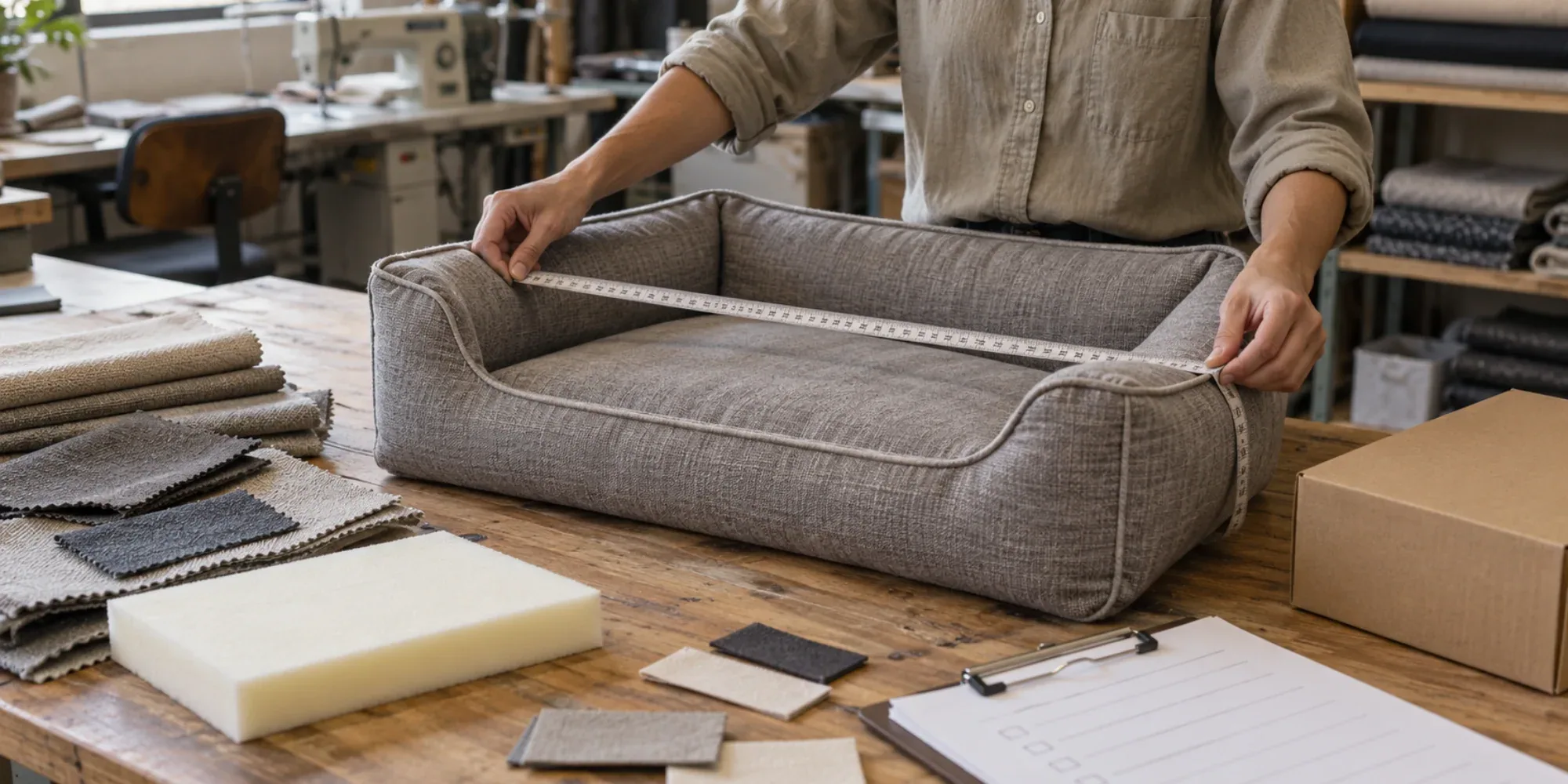
To manufacture a successful private-label dog car bed, an OEM specification must address the unique physical constraints of vehicle interiors. The specification must define a leveling base structure to counteract bucket seats, seatbelt passthroughs for secure attachment, and high-density foam to absorb road vibration. Additionally, it requires specifying abrasion-resistant and water-resistant fabrics for the cover, non-slip base materials, and packaging formats like vacuum compression that keep bulk shipping costs viable without compromising foam recovery.
The Vehicle Environment: Why Standard Bed Specifications Fail
Pet brands developing private-label travel products cannot simply repurpose standard home dog beds for automotive use. The vehicle environment introduces dynamic and geometric constraints that fundamentally change how a pet bed must be structured. Research indicates that dog owners place a strong focus on their relationship with their pets and frequently look for advice. When this dedication translates to including their dogs in frequent travel, buyers often attempt to place standard flat beds in their vehicles. They quickly discover that residential product specifications completely fail to address angled passenger seating, continuous road vibration, and restricted cabin dimensions. The more people I meet, the more I like my dog: A study of pet-oriented social networks on the Web | First Monday
The most immediate structural challenge in automotive pet bed design is seat geometry. Unlike living room floors, passenger seats and rear bench seats are almost never flat. They feature contoured bucket designs with varying degrees of incline, pronounced side bolsters, and rearward slopes intended to support human ergonomics. If a manufacturer relies on a standard slab of uniform-thickness foam, the pet bed will simply conform to the steep angle of the car seat. This forces the dog to constantly expend physical energy adjusting its balance to avoid sliding into the seat bight—the deep crease between the seat cushion and backrest—or tipping toward the door panel. A continuously sloping surface prevents the traveling animal from lying down comfortably.
- Lack of structural leveling: Uniform flat bases tilt on angled car seats, actively compromising the pet's balance during transit.
- Insufficient lateral support: Standard residential bolsters are often too soft to absorb the shifting weight of a dog during vehicle cornering and braking.
- Incompatible sizing: Typical rectangular dimensions frequently clash with vehicle seatbelt buckles, center consoles, and interior door handles, preventing a secure installation.
To counteract seat angles, an effective OEM specification for a dog car bed must include a dedicated leveling base. This typically requires a multi-layer foam construction where the bottom layer acts as a firm, wedge-like structural block that fills the void created by the seat's incline. By specifying a firm, shaped base layer, private-label buyers can ensure the primary sleeping surface remains completely horizontal, regardless of the underlying seat contour. Providing this level structural foundation is critical for keeping the traveling pet physically stable, reducing the physical stress associated with a sloping surface, and minimizing the need for the dog to brace continuously.
Dimensional constraints further separate specialized vehicle beds from standard residential models. While a sprawling Custom Foldable Human Dog Bed works well for shared lounging in an open living room, automotive pet beds must fit strictly within defined seat widths or rear bench configurations. A precise OEM specification defines maximum exterior dimensions to prevent the bed from covering crucial seatbelt receptacles or overhanging the front edge of the seat, which severely compromises stability. The specification must also account for necessary clearance around center armrests and door contours to ensure a proper fit. For company-specific information, see Lincellipet.
Finally, standard home beds generally lack the necessary material density to isolate the dog from persistent road vibration. A vehicle in motion transfers continuous kinetic energy directly through the chassis and seats. A low-density polyfill or thin foam pad that feels adequately plush on a solid floor will fully compress under the dog's weight in a moving car, transferring that vibration directly into the animal's body over the course of a journey. OEM specifications for car beds must require higher-density foams capable of absorbing this sustained low-frequency motion, allowing the bed to function as an active shock absorber rather than just a static resting surface.
Foam and Structural Specifications for Transit
A vehicle in motion introduces constant kinetic energy, transferring low-frequency vibrations directly through the chassis and seats into the pet's body. For healthy animals, this is fatiguing; for aging dogs or those with joint issues, it can be deeply uncomfortable. Organizations like Canine Arthritis Resources and Education note that pet parents and veterinary teams actively seek management options to keep arthritic dogs comfortable and active. Translating this consumer need into an automotive product requires an OEM specification that physically isolates the animal from the vehicle's chronic vibration, rather than simply offering a soft surface. Canine Arthritis Resources & Education | Dog arthritis tips and resources
Achieving this isolation requires dividing the bed's foam core into distinct functional layers. The foundational layer must serve as the structural wedge that corrects the seat angle. Because this base layer supports the entire dynamic weight of the dog on an uneven surface, the OEM specification must mandate a very high Indentation Load Deflection rating. If a private-label buyer allows the factory to use soft foam for this structural wedge, the leveling effect will collapse as soon as the vehicle corners, causing the dog to slide and forcing them to brace continuously.
Above this high-firmness base, the specification must detail the primary sleeping cushion responsible for vibration dampening and joint support. Buyers must ensure the manufacturer provides precise measurements rather than relying on generic marketing terms like premium or plush. It is critical to distinguish between two distinct physical properties: firmness and density. Firmness, measured by Indentation Load Deflection, determines the foam's ability to resist bottoming out under localized pressure points like a dog's elbows and hips. Density ensures the foam retains its supportive structure and durability over time. For company-specific information, see Lincellipet.
Setting exact metrics ensures the product performs consistently over time, but those metrics must be verified. Physical property degradation is a major risk in automotive pet products due to constant dynamic loads and extreme cabin temperature fluctuations. To prevent the foam from permanently flattening after a few trips, specifications should reference established testing protocols. For instance, the official technical guidelines for CertiPUR-US certification detail testing for the physical property and environmental criteria of flexible polyurethane foam used in bedding. Requiring OEM partners to validate their foam against similar baseline physical property benchmarks ensures the material will maintain its supportive structure. Technical Guidelines
- Bottom base layer firmness: Must be rigid enough to maintain a horizontal plane across contoured bucket seats.
- Comfort layer properties: Firmness must resist bottoming out under localized pressure points, while high density ensures the foam retains its lifespan without flattening.
- Physical property testing criteria: Required baseline performance to prevent premature material fatigue under travel stress.
- Thermal resilience: The ability of the selected foam to withstand the extreme heat common in parked vehicles without degrading.
Private-label brands must also navigate the direct tradeoff between foam density and manufacturing economics. Higher density foam offers superior durability and structure retention for arthritic dogs, but it increases the overall weight and raw material cost of the unit. Furthermore, while dense, structural foam performs exceptionally well in the vehicle, it poses distinct challenges for packaging. Overly rigid base foams can resist vacuum compression or fail to fully rebound if compressed too aggressively. Consequently, the structural foam specification must balance transit performance against the realities of freight optimization and bulk shipping limits.
Fabric and Cover Durability Requirements
Unlike a living room where a dog calmly circles before sleeping, a vehicle is a highly dynamic space. Dogs frequently shift their weight to maintain balance during acceleration, braking, and cornering, actively driving their claws directly into the bed surface to stabilize themselves. Furthermore, travel inherently involves constant transitions from outdoor environments to the confined vehicle cabin, introducing mud, moisture, and coarse debris. Consequently, an OEM specification for a car bed cover cannot rely on the soft, lightweight fabrics often used for indoor pet lounging. The textile specification must instead prioritize high mechanical strength, moisture management, and rapid maintenance.
To withstand the point-load pressure of bracing claws, private-label buyers should specify heavy-duty woven textiles rather than loose knits, thin microfibers, or decorative plush materials. Synthetic canvas, such as high-denier polyester or nylon Oxford cloth, provides a tightly woven surface that resists snagging and punctures. When defining this requirement for a manufacturing partner, the specification should move beyond subjective terms like durable and instead require fabrics that feature a tight, high-density weave. Tighter weaves not only prevent claw penetration but also stop loose fur and outdoor grit from embedding deeply into the fabric matrix. This smooth, dense surface structure makes routine vacuuming between car trips significantly easier for the end user, reducing the maintenance burden of traveling with a pet.
- Concealed zipper tracks: Zippers must be hidden beneath a continuous fabric flap to prevent metal or hard plastic components from scratching the vehicle interior upholstery.
- Extended wraparound openings: The zipper must span at least three sides of the bed to allow easy removal and reinsertion of the rigid leveling foam base without tearing the cover.
- Reinforced structural seams: High-stress junctions, particularly where the bolsters meet the main sleeping area, require double stitching to withstand the lateral force of a dog bracing against them.
These hardware and construction details matter heavily in transit. The constant shifting of a pet places immense tension on the fabric panels. When a dog presses heavily against a side bolster, standard single-needle stitching can easily rupture. Furthermore, because automotive beds accumulate dirt rapidly from rest stops, the covers require frequent machine washing. If an OEM specification only includes a short, single-side zipper, the end user will struggle to bend and force the specialized angled foam base through a small opening. This forceful stuffing frequently tears the zipper terminal ends, leading to premature product failure. Specifying extended zippers and reinforced seams directly prevents these common issues.
Managing moisture requires precise material specifications, as wet foam degrades quickly and traps odors within a small, enclosed car cabin. Specifying moisture protection involves a direct tradeoff between absolute waterproofing and fabric flexibility. A topically applied water-resistant chemical coating allows liquids to bead up and roll off, which maintains the fabric's soft drape and breathability. However, these surface coatings inevitably wear away with repeated machine washing and the physical friction of the dog turning. Conversely, specifying a laminated backing, such as a thermoplastic polyurethane layer, creates a persistent waterproof barrier that stops fluids completely. The tradeoff is that laminated fabrics are noticeably stiffer, can create a distracting crinkling sound during transit, and significantly reduce air permeability, which may cause the sleeping surface to retain unwanted body heat during long summer drives.
Integration and Safety: Fastenings and Non-Slip Bases
Even with specialized leveling foam and durable fabrics, an automotive pet bed will fail if it freely slides across the vehicle interior. The dynamic forces of a moving car, specifically the lateral pull of cornering and the forward momentum of heavy braking, require the bed to be physically anchored to the seat. An OEM specification must address this by defining an integrated system of structural fastenings and friction materials that keep the unit stationary without damaging the vehicle upholstery.
The primary anchoring mechanism for the bed itself should leverage the vehicle's built-in restraint systems. A standard pet bed lacks secure attachment points, meaning the empty unit can easily become displaced. To prevent this, the product specification must detail seatbelt passthroughs. These are reinforced channels or heavy-duty webbing loops built directly into the rear bolsters of the bed, allowing the car's standard three-point seatbelt to thread through and lock the bed frame tightly against the seatback. It is critical to understand that these fabric passthroughs only secure the mass of the bed itself. While the OEM brief must specify box-stitched reinforcement at the passthrough seams to prevent the fabric cover from tearing under the weight of the shifting bed, this does not protect the animal. The pet must always be independently secured with a crash-rated vehicle harness to safely handle the extreme dynamic forces of a sudden stop.
To supplement the seatbelt integration, adjustable straps that loop around the vehicle's headrests help prevent the back of the bed from pitching forward during travel. The specification for these straps must address the harsh environmental conditions of a car interior. Standard consumer-grade plastic hardware can become brittle during freezing winter temperatures or warp in the extreme heat of a parked car in summer. Buyers should specify high-tensile, UV-resistant nylon webbing and temperature-stable hardware, such as automotive-grade polyoxymethylene buckles, to ensure long-term durability. It is vital to note that these headrest straps serve only to hold the bed upright and are not structural anchor points. They cannot bear a dog's dynamic weight shift; to remain safe, the dog must be separately tethered to the vehicle's dedicated structural anchors.
Securing the top and rear of the bed is only partially effective if the bottom base slides freely against smooth leather or vinyl seats. Many standard residential pet beds use a lightweight polyester base dotted with cheap polyvinyl chloride for grip. In a vehicle environment, the continuous friction of the dog's shifting weight, combined with high cabin temperatures, often causes these basic dots to shear off or melt, potentially permanently staining the car's upholstery.
- Heat-resistant friction materials: Specify high-grade silicone grip patterns that maintain their tackiness without degrading or transferring residue in high-heat conditions.
- Maximum surface coverage: The anti-slip treatment must extend across the entire bottom contact area to maximize friction against the vehicle seat, rather than just lining the perimeter.
- High-denier substrate: The base fabric holding the grip material must be tightly woven to resist stretching or tearing under lateral shearing forces when the vehicle corners.
A successful private-label dog car bed relies on the coordinated performance of these features. The silicone base provides constant friction against the seat cushion, the seat bight anchors stop gradual forward sliding, and the seatbelt passthroughs lock the entire structural foam assembly firmly against the seatback. Specifying these elements in exact detail ensures the manufacturer delivers a secure, stable platform that safely supports the pet during travel.
Packaging, Freight, and Assembly Economics
The high-density foam and bulky leveling wedges required for a functional car bed create a severe logistical problem. Shipping fully assembled, uncompressed pet products means brands are largely paying to ship air. To make a private-label dog car bed economically viable, the OEM specification must aggressively address packaging and freight density through vacuum compression.
Vacuum compression is the standard manufacturing solution for foam pet products, but automotive beds introduce a unique structural complication. The rigid, high-firmness foam required for the seat-leveling base inherently resists compression. If standard, aggressive roll-packing machinery is applied to this specialized wedge, the foam's cellular matrix can permanently fracture. The result is a warped base that will no longer sit flush against a contoured vehicle seat, defeating the primary engineering purpose of the car bed.
Instead of assuming the foam will naturally bounce back upon delivery, private-label buyers must write strict rebound tolerances into their manufacturing agreements. A useful specification explicitly states the acceptable dimensional variance, such as requiring the foam to recover to a defined percentage of its original drawn dimensions within 48 to 72 hours of unpacking. Because a leveling base relies on precise angles to counteract a bucket seat, any permanent distortion renders the product defective. Buyers should require the factory to conduct pilot-run recovery tests that simulate the expected ocean freight transit time, which routinely exceeds 30 days, before approving the final packaging format.
- Maximum compression ratio: The defined limit of vacuum sealing to protect rigid base layers from cellular damage.
- Rebound dimensional tolerance: The acceptable variance in the foam's length, width, and thickness after an established unboxing recovery period.
- Component separation: Guidelines establishing whether structural foam wedges should be packed separately from the fabric covers to prevent zipper strain.
- Master carton dimensions: Exact outer carton sizes engineered to maximize space utilization within a standard shipping container.
Beyond raw freight optimization, the packaging specification determines the final assembly experience for the end consumer. Vacuum-sealing a fully stuffed, heavy-duty car bed often results in deeply wrinkled, abrasion-resistant fabrics and physically strained zippers. To prevent this, specifications frequently dictate that the durable outer cover and the waterproof inner liners be folded flat within the carton, while only the foam core is subjected to vacuum compression. Although this approach requires the purchaser to insert the foam into the cover upon delivery, it protects the structural textiles and hardware from transit damage, ultimately reducing return rates caused by permanently deformed product components.
The OEM Dog Car Bed Specification Checklist
A complete OEM specification merges distinct material, structural, and logistical requirements into a single reference document. Rather than relying on generic marketing terms like plush or durable, private-label buyers must provide their manufacturing partners with exact physical criteria. The following checklist consolidates the critical requirements necessary to produce a functional, safe, and economically viable dog car bed, organized by major production categories.
| Category | Specification Requirement | Purpose |
|---|---|---|
| Foam Architecture | Multi-layer construction with a firm leveling wedge base | Counteracts bucket seat angles to provide a flat sleeping surface. |
| Base Firmness | High Indentation Load Deflection (ILD) rating for the base wedge | Prevents the leveling structure from collapsing under dynamic shifting. |
| Comfort Layer | High-density foam upper layer | Absorbs low-frequency road vibration to protect aging joints. |
| Exterior Dimensions | Maximum width and depth limits tailored to specific vehicle seats | Ensures the bed does not overlap seatbelt buckles or overhang the seat edge. |
Defining the foam structure ensures the dog remains stable, but the outer textiles dictate the product's lifespan. Because the vehicle interior exposes the bed to concentrated claw pressure and outdoor moisture, the fabric specification must prioritize high mechanical strength and practical maintenance over simple softness.
| Component | Specification Requirement | Purpose |
|---|---|---|
| Primary Textile | High-denier woven synthetic canvas | Resists claw punctures and prevents dirt from embedding in the weave. |
| Moisture Protection | Thermoplastic polyurethane laminated backing or internal waterproof liner | Prevents liquid from penetrating and degrading the structural foam core. |
| Zipper Layout | Extended, three-sided wraparound zippers | Allows easy removal of rigid leveling wedges without tearing seams. |
| Zipper Hardware | Concealed zipper tracks with protective fabric flaps | Prevents metal components from scratching the vehicle's interior upholstery. |
| Seam Construction | Double-stitched junctions at bolster and base intersections | Withstands the lateral force of a heavy dog bracing during cornering. |
With the core and cover defined, the specification must address how the bed integrates into the vehicle. Unanchored pet beds present a significant hazard during sudden braking, and standard non-slip dots frequently fail under high cabin temperatures.
| Integration Point | Specification Requirement | Purpose |
|---|---|---|
| Seatbelt Integration | Reinforced passthrough channels or heavy-duty webbing loops | Anchors the main bed frame firmly against the seatback using the car's built-in belts. |
| Seat Bight Anchors | Cylindrical foam or plastic inserts at the rear base | Wedges into the seat crevice to prevent forward creeping during braking. |
| Fastening Hardware | Automotive-grade polyoxymethylene buckles and UV-resistant nylon straps | Prevents plastic components from snapping in freezing temperatures or warping in extreme heat. |
| Base Grip | Heat-resistant silicone grip patterns over a high-denier substrate | Maximizes friction against leather or vinyl seats without melting or transferring residue. |
Finally, the physical mass of dense foam and bulky leveling wedges requires strict packaging controls. The economic viability of a private-label dog car bed depends on efficient container loading, which necessitates vacuum compression. However, the exact parameters must be carefully controlled to prevent permanent cellular damage to the specialized base foam.
| Packaging Parameter | Specification Requirement | Purpose |
|---|---|---|
| Compression Limits | Defined maximum vacuum compression ratio tailored to rigid base foams | Prevents permanent structural distortion of the precise angles needed for seat leveling. |
| Rebound Tolerance | Stipulated dimensional recovery percentage within 48 to 72 hours of unboxing | Establishes an objective quality control metric for accepting or rejecting a production run. |
| Component Packing | Structural foam compressed separately from folded outer fabric covers | Protects stiff textiles from permanent wrinkling and prevents zipper strain during transit. |
| Master Cartons | Custom outer carton dimensions engineered for specific shipping containers | Eliminates wasted airspace and optimizes bulk freight economics. |
Consolidating these criteria into a formal OEM specification eliminates ambiguity during the manufacturing process. By clearly detailing the required dimensions, material densities, safety hardware, and compression limits upfront, private-label brands can establish a reliable baseline for quality control. This comprehensive approach prevents costly redesigns, reduces transit-related product failures, and ensures the final car bed effectively balances the pet's travel needs with practical logistics.
