 跳到内容
跳到内容 
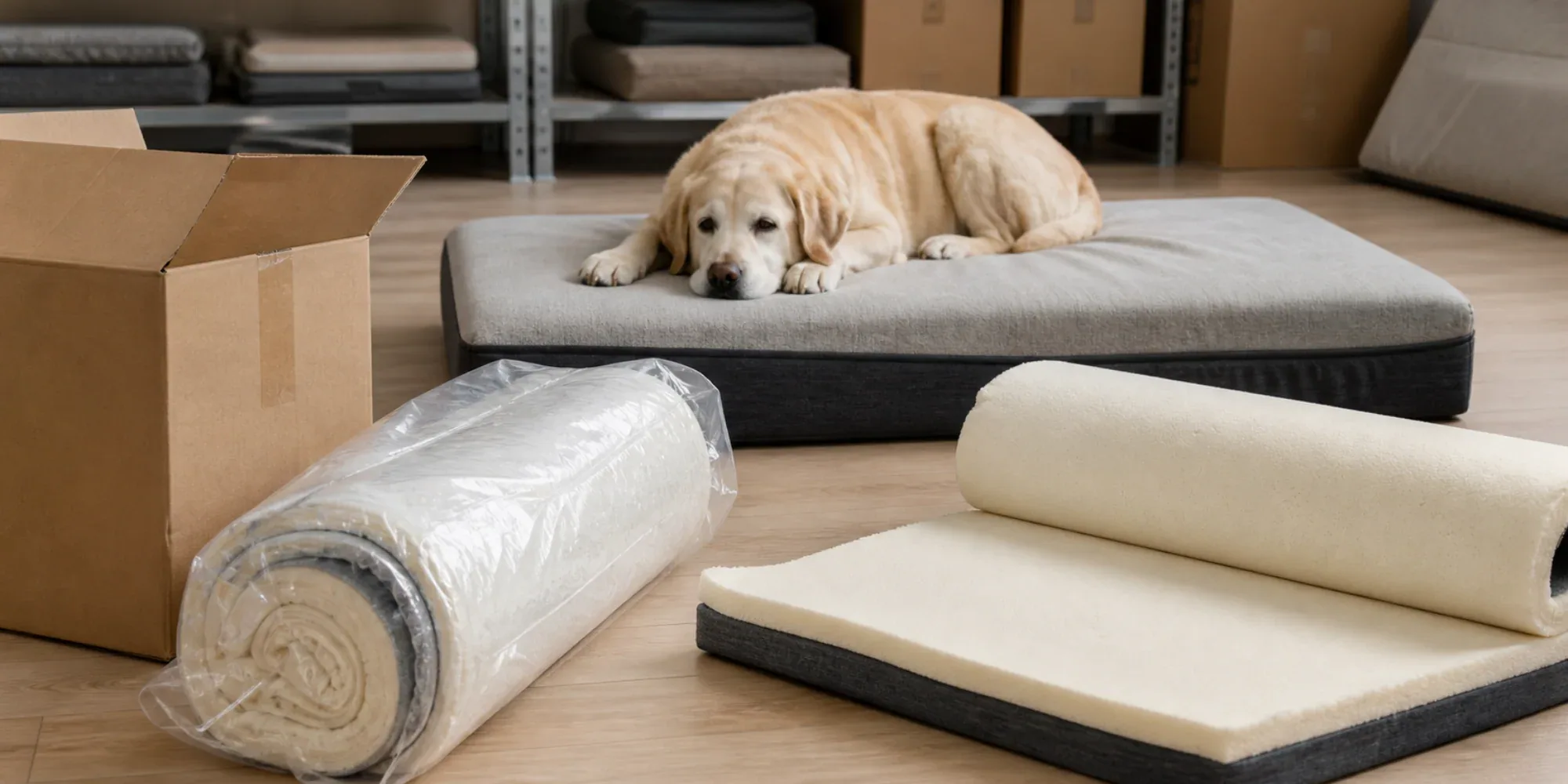
When sourcing vacuum-compressed senior dog beds, brands must verify that the foam recovers to its original specified dimensions and firmness after prolonged compression. This requires testing sample beds under simulated shipping durations, measuring exact recovery times (typically 24 to 48 hours), and checking for permanent structural deformation or foam cell wall damage that would compromise the load-bearing support required by older dogs with joint conditions.
The Intersection of Senior Dog Support Needs and Compression Limits
When sourcing senior dog beds, brands must verify that the compressed foam ultimately recovers to within acceptable tolerances of its original specified dimensions. Unlike standard pet beds designed primarily for superficial comfort, a senior dog bed functions as a structural support system for aging pets facing reduced mobility. Its main job is to distribute the animal's weight evenly, preventing painful pressure points. The physical properties of the foam directly deliver this necessary relief, making dimensional recovery a critical sourcing metric.
Specific joint conditions require precise management to keep older dogs comfortable. According to its published statements, Canine Arthritis Resources and Education provides evidence-based tools and resources to help veterinary teams and pet parents identify and manage canine arthritis. Similarly, the Orthopedic Foundation for Animals states its mission is to improve companion animal health by reducing genetic diseases, maintaining a historical focus on conditions like hip dysplasia. When a dog manages these structural diseases, the physical resistance of their resting surface becomes a crucial daily factor. The bed must yield enough to cushion the joints gently, yet push back with sufficient firmness to keep the spine aligned and assist the dog when attempting to stand up. Canine Arthritis Resources & Education | Dog arthritis tips and resources About Us | OFA
Foam provides this essential support through its internal cellular structure. High-density polyurethane foams consist of millions of microscopic cell walls that compress under the animal's weight and spring back when that weight is removed. The density and firmness profile of these layers dictate how well the bed isolates painful joints from the floor. If the foam bottoms out under pressure, the dog's weight presses against the rigid floor, exacerbating the very joint pain the product was manufactured to alleviate.
To lower freight costs and optimize shipping container space, brands routinely rely on vacuum compression to pack these large, dense beds into compact cartons. This packaging process forcefully extracts the air out of the foam structure, subjecting the internal polyurethane cell walls to immense physical stress. Depending on the complexity of the global supply chain, the foam often remains in this tightly crushed state for weeks or even months during overseas transit, customs clearance, and domestic warehouse storage.
This extended duration is where the mechanical limits of vacuum compression intersect directly with the specific support needs of older dogs. When unpacked, the foam must successfully rebound. Because polyurethane foam naturally undergoes a slight permanent set after prolonged vacuum compression, demanding perfect recovery to exact original dimensions is physically unrealistic. Instead, the decompressed foam must recover to within acceptable manufacturing tolerances for its intended thickness and firmness. If prolonged compression causes excessive structural fatigue and damages the internal cell walls, the material will permanently fail to return to its required load-bearing capacity.
A dog bed suffering from permanent structural deformation will look noticeably thinner or exhibit sagging areas where the internal architecture has prematurely collapsed. For a healthy puppy, a softer resting surface might not present a functional issue. However, for a senior dog with weakened leg muscles and arthritis, a compromised foam layer entirely fails its primary purpose. The dog sinks too deeply into the material, lacking the essential resistance needed to push up safely to a standing position. Verifying that foam adequately rebounds after prolonged compression is therefore a necessary sourcing requirement, determining whether the delivered product provides the targeted joint support buyers expect.
Dimensional Recovery and Time-to-Rebound Metrics
Establishing a reliable rebound verification protocol begins with setting exact dimensional baselines. When sourcing a vacuum-compressed bed for senior dogs, brands cannot rely on visual assessments to determine if the foam has fully recovered. Instead, product teams must measure the decompressed product against the original engineering specifications for length, width, and height. Flexible polyurethane foam naturally exhibits minor dimensional manufacturing variances, so expecting perfection is unrealistic. However, because older dogs rely on specific foam depths to prevent their joints from striking the floor, a substantial or excessive deficit in the final recovery state can significantly alter the bed's protective capabilities.
The recovery process is time-dependent. When a dog bed is released from its vacuum-sealed packaging, air rushes back into the crushed cellular structure of the polyurethane. This expansion does not happen instantly. Brands must track the recovery timeline by measuring the dimensions at specific intervals after unpacking. A standard verification protocol records measurements immediately upon opening, and then at 24, 48, and 72 hours. This time-to-rebound metric tells the brand what the end consumer will experience and whether product instructions must advise buyers to wait a day or two before letting their dog use the bed.
- Overall center thickness to ensure the core load-bearing area has regained its specified depth.
- Perimeter and corner height to check for pinched edges where the vacuum seal applied the most acute pressure.
- Base flatness to confirm the foam has not warped, which would cause the bed to slide or rock when an older dog steps onto it.
- Bolster and sidewall alignment to ensure the structural borders remain upright and capable of supporting a resting head or back.
Edge recovery is a frequent point of failure in vacuum-compressed packaging. While the center of a large foam slab may quickly pull in air and expand, the corners and edges often remain pinched or permanently creased if the foam lacks sufficient resilience. If the perimeter fails to recover to its intended height, the bed takes on a domed shape. For a senior dog with limited mobility, a domed surface creates instability, forcing them to balance on an uneven area rather than sinking evenly into a flat, supportive plane. Brands must reject foam formulations exhibiting this uneven dimensional recovery.
Time-to-rebound also presents a critical commercial tradeoff. Foam formulations exist that might eventually recover their original dimensions after a week unpacked. However, expecting a consumer to wait seven days before their arthritic dog can use a newly purchased bed is impractical and drives customer returns. A sensible rule of thumb for private-label product teams is that the foam should achieve the vast majority of its specified dimensions within the first 24 hours, and reach full recovery by 48 to 72 hours. If the foam requires more time, the brand should adjust the foam formulation, lower the compression ratio, or alter the packaging method.
Finally, verifying these metrics is only useful if the testing conditions mirror reality. A foam block compressed in a factory and decompressed an hour later will almost always rebound perfectly. To accurately assess dimensional recovery, brands must require their suppliers to compress the sample beds, hold them in that state for a duration that matches the expected overseas transit and warehouse storage time, and only then evaluate the time-to-rebound and final dimensions.
Verifying Firmness Retention and Physical Properties
While verifying the dimensional recovery of a decompressed dog bed is an essential first step, a visual return to the specified thickness does not guarantee that the product has retained its functional support. Brands must also verify the physical properties of the polyurethane foam. When a vacuum-compressed bed expands, air refills the internal voids, restoring the overall shape. However, if the immense pressure of the vacuum packaging process damaged the foam's internal architecture, the material will exhibit a reduced load-bearing capacity. For a senior dog requiring targeted joint relief, a bed that looks thick but compresses too easily under body weight is functionally useless.
The primary mechanism behind this loss of support is cell wall fatigue. High-density polyurethane foam consists of a microscopic matrix of struts and walls. During vacuum compression, these structures are forcefully folded against one another. Over extended transit and storage periods, this sustained physical stress can cause micro-tears or permanent yielding. When the plastic packaging is breached and the foam pulls air back in, the weakened struts may still stand upright, propping the bed up to its original height. Yet, because their structural integrity is compromised, they will collapse much faster when downward force is applied.
To verify that this degradation has not occurred, product teams must measure the foam's firmness and density. Density refers to the mass of the polyurethane material per unit volume, dictating overall durability. Firmness, typically measured as Indentation Load Deflection, dictates how much weight is required to compress the foam by a specific percentage. A measurable drop in the firmness rating after decompression indicates that the internal cell walls have fatigued. Brands must test both uncompressed control samples and decompressed production samples to ensure firmness remains within an acceptable tolerance range for orthopedic support.
Standardized testing protocols provide the framework for these evaluations. For instance, the official technical guidelines for CertiPUR-US certification outline detailed testing methods for the physical property and environmental criteria of flexible polyurethane foam utilized in bedding and furniture. By referencing established industry testing guidelines, brands can set objective benchmarks for their manufacturing partners. Instead of relying on subjective feelings of softness, quality control teams can use standardized compression tests to quantify exactly how much resistance the decompressed foam provides compared to the original engineering specifications. Technical Guidelines
Establishing this verification requires a clear testing protocol before bulk production begins. Brands should request that their suppliers simulate the exact shipping conditions the product will face. This involves compressing prototype beds, storing them for a duration equivalent to the expected overseas transit often 30 to 60 days and then conducting physical load tests after a full 72-hour recovery period. Comparing these results against a fresh, uncompressed foam block reveals the exact percentage of firmness lost. If the decompressed bed yields significantly more under a simulated dog's weight, the brand must consider adjusting the formulation.
This requirement for strict load-bearing verification extends beyond standard flat beds. Any product designed to support an older dog's weight and mobility requires the same rigorous evaluation of firmness retention. For example, when sourcing Custom Foam Pet Stairs and Ramps, product teams must ensure the steps do not soften or buckle after decompression. If the edges or treads of a foam stair lose their firmness due to cell wall fatigue, an arthritic dog could lose their footing. The physical stability of the foam depends entirely on surviving compression without losing structural resistance. For company-specific information, see Lincellipet.
Ultimately, verifying firmness retention involves navigating the tradeoff between material costs and shipping efficiency. Foams formulated with higher resilience are better equipped to survive long compression cycles without suffering permanent structural fatigue, though these specialized formulations increase initial manufacturing costs. Lower-grade foams may reduce production prices and compress easily for optimal container loading, but they frequently demonstrate a loss in firmness after decompression. For senior dog beds, where consistent orthopedic support is the core value proposition, brands must prioritize foam formulations that verifiably retain their physical properties over maximizing the compression ratio.
The Impact of Multi-Layer Foam Structures on Rebound Variability
Senior dog beds frequently move beyond single-block foam slabs to incorporate multi-layer orthopedic designs. A common configuration pairs a firm, high-density base layer with a softer, pressure-relieving memory foam top. This dual-layer construction is engineered to deliver deep structural support to keep joints off the floor while offering a contoured surface that conforms to the dog's body. However, combining different foam chemistries introduces significant variability into the decompression process. When evaluating a Custom Orthopedic Memory Foam Dog Bed, brands must understand that the overall product will only perform correctly if each distinct material recovers fully after prolonged vacuum compression. For company-specific information, see Lincellipet.
The primary challenge in sourcing multi-layer beds is the disparity in how different foam types respond to being crushed. Standard high-density base foam relies on resilient cellular struts designed to spring back quickly once the vacuum seal is broken. In contrast, memory foam is viscoelastic and inherently temperature-sensitive. Its cell structure reacts to body heat and yields slowly under pressure. After spending weeks tightly compressed, memory foam typically requires substantially more time and warmer ambient conditions to regain its original shape. If an unboxing test occurs in a cold warehouse, the high-density base might expand within hours, while the memory foam layer remains stiff and flattened for days.
Because of these differing recovery timelines and material sensitivities, verifying the overall exterior thickness is insufficient for multi-layer products. Consider a bed engineered to be six inches thick, consisting of four inches of base foam and two inches of memory foam. If the base regains only three and a half inches while the contouring top stalls at just one inch, the total height falls short, and the orthopedic function is compromised. Product teams should open the fabric cover to measure each individual layer's physical dimensions. However, because standard firmness testing requires thick, unbonded foam blocks to prevent bottoming out, brands cannot independently measure the firmness of a thin, glued layer inside the finished product. Instead, firmness retention must be tested on the fully assembled composite bed or on separate, unglued raw material samples subjected to the identical compression cycle.
Beyond the physical recovery of the foam itself, vacuum compression places extreme shear stress on the adhesive used to bond multiple layers together. When air is forcefully extracted, different foam densities contract at different rates, pulling against the glue line. Upon decompression, unequal expansion can cause the layers to tear apart or shift out of alignment. While the tightly fitted fabric cover prevents a detached top layer from sliding entirely off the base, a lamination failure still causes uneven bunching when an older dog steps onto the bed. This creates an unstable resting surface. Verification protocols must include a physical inspection of internal seams to ensure the adhesive bond remains intact and flexible after expansion is complete.
To mitigate these risks, brands must carefully balance their packaging strategies against the complexity of the foam structure. Highly engineered multi-layer beds often cannot withstand the same aggressive packaging methods as simpler, single-layer products without risking permanent damage. Product managers may find that flat vacuum compression without roll-packing is necessary. Roll-packing introduces severe shear and crushing forces that twist the bonded layers, significantly increasing the likelihood of lamination failure and structural foam fatigue. Testing prototype beds using the exact layer configuration, adhesive type, and flat compression method is the only reliable way to establish a safe baseline before moving into bulk manufacturing.
Compression Duration and Environmental Factors During Transit
Factory-floor quality control checks often involve compressing a foam bed and opening it hours later to measure the expansion. While this confirms the immediate mechanical success of the vacuum seal, it fails to account for the reality of international logistics. For a brand sourcing vacuum-compressed senior dog beds, relying solely on immediate decompression testing creates a false sense of security. Because the foam has not been subjected to the sustained stress of a long transit period, it will naturally rebound much faster and more completely than a product shipped to a consumer.
The primary variable separating a factory test from a consumer unboxing is time. When vacuum-packed, the polyurethane cellular structure is held in a crushed state. Over days and weeks, the physical structure of the foam begins to adapt to this compressed shape. The longer the foam remains tightly rolled or flattened inside its shipping carton, the higher the risk of permanent structural fatigue. A bed that rebounds to its full orthopedic thickness after a single day of compression might fail to reach that same depth after spending two months in a shipping container. Brands must establish maximum compression durations with their suppliers, ensuring that the time from factory packing to consumer unpacking does not exceed the material's mechanical limits.
Beyond duration, environmental conditions during transit heavily dictate how the foam will behave upon arrival. Ocean freight and uninsulated warehouse storage expose compressed beds to extreme temperature fluctuations. Memory foam, frequently used in the top layers of senior dog beds for pressure relief, is highly temperature-sensitive. Its viscoelastic properties become stiff and unyielding in cold environments. If a container arrives in a cold climate during winter, the tightly packed memory foam layers will resist expansion when the vacuum seal is broken. The air cannot easily permeate the rigid cellular structure, significantly delaying the time-to-rebound and leaving the bed looking flat and unsupportive for days.
Conversely, high heat presents its own set of environmental risks, particularly for multi-layer orthopedic beds. Sustained high temperatures inside a shipping container can soften the adhesives holding the memory foam and high-density base layers together. When the bed is eventually decompressed, the weakened bond may fail to hold the layers in alignment as they expand at different rates. Furthermore, prolonged exposure to heat while under intense vacuum pressure can accelerate the degradation of the polyurethane cell walls, increasing the likelihood that the foam will permanently lose its firmness and fail to provide the necessary joint support for an aging dog.
To account for these environmental factors, product teams must implement transit simulation protocols before approving a final foam formulation. Rather than trusting an immediate factory rebound, brands should require their manufacturing partner to seal prototype beds and hold them in a compressed state for a duration that matches the expected supply chain timeline, often four to eight weeks. Ideally, these samples should be subjected to the anticipated temperature ranges of the target market. Only after this simulated transit period should the beds be unpacked and evaluated for dimensional recovery and firmness retention.
By verifying rebound performance under realistic environmental conditions, brands protect their product quality and reduce the risk of customer returns. A senior dog suffering from arthritis cannot wait a week for a cold, stiff bed to slowly regain its shape, nor can they safely use a bed that has permanently lost its structural integrity due to extended heat and pressure. Sourcing teams must treat the supply chain environment as an active physical stressor on the product, ensuring the chosen foam chemistry and compression ratios are resilient enough to survive the actual journey from the factory to the end user.
Establishing a Practical Rebound Verification Protocol for Sourcing
Establishing a formal testing protocol with a manufacturing partner is the final defense against sourcing compromised orthopedic dog beds. Because immediate factory-floor decompression tests fail to capture the realities of prolonged overseas transit, brands must mandate pre-production sampling that actively simulates the supply chain. Before signing a bulk manufacturing agreement, sourcing teams should require their factory to execute a controlled compression and transit test. This test must utilize the exact foam formulation, adhesive, and packaging machinery planned for final production.
- Produce a prototype matching the mass-production specification, recording baseline measurements of the uncompressed foam's dimensions and firmness rating.
- Vacuum-compress and roll-pack the bed using intended commercial machinery to match actual production line compression ratios.
- Store the sealed sample for 30 to 60 days to replicate anticipated shipping and domestic warehousing durations.
- Expose the stored sample to temperature variations reflecting the target market's seasonal climate, particularly if the design uses temperature-sensitive memory foam.
Once the simulated transit period concludes, inspectors must prepare the sample for decompression. If the transit simulation included cold temperatures, teams must not open the package and measure rebound immediately. Memory foam remains stiff when cold, so immediate measurement yields falsely failed results. The sealed sample must first acclimatize to standard indoor room temperatures. Afterward, inspectors open the packaging and track decompression. The manufacturer should record the time-to-rebound by taking precise dimensional measurements at the one-hour, 24-hour, and 48-hour marks. These decompressed measurements, alongside a secondary firmness test, must be compared directly against the uncompressed baseline data. If the bed fails to regain its required load-bearing capacity within 72 hours, the design is not viable.
A failed rebound test requires actionable adjustments to the product specification. If the decompressed foam bottoms out too easily, the brand has three primary levers. They can upgrade the foam density to increase structural resilience, switch to a more responsive foam chemistry, or reduce the overall compression ratio. Decreasing the compression ratio requires packing the bed into a larger carton, which decreases container-loading efficiency and increases the per-unit freight cost. However, for a product explicitly designed to support an aging dog's aching joints, compromising on load-bearing capacity will cost the brand far more in negative reviews and customer returns.
Once a prototype successfully passes the transit test, these verified metrics must be integrated into the purchase agreement, explicitly defining acceptable tolerance levels for recovery time and final dimensions. Furthermore, brands must establish practical ongoing batch testing. Requiring a 60-day compression hold for everyday manufacturing is physically impractical; a factory cannot delay shipping finished batches to wait for test results. Instead, ongoing bulk production quality assurance should verify the uncompressed foam's density and firmness prior to packaging. Testing raw material before compression catches unauthorized material substitutions immediately. Prolonged compression hold tests can then be reserved for periodic quality audits.
By systematically verifying foam rebound through realistic transit simulations and rigorous pre-packaging material checks, private-label teams manage objective mechanical requirements rather than guessing about material quality. The data generated during this testing protocol also serves as the foundation for accurate product labeling, allowing brands to confidently instruct consumers on how long they should wait before allowing their dog to use the bed. A rigorous verification protocol guarantees that the delivered product performs exactly as engineered, providing consistent joint relief and structural support.
