 跳到内容

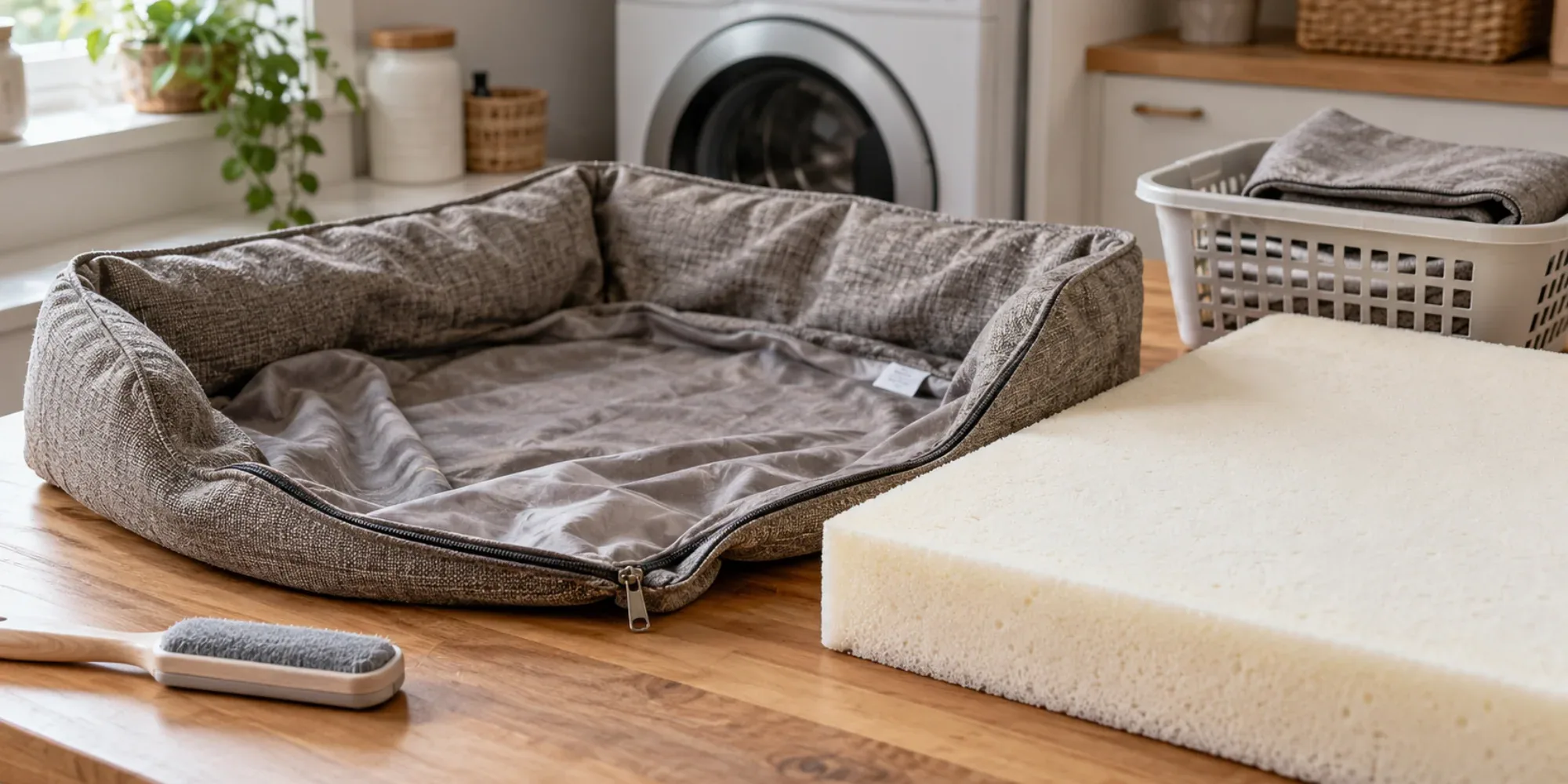
A high-quality washable dog car bed relies on a durable, removable outer cover and a structured foam core. Proper care involves completely separating these components: machine-washing the abrasion-resistant cover to remove vehicle dirt and hair, while strictly limiting the polyurethane foam to spot-cleaning, as the heavy mechanical agitation of a washing machine or improper drying can permanently tear and warp the saturated material.
The Physical Demands of Vehicle Travel on Dog Beds
An indoor dog bed typically rests on a stationary floor, dealing primarily with the static weight of a resting animal and ambient household dust. In contrast, a moving vehicle is a highly dynamic environment. When a car accelerates onto a highway, brakes sharply, or navigates tight corners, the kinetic forces transfer directly to the dog inside. To remain stable, dogs must constantly shift their weight, brace their legs, and adjust their center of gravity. This continuous physical adjustment creates a specific set of mechanical demands on any bedding placed in the vehicle, requiring performance characteristics far beyond a simple soft surface.
The dynamic motion of a vehicle can be particularly fatiguing for dogs, especially those needing proactive joint care. According to Canine Arthritis Resources and Education, evaluating different supportive strategies plays a significant role in preserving an animal's long-term mobility and quality of life. While a basic thin blanket or an unpadded seat protector might successfully keep the car upholstery clean, these minimal barriers offer no structural reinforcement for the animal's joints. If a dog requires physical support to remain comfortable during travel, the bed must actively absorb road vibrations and stabilize the animal against the swaying motion of the vehicle. Canine Arthritis Resources & Education | Dog arthritis tips and resources
To achieve this required stabilization, the bed relies on a structured interior capable of supporting localized pressure. A high-density core is necessary to provide the upward resistance that prevents a dog's elbows and hips from sinking entirely through to the hard plastic or leather seat beneath them. Unlike loose polyester fill, which easily displaces and clumps when a heavy dog shifts its weight during a sharp turn, a dense, continuous block of polyurethane foam maintains its structural integrity and provides stable underlying support across the entire resting area. For company-specific information, see Lincellipet.
Alongside the distinct need for structural support, regular vehicle travel introduces significant friction and surface abrasion. Because dogs instinctively use their claws to grip the resting surface and brace against the movement of the car, the outer material of the bed is continuously subjected to intense, concentrated mechanical stress. Every time the dog adjusts its posture to counteract a sudden stop or swerving turn, their claws scrape directly against the textile. If the cover material lacks high breaking strength and exceptional abrasion resistance, this repeated scratching will quickly compromise the fabric, leading to fraying, torn seams, and structural failure.
Furthermore, the vehicle environment is uniquely prone to heavy dirt accumulation. Dogs frequently enter the car directly from vigorous outdoor activities, dragging wet mud, rainwater, abrasive sand, and loose organic debris inside. In the enclosed space of a vehicle cabin, the dog's body weight physically presses this moisture and grit directly into the surface of the bed. Capillary action can quickly pull wet mud and fine particulates deep into the fabric fibers. If this heavily soiled moisture permeates beyond the protective outer layer and reaches the core support foam, it becomes exceptionally difficult to extract.
These combined environmental demands create a fundamental material conflict: the necessity for dense structural support to counteract vehicle motion opposes the requirement for frequent, intensive washing to remove outdoor debris. The dense foam structures required to stabilize a dog's joints cannot withstand soaking or the harsh mechanical agitation of a washing machine without suffering irreversible physical degradation. Conversely, durable textiles that can survive regular laundering offer no inherent joint support. Consequently, successfully managing a washable dog car bed requires a strictly modular design. The bed must feature a rugged, removable outer cover built to withstand both claw friction and heavy washing, kept completely separated from an encapsulated foam core that remains structurally intact and dry.
Cover Materials: Abrasion Resistance and Breaking Strength
In a moving vehicle, a dog bed cover serves as much more than a comfortable surface; it acts as a load-bearing structural barrier. When a vehicle accelerates, navigates tight turns, or brakes sharply, a dog instinctively uses their paws and claws to grip the surface beneath them to maintain their balance. This constant adjustment subjects the outer fabric to concentrated mechanical stressors. Every pivot introduces direct friction, and every sudden weight shift applies localized tension to the textile. Furthermore, because car beds naturally collect dirt and rainwater, they require frequent machine washing. The tumbling and heavy agitation of a wash cycle add a second distinct layer of mechanical stress.
To survive this dual combination of vehicle use and repeated laundering, the textile used for the outer cover must demonstrate exceptional performance in two specific material properties: abrasion resistance and breaking strength. If a cover fabric lacks these measurable characteristics, it will quickly develop snags, thin patches, and eventual holes. A compromised cover instantly fails its primary purpose, allowing outdoor dirt and moisture to bypass the protective layer and irreversibly damage the internal foam core beneath.
Abrasion resistance defines a fabric's ability to withstand continuous surface rubbing without the individual fibers wearing away, pilling, or snapping. In industrial testing environments, this property is carefully measured. One established procedure assesses how well textile fabrics resist abrasion by applying a rotary platform abrader, a device that continuously grinds against the test material to simulate long-term frictional wear. D3884 Standard Guide for Abrasion Resistance of Textile Fabrics (Rotary Platform Abrader Method)
For a washable dog car bed, high abrasion resistance is continuously tested by both the resting animal and the washing machine. In the car, a dog's claws create sharp, concentrated friction. When a dog naturally digs to create a comfortable resting spot, they apply localized scraping and pulling forces to the top layer of the weave. A cover with low abrasion resistance will rapidly show signs of surface pilling, eventually leading to thinned-out spots where claws have sheared the fibers. Similarly, the washing machine drum continuously rubs against the fabric during the wash cycle. High abrasion resistance, typically found in tightly woven synthetics, ensures the cover does not degrade from these ongoing frictional forces.
The second critical property is breaking strength, which evaluates the maximum tensile force a fabric can withstand before it completely ruptures. This property is evaluated using standardized grab tests that determine the breaking strength and elongation a specific textile fabric can handle under tension. In these evaluations, tension is applied to an isolated portion of the fabric rather than the entire width. This localized testing methodology closely mirrors how acute, sudden stress is applied in real-world scenarios. D5034 Standard Test Method for Breaking Strength and Elongation of Textile Fabrics (Grab Test)
High breaking strength is vital for managing the sudden stresses of vehicle travel. If a heavy dog loses its footing during a sudden stop, its claws hook directly into the fabric while the momentum of its body weight pulls forcefully against that single anchor point. If the fabric's breaking strength is insufficient, that sudden concentrated load will cause the textile to rip. Breaking strength is equally crucial in the laundry room. When a large cover becomes saturated with water in the washing machine, its mass increases significantly. During the spin cycle, the fabric is subjected to severe mechanical tension as the moving drum pulls the material against its own wet weight. A fabric with low breaking strength is highly susceptible to tearing when caught in these opposing forces.
When evaluating the physical durability of a dog car bed cover, numerical testing data is rarely printed on consumer packaging. However, owners can make practical assessments based on how these properties manifest in the material's construction. Soft, loosely tufted fabrics or delicate fleece might feel luxurious to the touch, but their open structure provides terrible resistance to claw tension and surface abrasion. Claws easily slide under loose threads, maximizing the pulling force on unprotected fibers. Instead, owners should look for textiles engineered specifically to deflect these physical stressors without compromising the animal's immediate safety.
- Tightly woven surfaces: Fabrics where threads are closely packed leave very little room for a dog's claws to catch. Distributing the force of a scrape across multiple dense fibers improves the overall breaking strength and fundamentally reduces the rate of abrasive wear.
- Balanced traction textures: The fabric must provide enough surface grip for the dog's paw pads to safely anchor against the vehicle's dynamic motion. Slick finishes must be avoided, as a lack of traction compromises the dog's balance and forces them to dig harder to find stability.
- Reinforced seam construction: Even the strongest fabric will fail if the assembled pieces are joined weakly. Double-stitched seams or reinforced edge binding ensure the connection points share the high breaking strength of the main fabric panels.
- Heavy-duty closures: Zippers must be robust enough to handle the concentrated tension applied when a heavy dog shifts its weight during transit, and the substantial stretching force applied by an owner squeezing a dense foam core back inside after laundering.
Successfully managing a washable dog car bed requires acknowledging that the outer shell must bear the brunt of all mechanical abuse. The cover acts as a sacrificial barrier that actively protects the sensitive foam support structure hidden inside. By ensuring the chosen cover material possesses high abrasion resistance to handle claws and washing friction, alongside robust breaking strength to survive weight shifts and heavy agitation, owners can confidently wash the outer layer as often as necessary. This durable exterior is what allows the internal foam core to remain safely encapsulated and structurally intact.
Evaluating the Polyurethane Foam Core
The core interior within a washable dog car bed acts as a crucial structural buffer between the resting animal and the hard, moving vehicle seat. Unlike standard indoor resting areas where the main requirement is basic comfort, a moving car subjects a dog to continuous dynamic forces. As the vehicle accelerates, brakes sharply, or leans into turns, the dog instinctively braces against the movement to maintain their balance. This bracing action drives localized pressure points specifically the elbows, shoulders, and hips forcefully downward into the bed. If the core material easily yields under these sudden weight shifts, the dog strikes the solid seat beneath, leading to physical discomfort and joint fatigue. Flexible polyurethane foam is typically utilized in these applications because its internal cellular structure compresses to absorb sudden loads while exerting the necessary upward resistance to stabilize the dog's posture.
To provide this upward resistance over time, the polyurethane foam core must be evaluated based on its specific material characteristics, primarily density and firmness. Density refers to the mass of the polyurethane material present within a given volume, dictating the long-term durability and structural continuity of the bed. A higher-density foam contains more physical material to bear the dog's weight, significantly reducing the likelihood that the bed will prematurely break down after months of repeated use. Firmness determines how the bed immediately responds to localized pressure. A functional car bed requires a delicate mechanical balance: it must be firm enough to prevent heavy joints from sinking all the way through to the seat during a sharp turn, yet yielding enough to comfortably absorb the constant, low-frequency vibrations transferred from the road surface.
Because reliable performance is critical, these structural materials are often evaluated against established industry benchmarks. For instance, the official technical guidelines for CertiPUR-US certification detail testing for physical property and environmental criteria in flexible polyurethane foam for use in furniture and bedding. These laboratory evaluations assess key performance indicators such as compression set, which calculates the permanent loss of foam thickness after enduring continuous heavy pressure and elevated temperatures. While these standardized frameworks do not specifically simulate the mechanical stress of an animal bracing itself during vehicle travel, established furniture durability metrics serve as a highly practical proxy. By analyzing general resilience and shape retention, buyers can distinguish between a cohesive foam formulation that delivers lasting structural support and alternative padding that will permanently crush under repeated use. Technical Guidelines
Understanding these structural requirements explains why loose polyester fiberfill is generally unsuitable for active vehicle travel environments. While loose fill offers a soft texture in stationary settings, it lacks a cohesive internal architecture. When a heavy dog shifts its weight to counteract the motion of a turning vehicle, loose fibers are mechanically pushed aside. This rapid displacement creates empty hollows where the dog needs support, allowing their joints to impact the hard car interior. In contrast, a continuous block of flexible polyurethane foam actively compresses to absorb incoming kinetic energy and then recovers its original shape. By compressing and rebounding, cohesive foam distributes concentrated weight across a wider surface area, ensuring the animal remains securely supported and insulated.
The physical demands placed on flexible polyurethane foam in a car bed closely parallel the requirements of other active weight-bearing accessories. Any application where an animal relies on a soft surface to support its movement requires a firm, high-density core that will not buckle under sudden downward force. For example, ensuring stable footing and preventing joint strain during elevation changes relies on the exact same principles of foam density, compression response, and shape recovery. Evaluating the core means recognizing it as an active structural component rather than just passive padding. This functional reality dictates strict maintenance boundaries between the outer cover and the internal support core. For company-specific information, see Lincellipet.
Care Instructions: Why Foam and Covers Must Be Separated
Successfully maintaining a washable dog car bed relies on a strict operational rule: the outer cover and the internal foam core must never share a cleaning method. While the label "washable" applies to the bed as a complete system, placing an assembled, solid-foam bed directly into a washing machine will quickly destroy its structural integrity. The rugged textiles required to handle claws and the flexible polyurethane foam needed for joint support react to water and mechanical agitation in fundamentally opposite ways, making strict separation non-negotiable.
Flexible polyurethane foam provides support through an open-cell architecture that functions like a microscopic scaffolding. Submerging this material in water does not chemically alter its polymer composition. Instead, the danger lies in the mechanical forces applied while the material is saturated. When completely submerged, the foam behaves like a massive sponge, absorbing many times its dry weight in liquid. The sheer volume of trapped water puts immense physical strain on the delicate internal cellular walls. If a saturated core undergoes the tumbling and centrifugal forces of a washing machine's spin cycle, the material cannot support its waterlogged mass. This mechanical stress physically tears the internal structure apart, leaving the core permanently misshapen and unable to insulate a dog's joints against the hard car seat.
Even if a submerged foam insert survives the wash cycle without visibly tearing, the subsequent drying phase presents an equally destructive point of failure. The dense cellular structure traps moisture deep inside. Air-drying a fully saturated block of polyurethane foam often takes several days, creating an ideal damp environment for mold and mildew to develop before the center is completely dry. Conversely, placing the saturated foam into a household tumble dryer causes severe mechanical damage. Standard home dryers do not reach the extreme temperatures required to chemically scorch thermoset polyurethane. Rather, the aggressive tumbling action repeatedly drops the heavy, waterlogged foam against the metal drum, tearing the saturated cellular walls and risking severe structural warping that ruins the bed's intended shape.
Because heavy mechanical agitation destroys the saturated material, the polyurethane core must be strictly limited to gentle spot cleaning. If muddy water or accidents penetrate the outer textile layer, owners should immediately unzip the cover and address the foam directly. Effective spot cleaning involves blotting the affected area with a damp cloth and a mild, pet-safe enzymatic cleaner, carefully avoiding soaking the material further. Afterward, the foam must dry completely in a well-ventilated space before the cover is reattached. Using a waterproof inner liner is a highly practical way to block moisture from reaching the foam entirely.
The outer textile cover, conversely, is explicitly built to handle intensive, repeated cleaning. To properly remove the accumulation of dirt, sand, and pet hair typical of vehicle travel, the cover must be completely separated from the foam. Shaking it out aggressively before washing helps dislodge loose grit that could otherwise clog the washing machine's drainage system. Washing the empty cover in cold or warm water with a standard mild detergent effectively breaks down accumulated oils and mud without aggressively stripping the synthetic fibers.
While the cover is designed for high breaking strength and abrasion resistance, aggressive laundering practices can still compromise its longevity. Harsh chemicals like bleach gradually weaken synthetic fibers, reducing their capacity to withstand the friction of a dog's claws during transit. Additionally, drying the cover on high heat frequently causes the fabric to shrink. If the cover shrinks even slightly, squeezing the dense foam core back inside becomes extremely difficult, placing constant tension on the zippers. Air-drying the cover or tumbling it strictly on a low-heat setting preserves the dimensions of the fabric and protects the reinforced seams.
Routine Inspection and Reassembly
Maintaining a washable dog car bed extends beyond simply separating the cover from the core and running a laundry cycle. Because the outer textile serves as the primary structural and environmental barrier, routine inspection and careful reassembly represent critical steps in preserving long-term functionality. Each wash cycle provides a practical opportunity to evaluate how well the fabric is withstanding the mechanical stress of active vehicle travel. By identifying minor material failures before they worsen, owners prevent moisture and heavy soil from bypassing the cover and penetrating the vulnerable polyurethane foam. This preventative maintenance directly protects the joint support the bed provides during transit.
The ideal time to inspect the outer cover is immediately after it has finished drying, while the fabric remains empty. Owners should physically examine the high-traffic areas of the material, focusing on sections where the dog naturally braces against the car's motion. Identifying signs of surface pilling, thinning threads, or sections where the weave has started pulling apart provides an early warning that the abrasion resistance is degrading under continuous claw friction. A localized thin patch fundamentally reduces the fabric's breaking strength. If left unaddressed, a sudden shift in a heavy dog's weight during a sharp turn could overload that weakened spot, leading to a large tear that compromises the entire bed.
Beyond evaluating the flat fabric panels, the structural joints of the cover require equally close attention. The seams and closures endure mechanical tension from supporting the dog's shifting mass and from the pulling forces exerted by the washing machine against the wet fabric. Owners should gently stretch the material along the reinforced seams to verify internal stitches remain intact. Furthermore, zipper tracks must be completely cleared of trapped pet hair, dried mud, or outdoor grit. Debris lodged inside the zipper teeth often causes the metal slider to snag or derail completely. While addressing trapped grit on the bed itself, owners should also wipe down the vehicle seat beneath the bed. Sand and coarse dirt inevitably accumulate under the resting area. If ignored, the weight of the dog pressing the bed down during transit will grind these trapped particles into the car seat, permanently abrading the upholstery.
While the cover is being washed, the polyurethane foam core requires its own routine evaluation. Even when protected by a highly durable outer layer, the foam can still encounter ambient moisture from temperature fluctuations inside the vehicle cabin or minor liquid spills that seeped through the zipper. Owners should physically press along the surface of the bare foam to feel for hidden dampness. If spot cleaning was necessary, the affected core must remain in a well-ventilated space until all residual moisture has evaporated. Reinserting a partially damp foam block into a tightly woven cover traps moisture inside. This oversight creates a closed environment that encourages mold growth and accelerates the physical breakdown of the polyurethane structure.
Once the cover is intact and the foam is entirely dry, reassembly must be managed deliberately to avoid damaging either component. High-density support foam is inherently bulky and generates significant surface friction against textiles, making it difficult to slide back into a fitted casing. Forcing the foam inside by aggressively yanking on the fabric places unnecessary tension on the zipper ends, which can exceed the material's breaking strength. Instead, the foam should be manually compressed as it is carefully guided into the corners of the cover. Once the corners are aligned, owners can gently massage the exterior fabric to help the internal core expand and settle flat into its intended dimensions.
