 跳到内容

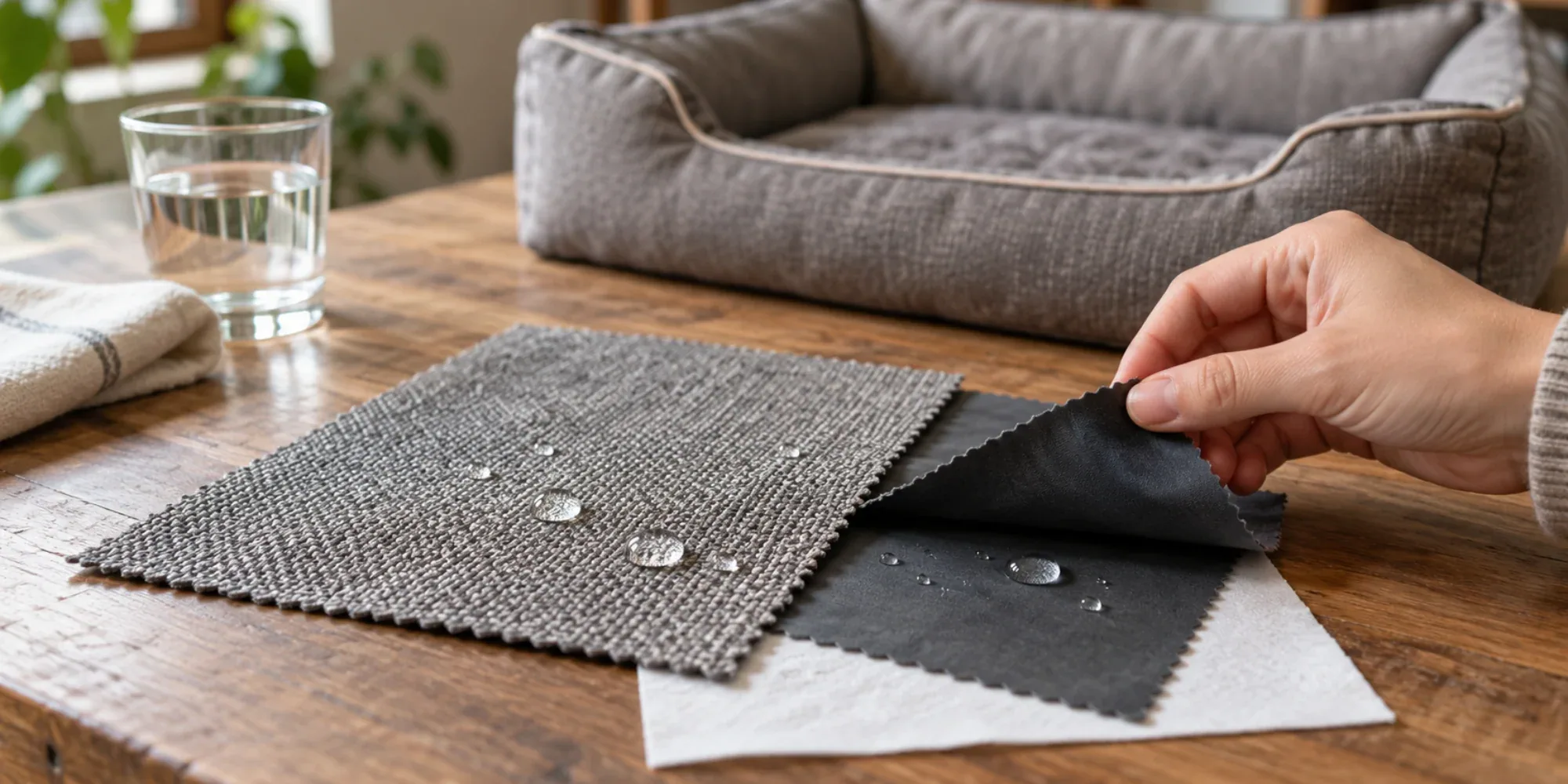
Water-resistant dog car beds repel light moisture and spills temporarily using surface treatments or tight fabric weaves, making them suitable for everyday travel and quick cleanups. Waterproof beds use impermeable physical barriers, such as a polyurethane backing or internal liner, to entirely block liquid penetration, which is necessary for muddy dogs, wet environments, or incontinence. When evaluating these products, buyers must check the type of protective coating, the presence of a continuous waterproof laminate or separate liner, seam construction (as unsealed seams leak), and the fabric's abrasion resistance to ensure dog claws do not compromise the protective layer.
The Core Distinction: Repelling Moisture vs. Blocking Liquids
When selecting dog car beds, buyers must establish whether the product needs to repel incidental moisture or entirely block liquids from reaching the vehicle seat and the internal foam. This distinction defines the core difference between water-resistant and waterproof materials. Water-resistant fabrics delay liquid penetration by utilizing surface properties to keep moisture from absorbing immediately. In contrast, waterproof designs utilize continuous physical barriers to stop liquid transfer entirely. Understanding this baseline is essential, as selecting the wrong barrier type leads to saturated foam.
Water-resistant dog car beds typically rely on tightly woven synthetic fabrics, such as high-denier polyester or oxford cloth, often treated with a surface coating. When a dog climbs into the car with damp paws, these treatments lower the fabric's surface energy, allowing the water's natural tension to form distinct droplets. This provides the owner a brief window to wipe away the moisture before it soaks through. However, buyers must recognize that water-resistant fabrics are not impermeable. Under sustained pressure from a dog lying down on the wet spot, or if liquid is left unattended, the moisture will eventually breach the fabric and saturate the underlying cushion.
True waterproof performance requires a physical, impermeable layer. This is usually achieved by laminating a solid polyurethane or thermoplastic polyurethane backing directly to the underside of the fabric, or by enclosing the internal foam core in a separate sealed liner. Because this barrier does not rely on surface energy, it blocks liquid even when subjected to the weight of a heavy dog or left to sit over long journeys. For buyers sourcing large-format items like a Custom Foldable Human Dog Bed for travel use, evaluating whether the product uses a temporary surface treatment or a structural laminate dictates how reliably it will protect the interior materials. For company-specific information, see Lincellipet.
- Light weather and easy cleaning: Water-resistant covers with tightly woven oxford fabric support quick wipe-downs for lightly damp dogs.
- Active outdoor travel: Dogs walking in heavy mud require waterproof laminates to prevent saturated foam and persistent odors.
- Senior and incontinent dogs: Only fully waterproof physical barriers can reliably protect the foam core from accidents during long trips.
Mislabeling these two categories is a frequent cause of product failure in travel scenarios. A bed marketed as waterproof but built only with a surface coating will wet out during a long car ride with a wet dog. Conversely, over-specifying a heavy waterproof laminate for a bed intended only for casual trips can introduce unnecessary fabric stiffness and reduce air circulation. Product managers must verify the specific barrier mechanism rather than relying on general marketing terminology.
Evaluating Water-Resistant Features: Surface Coatings and Weaves
When evaluating water-resistant dog car beds, product managers must examine the base fabric construction. The foundation of water resistance relies on understanding the relationship between thread thickness, measured in denier, and weave density. Buyers often specify materials like heavy-duty polyester or nylon oxford cloth for tear strength. While higher-denier fabrics use thicker threads that provide excellent durability against claws, these thick yarns inherently create larger microscopic gaps between the intersecting threads. Heavy-duty fabrics rely on chemical surface treatments to mitigate this. However, these treatments do not physically bridge the gaps between the threads, as a standard, non-porous solid film would do to create a basic waterproof laminate. Because basic non-porous films eliminate air circulation, brands preserve breathability in water-resistant designs by utilizing chemical treatments that coat the individual fibers instead. Because neither the weave nor the coated fibers completely seal the textile pores, the base fabric alone is insufficient to protect internal foam from wet dogs.
The defining feature of a water-resistant cover is its durable water repellent surface coating. Evaluators reviewing a prototype should look for immediate surface tension when liquid hits the fabric. A properly applied coating alters the surface energy of the textile so water beads up and rolls off rather than soaking into the fibers. To assess this, buyers can conduct a simple drop test. If the water forms distinct, spherical droplets that hold their shape, the coating functions correctly. If the liquid immediately spreads out or darkens the fabric, the treatment is absent or degraded.
Understanding when a water-resistant fabric will wet out is critical for setting accurate expectations. Water-resistant beds are designed to buy the owner time to wipe away spills or handle a dog shaking off light rain. They are not built to withstand standing water or heavy, localized pressure. When a dog lies down, their body weight forces pooled water against the fabric. This physical pressure quickly pushes the moisture through the microscopic weave gaps, bypassing the fiber-coating surface treatment completely. If the product is meant for short, everyday trips where the dog might only have damp paws, water-resistant treatments offer sufficient protection while maintaining better breathability than fully sealed standard waterproof laminates.
- Fabric weave and denier: Balance the need for durable threads against the reality that heavy yarns create larger gaps requiring robust, fiber-coating chemical treatments.
- Droplet formation: Verify that water instantly beads on the surface during prototype testing.
- Breathability: Assess whether the lack of a non-porous solid laminate allows air to pass through freely.
- Coating durability: Check how the surface treatment withstands repeated machine washing and mechanical friction.
Finally, buyers must check the longevity of the water-resistant treatment. Surface coatings wear down through mechanical abrasion from claws, dirt exposure, and regular machine washing. Product managers should evaluate testing data or conduct in-house wash cycles to determine how many washes the cover endures before the water-repellent properties fail. If a car bed requires frequent laundering due to mud, a standard treatment will eventually wash away, leaving only the porous base fabric to defend against moisture. Evaluating this degradation rate prevents customer complaints about beds losing their protective qualities, allowing buyers to specify higher-grade chemical treatments when required.
Evaluating Waterproof Features: Laminates and Internal Liners
Buyers evaluating waterproof dog car beds must verify the presence of a continuous physical barrier. Unlike water-resistant weaves that rely on surface tension, a waterproof barrier is a solid film designed to block liquid completely. However, waterproofing is not an absolute state; materials block moisture by withstanding hydrostatic pressure up to specific rated limits. While high-quality laminates reliably prevent urine and mud from passing through, extreme localized pressure from a heavy dog could exceed the threshold of a lower-grade film. Specifying an appropriate pressure rating ensures liquid does not saturate the internal foam, though preventing that moisture from eventually reaching the vehicle upholstery also depends on the bed's physical shape and its ability to manage runoff.
The most common manufacturing approach for achieving this internal protection is laminating a film directly to the underside of the bed's outer fabric. This structural backing is typically formulated from polyurethane or thermoplastic polyurethane. When assessing a laminated cover prototype, product managers must physically check the material for flexibility and noise generation. Lower-grade polyurethane laminates often feel rigid and produce a distinct rustling sound when the fabric bends. Because vehicle environments can induce anxiety in pets, loud fabrics can agitate nervous dogs during travel. High-quality thermoplastic polyurethane should remain quiet and pliable, even when the car interior drops to cold temperatures.
An alternative strategy to laminating the exterior cover is utilizing a secondary internal liner. In this configuration, the car bed features a standard, unlaminated outer cover that allows air to flow freely, while the internal foam core is sealed inside a dedicated waterproof encasement. Buyers often choose this dual-layer construction when prioritizing washing convenience. Because the exterior cover separates completely from the moisture barrier, the user can machine wash the outer shell frequently without exposing the delicate waterproof laminate to mechanical agitation or heat in the dryer.
Internal liners are particularly critical when the product relies on high-value foam components that cannot be easily replaced. For example, if a buyer is sourcing a Custom Orthopedic Memory Foam Dog Bed for travel use, the internal liner ensures accidental soiling does not penetrate and degrade the specialized support layers. When evaluating inner liners, product managers should assess the abrasion resistance of the encasement fabric itself, as it must withstand continuous friction from the heavy outer cover shifting against it during vehicle motion. For company-specific information, see Lincellipet.
- Verify the specific material compound used for the barrier, distinguishing between basic polyurethane and flexible thermoplastic polyurethane.
- Test the fabric assembly for noise generation by aggressively compressing the layered materials by hand.
- Check the care label requirements against the intended physical barrier to ensure washing expectations align with the laminate's thermal limits.
Finally, buyers must account for the structural impact of an impermeable barrier on the bed's performance. A continuous waterproof layer traps air inside the foam core. When a dog steps onto the cushion, displaced air must escape. If the barrier is entirely airtight without designated venting mechanisms, the bed will balloon outward and firmly resist compression under pressure. This creates an unstable resting surface and places immense stress on the seams. Evaluating a waterproof design requires checking that the manufacturer has balanced complete liquid protection with necessary air exhaust routes.
Identifying Structural Weak Points: Seams and Zippers
Selecting a high-quality waterproof laminate or internal liner is only the first step in specifying a waterproof dog car bed. The primary reason waterproof products fail in real-world travel scenarios is not fabric penetration, but structural liquid ingress. Whenever a sewing needle passes through a waterproof material during manufacturing, it punctures the protective polyurethane film. If left unsealed, these microscopic holes create a direct channel for liquid to bypass the barrier. Product managers must evaluate how the manufacturer addresses these structural weak points, specifically focusing on seam construction and zipper enclosures.
Buyers should verify the specific assembly method used for all waterproof covers and internal encasements. Standard overlock or lockstitch seams offer zero resistance to standing liquid. To maintain the integrity of a waterproof barrier, the manufacturer must apply seam-sealing tape. This process involves using specialized machinery to heat-press a thin thermoplastic tape over the interior of the stitched seam, sealing the needle holes and bridging the gap between the joined fabric panels. When inspecting a prototype, buyers should turn the cover inside out to check the tape application. The tape must adhere flatly without bubbling, peeling, or missing sections, particularly around corners where the fabric bunches. Alternatively, high-frequency welding completely eliminates needle holes by fusing the coated panels together, though this requires specific synthetic materials and often increases production costs.
Beyond seams, zippers represent the largest vulnerability in any removable cover. A standard nylon coil or molded plastic zipper allows water to pass through the teeth and the fabric tape almost instantly. If a wet dog rests directly over an unprotected zipper during a long car ride, the internal foam will absorb the liquid. To mitigate this, evaluators should look for water-resistant zippers, which feature a polyurethane coating over the zipper tape and reverse-coil construction to minimize physical gaps. However, even coated zippers are not entirely impermeable under heavy pressure.
The most reliable defense for a closure is a physical barrier known as a zipper baffle or storm flap. This is an overlapping strip of the primary waterproof fabric that completely covers the zipper track. When designing or sourcing a dog car bed, buyers must ensure this flap is wide enough to stay closed when the bed is compressed and shifted by the dog's weight. Some designs incorporate a dual-flap system or hook-and-loop fasteners to secure the flap in place. Additionally, the location of the zipper is critical. A zipper running along the top edge or directly across the sleeping surface is highly susceptible to liquid ingress. A well-designed waterproof bed positions the zipper along the bottom edge or underneath the base, physically removing it from the path of gravity-driven moisture and spills.
- Inspect the interior of the cover for continuous, well-adhered seam tape over all stitched joints.
- Verify that zippers are positioned away from the primary resting surface and potential pooling areas.
- Check for overlapping fabric baffles that physically shield the zipper track from direct moisture exposure.
- Ensure water-resistant zipper coatings do not peel or stiffen excessively in cold vehicle environments.
Assessing Surface Durability: Abrasion and Pilling Resistance
A waterproof laminate or a water-resistant coating is only as reliable as the primary outer fabric defending it. During vehicle travel, dogs frequently circle to find a comfortable position, dig at the cushion, or brace themselves with their claws against the sudden stops and turns of the car. This active behavior applies intense, localized mechanical stress to the surface of the dog car bed. Over time, the repeated friction of rough paw pads and sharp claws can physically degrade the face fabric. If this constant friction prematurely wears down the textile, underlying moisture barriers are directly exposed to physical damage. Once an internal polyurethane backing is scratched, stretched, or punctured, or a surface treatment is rubbed away, liquid will immediately bypass these compromised defenses. When this happens, moisture saturates the internal foam. This completely neutralizes the product's waterproof specifications, rendering the travel bed useless for its protective purpose.
To ensure the moisture barrier remains intact over time, product managers must critically evaluate the abrasion resistance of the primary cover fabric. Abrasion refers to the surface wear caused by repeated rubbing, scraping, and pressure. Buyers can assess a fabric's durability by reviewing results from standardized mechanical testing, such as the rotary platform abrader method. According to the standard guide, this method determines the abrasion resistance of textile fabrics by subjecting them to a rotating abrasive action under a controlled load. While this standardized textile test does not simulate the exact twisting friction of a dog pivoting on a bed, the resulting abrasion data provides an essential, objective benchmark for evaluating general resistance to real-world friction. By requiring textiles that perform well under rotary abrader testing, brands can ensure the outer layer will not easily thin out or tear under typical travel conditions. Maintaining this structural integrity safely encases and protects the vulnerable, thin waterproof laminates hidden beneath. D3884 Standard Guide for Abrasion Resistance of Textile Fabrics (Rotary Platform Abrader Method)
Beyond severe abrasion, buyers must account for pilling resistance when evaluating water-resistant models. Pilling occurs when loose fibers break, migrate to the surface, and tangle into small knots due to continuous friction. While often viewed as a purely aesthetic defect, pilling drastically impacts the functional performance of durable water repellent treatments. The irregular, knotted surface created by these pills disrupts the fabric's ability to maintain high surface tension. Instead of remaining intact, beading up, and rolling off the cover, water droplets catch on the raised, tangled fibers. The moisture then pools together and soaks directly through the textile weave. Additionally, dirt easily becomes trapped within a heavily pilled surface, further degrading the chemical coating. Once surface tension fails, the water-resistant property is lost entirely, and the fabric acts like a sponge, absorbing travel spills and mud.
To predict how a fabric will age and maintain a smooth surface, evaluators look at standard test methods for surface changes, such as the random tumble pilling tester or the brush pilling tester. These controlled laboratory procedures simulate long-term wear, brushing, and tumbling friction. However, buyers must understand their strict limitations. While these tests provide useful comparative data to see how different textiles might behave, the published standards for these specific methods explicitly state they are not recommended for formal acceptance testing. Because laboratory pilling tests evaluate textiles using generic abrasive mechanisms, they do not perfectly replicate the exact mechanical stress a dog applies in a car. Product managers should not use them as the sole basis for material selection or absolute pass-and-fail criteria. Instead, they serve as helpful directional indicators that should always be combined with real-world field trials. D3512/D3512M Standard Test Method for Pilling Resistance and Other Related Surface Changes of Textile Fabrics: Random Tumble Pilling Tester D3511/D3511M Standard Test Method for Pilling Resistance and Other Related Surface Changes of Textile Fabrics: Brush Pilling Tester
- Abrasion test performance: Review rotary platform abrader test data to confirm the face fabric demonstrates sufficient general abrasion resistance to withstand mechanical wear without exposing internal laminates.
- Pilling resistance indicators: Use brush or tumble pilling tests as comparative tools to estimate surface longevity, acknowledging they are not formal acceptance criteria.
- Material structure: Prioritize tightly woven synthetic fibers over loose weaves that are susceptible to fraying, snagging, and structural degradation under friction. D3884 Standard Guide for Abrasion Resistance of Textile Fabrics (Rotary Platform Abrader Method) D3512/D3512M Standard Test Method for Pilling Resistance and Other Related Surface Changes of Textile Fabrics: Random Tumble Pilling Tester D3511/D3511M Standard Test Method for Pilling Resistance and Other Related Surface Changes of Textile Fabrics: Brush Pilling Tester
Selecting a fabric that excels in these physical durability metrics involves navigating real-world material tradeoffs. Textiles with the highest abrasion and pilling resistance, such as heavy ballistic nylon or dense canvas, are highly effective at protecting waterproof layers but tend to be quite rigid. This inherent stiffness can reduce the bed's overall comfort, generate excessive noise during vehicle motion, and make the product difficult to compress for efficient shipping. Conversely, ultra-soft plush or fleece fabrics might appeal to buyers seeking cozy aesthetics, but they typically lack the structural integrity required to shield a waterproof backing from an active, digging dog. When finalizing car bed specifications, buyers must establish baseline durability standards that align with the anticipated size and activity level of the intended dog, ensuring the textile reliably defends the moisture barrier without entirely sacrificing passenger comfort.
Impact on Foam Integrity and Senior Dog Care
The ultimate goal of specifying a protective fabric cover is preserving the internal cushion. Dog car beds frequently utilize flexible polyurethane foam. While certain materials, such as those meeting CertiPUR-US guidelines, are formally evaluated for specific physical property and environmental criteria to ensure adequate cushioning for furniture and bedding, standard foams do not universally undergo these checks. Regardless of the exact foam grade specified, preserving its intended structural integrity and hygiene during travel requires keeping the core entirely dry. Technical Guidelines
If a water-resistant surface coating fails under pressure, or if unsealed seams leak, liquid saturates the open-cell structure of the polyurethane foam. Trapped moisture rapidly breeds mold and causes persistent odors within the confined space of a car. Beyond hygiene issues, repeated moisture exposure can physically degrade certain foam layers over time, reducing their rebound capabilities. Once a supportive foam core loses its structural integrity, it can no longer effectively cushion a dog against a rigid vehicle seat.
Maintaining consistent physical support is critical for senior dogs. Organizations like Canine Arthritis Resources and Education (CARE) provide resources to help identify signs early and understand the management options available to keep your dog active and enjoying life. Managing joint health during travel requires providing a reliable, shock-absorbing surface. If a bed's foam is compromised by moisture ingress, it cannot adequately cushion arthritic joints, exacerbating discomfort on long trips. Canine Arthritis Resources & Education | Dog arthritis tips and resources
The foam's vulnerability is compounded when traveling with older dogs. Senior pets are disproportionately prone to urinary incontinence or mobility issues, making quick exits during rest stops difficult. In these scenarios, a temporary water-resistant treatment is inadequate because warm liquid rapidly bypasses the weave under the dog's weight. Because thick memory foam bases cannot be easily machine-washed or dried, severe accidents render the core permanently unusable. Even if the foam's mechanical rebound and physical support remain intact, the unavoidable hygiene, mold, and odor risks dictate that the cushion must be replaced.
- Impermeable laminates: Specify continuous waterproof barriers rather than temporary water-resistant coatings to block liquid entirely for senior pet products.
- Sealed construction: Verify fully taped seams and hidden zippers to prevent pooling urine from bypassing the barrier.
- Dedicated encasements: Evaluate secondary internal waterproof liners surrounding the foam core to guarantee protection.
Buyers must align their material specifications with the actual physical demands of their target demographic. While basic water-resistant covers suit young dogs that occasionally track light moisture into the car, they introduce unacceptable failure risks for senior dogs. By verifying continuous physical waterproof barriers, product managers ensure the bed maintains the critical joint support older pets require.
Sources
- D3884 Standard Guide for Abrasion Resistance of Textile Fabrics (Rotary Platform Abrader Method)
- D3512/D3512M Standard Test Method for Pilling Resistance and Other Related Surface Changes of Textile Fabrics: Random Tumble Pilling Tester
- D3511/D3511M Standard Test Method for Pilling Resistance and Other Related Surface Changes of Textile Fabrics: Brush Pilling Tester
- Technical Guidelines — 2025-03-31
- Canine Arthritis Resources & Education | Dog arthritis tips and resources
