 跳到内容
跳到内容 
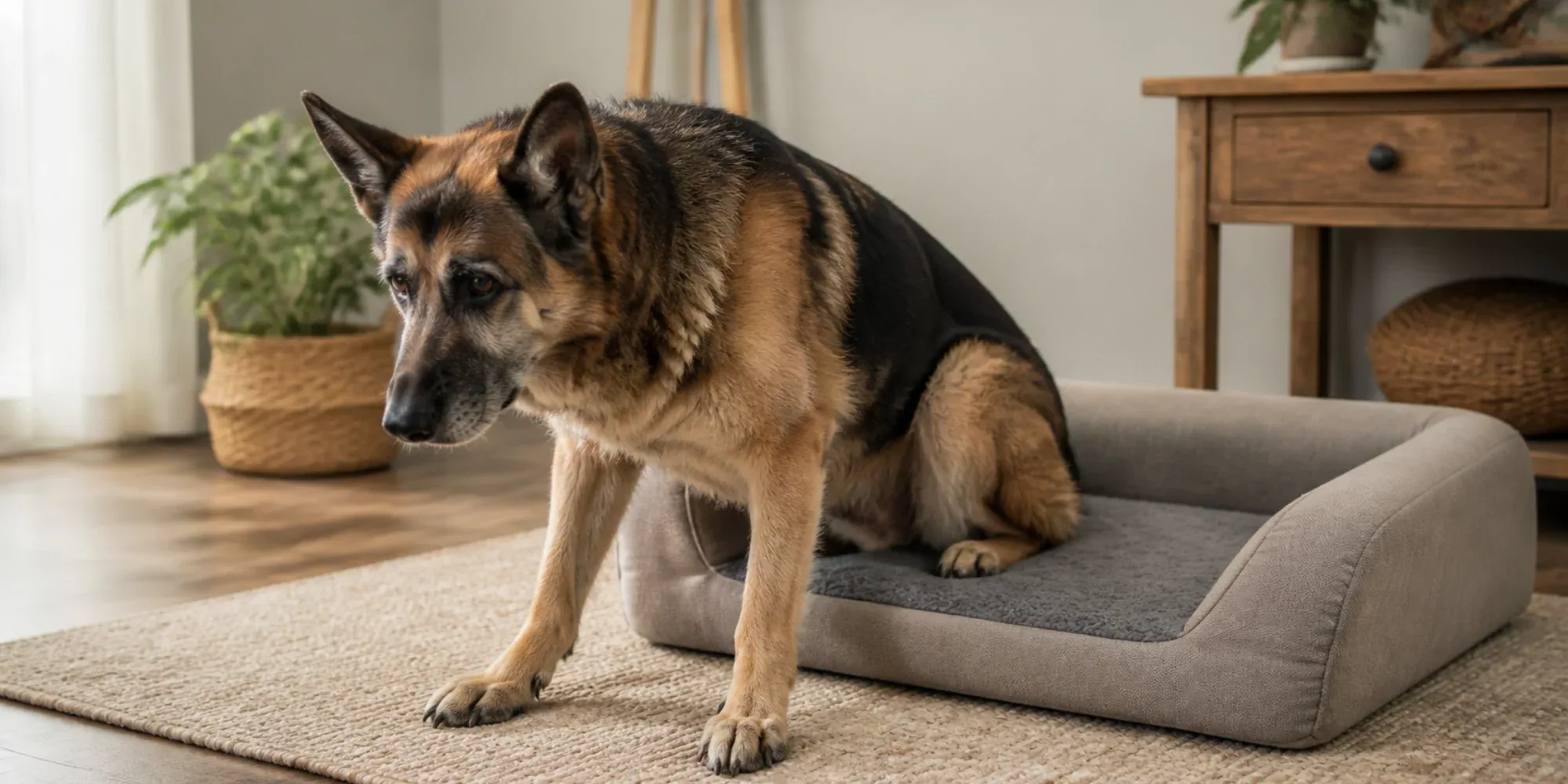
Senior dogs often experience stiffness after waking due to osteoarthritis or natural age-related joint changes. Prolonged resting in one position causes fluid in the joints to thicken, making initial movement difficult. A structurally supportive bed can help by distributing the dog's weight evenly and insulating their joints from cold floors, which makes standing up easier. However, a bed cannot cure underlying joint disease, reduce inflammation, or replace a comprehensive veterinary management plan.
The Physiology of Post-Sleep Stiffness in Senior Dogs
Many owners of senior dogs observe a familiar routine: the dog wakes up, hesitates, and struggles to stand, taking several stiff steps before finding their normal stride. This post-sleep stiffness is a common sign of canine aging. In reality, the difficulty a dog faces when rising from prolonged rest is rooted in the specific physical environment within their joints. Understanding why joints stiffen after lying down is the first step in distinguishing between natural age-related changes and conditions like osteoarthritis that require formal management.
To understand this stiffness, it helps to look at joint mechanics. The ends of the bones are covered by smooth cartilage, which acts as a shock absorber. The joint is enclosed in a capsule filled with synovial fluid. This fluid lubricates the joint, provides nutrients, and reduces friction. When a dog is active, movement keeps the synovial fluid evenly distributed and thin, allowing the joints to glide easily.
When a dog lies down for several hours, these physical dynamics change. Without the pumping action of movement, the synovial fluid pools and naturally thickens, becoming more viscous. When the dog wakes and attempts to stand, the joint must transition from a static state back to active motion. The initial steps force this thickened fluid to move, creating physical resistance. Once the dog has taken a few steps, the mechanical action generates heat and redistributes the fluid, thinning it out. This explains why a senior dog's stiffness often improves after a few minutes of walking.
As a dog ages, the baseline health of these structures declines. Cartilage loses water content and elasticity, making it less resilient. At the same time, synovial fluid production can diminish. For an older dog without underlying disease, these natural changes mean that transitioning from resting to moving simply takes more effort than it did in their youth.
For many senior dogs, morning stiffness is not merely a harmless byproduct of aging; it is a primary symptom of osteoarthritis. Canine osteoarthritis is a progressive disease characterized by active cartilage breakdown, joint capsule inflammation, and the formation of bone spurs. This condition is particularly prevalent in large breeds such as Labrador Retrievers, German Shepherds, and Golden Retrievers, where sheer body mass magnifies the daily strain on deteriorating joints. In an arthritic joint, thickened synovial fluid combined with a swollen capsule creates significant mechanical resistance. When an arthritic dog tries to rise after a long sleep, they fight both the physical resistance of the joint and the pain of inflammation.
Recognizing early signs of joint disease allows owners to intervene before mobility is severely compromised. Canine Arthritis Resources and Education offers a collection of complimentary materials to assist veterinarians and dog owners in spotting the symptoms of joint deterioration as soon as they appear. Tracking a dog's daily habits—such as how long it takes them to stand or if they shift their weight abnormally—provides valuable information for a comprehensive veterinary assessment. Canine Arthritis Resources & Education | Dog arthritis tips and resources
Observing a senior dog's post-sleep stiffness highlights the physical reality of their aging body. Prolonged rest exacerbates joint stiffness because of the way synovial fluid behaves when static, and osteoarthritis amplifies this friction into chronic discomfort. Acknowledging this physiology shifts the focus toward active management. While no environmental change can halt a progressive disease, understanding the mechanical effort required to stand clarifies why reducing the physical burden of that movement is important.
What a Dog Bed Can Actually Do for Stiff Joints
When an older dog struggles to stand after a long nap, owners naturally look to their sleeping environment for a practical solution. A dog bed is not a medical device, nor can it cure the underlying joint degradation that causes post-sleep stiffness. However, a properly structured resting surface actively alters the physical conditions under which the dog rests and rises. By changing the immediate environment around the dog's body, a bed provides tangible assistance. The primary physical benefits of a high-quality bed lie in mechanical support, specifically weight distribution and thermal insulation.
When a heavy object rests on an unyielding surface, the points of contact bear the entire load. For a resting dog, these primary contact points are the hips, shoulders, and elbows. On a bare floor, the dog's body weight forces these specific joints directly against the rigid ground. Over several hours, this localized pressure restricts blood circulation and compresses the delicate soft tissues surrounding the joint capsule. For a senior dog whose joints are already compromised by natural aging or osteoarthritis, resting heavily on hard pressure points directly exacerbates the structural pain they will inevitably feel upon waking.
A supportive bed changes this physical dynamic by distributing the dog's body weight across a wider surface area. Instead of the hips and elbows taking the brunt of the load, the structural material yields to the dog's shape. This is why the density and internal architecture of the bed matter significantly more than simple surface softness. If a bed is too soft or relies on loose fill, the heavy joints will push completely through the material and hit the floor, defeating the purpose of the cushion. A structured foam base suspends the dog's body in a neutral alignment, preventing this bottoming out. Layered support is often constructed to maintain alignment without sacrificing pressure relief, pairing dense base foams with yielding top layers. For company-specific information, see Lincellipet.
Beyond pressure relief, a properly constructed bed provides critical thermal insulation. Household floors, particularly tile, concrete, or hardwood, naturally act as continuous heat sinks that draw warmth away from a resting body. The synovial fluid inside a dog's joints naturally thickens during periods of rest. Cold temperatures cause this fluid to become even more viscous, increasing the physical friction within the joint capsule. When a senior dog sleeps directly on a cold floor, they lose body heat rapidly. Upon waking, they must force their way through highly viscous, cold joint fluid, drastically increasing the mechanical effort required to move.
A structured bed acts as a protective thermal break between the dog's body and the cold floor. Dense polyurethane foam and thick woven fabrics are naturally poor conductors of heat, meaning they trap the dog's radiant body heat close to their skin. By keeping the joints relatively warm throughout a long sleep, the bed helps maintain the synovial fluid at a slightly more fluid consistency than it would be on a bare floor. This directly reduces the compounding effect of cold temperatures, making the first few steps of the morning visibly less resistant and less strenuous for an aging dog.
The physical act of transitioning from laying down to standing up requires a sequence of muscle contractions and joint extensions. A dog must gather their limbs, establish firm traction, and push their body weight upward. On a slick floor, this is inherently difficult. While a structurally sound foam base provides a stable foundation, it does not inherently guarantee grip. Owners must specifically evaluate the exterior cover material for traction, seeking out textured fabrics that prevent paw pads from slipping. This combination—a firm internal base resisting downward pressure and a textured exterior fabric providing surface grip—creates a reliable launch pad that prevents muscles from overworking during the initial push.
Finally, the overall dimensions of the resting area dictate how freely a senior dog can reposition. Older dogs frequently need to fully extend their limbs to alleviate cramped muscles or shift weight away from an aching joint. If a bed is too small, the dog may sleep half on the bed and half on the floor, creating uneven spinal alignment. Providing a large surface ensures the dog remains fully supported regardless of how they stretch out. Expansive, structured resting surfaces are highly beneficial because they accommodate sprawling postures without forcing the dog's joints onto the uninsulated floor. Ultimately, the right bed provides the mechanical foundation that makes waking physically easier. For company-specific information, see Lincellipet.
Recognizing the Limits: What a Bed Cannot Change
A supportive sleeping environment fundamentally improves a senior dog's physical comfort, but relying on a bed as a standalone solution for joint stiffness is a critical mistake. While dense foam and thermal insulation reduce the mechanical burden of standing up, these features only address external environmental factors. A dog bed is a piece of furniture, not a medical intervention. Understanding the strict boundary between providing external comfort and treating an internal physiological condition is essential for any owner trying to manage their senior dog's daily mobility.
The most significant limitation of any bed is that it cannot alter the internal biology of a joint. As established, post-sleep stiffness in senior dogs is primarily driven by the physical realities of thickened synovial fluid, cartilage degradation, and chronic inflammation. A firm foam base prevents a dog's heavy joints from grinding against a rigid floor, which stops additional pressure-induced pain. However, that same bed does absolutely nothing to reverse the loss of cartilage, dissolve existing bone spurs, or reduce the swelling within the joint capsule. When an arthritic dog wakes up, the mechanical friction inside their joints remains entirely unchanged by the material they slept on.
This biological reality means that a dog with advanced osteoarthritis will still experience some degree of stiffness and hesitation, regardless of how perfectly their bed distributes their weight. Owners who expect a new, highly structured orthopedic bed to completely eliminate a dog's morning limp are often disappointed because they have mismatched a mechanical tool with a medical problem. The bed simply removes the unnecessary compounding pain of sleeping on a hard, cold surface, allowing the dog to deal solely with their baseline arthritis. It does not lower that physiological baseline.
Furthermore, a bed cannot replace the need for active veterinary management. Chronic joint stiffness requires a comprehensive approach to reduce internal inflammation and support overall joint health. This often involves a combination of prescription pain relief, targeted anti-inflammatory medications, and strict weight management. Extra body weight acts as a constant mechanical multiplier on degraded joints. No amount of dense foam can offset the strain of carrying excess pounds every time the dog walks. A bed supports the resting phase, but medical and nutritional interventions are required to support the active phase of the dog's day.
To build an effective care plan, owners must utilize professional guidance rather than relying solely on retail products. According to Canine Arthritis Resources and Education, they offer accessible, expert-designed materials intended to assist both veterinary professionals and dog owners in handling joint disease. Their platform focuses on spotting symptoms of deterioration promptly and outlining the full spectrum of management approaches available to maintain a dog's mobility. By consulting these educational materials, owners can implement strategies that actually help keep their dogs active, recognizing that an orthopedic mattress is only a supportive background element in a much larger medical framework. Canine Arthritis Resources & Education | Dog arthritis tips and resources
- Evaluating the dog's stiffness with a veterinarian to rule out acute injuries and diagnose the specific stage of osteoarthritis.
- Implementing a strict weight management protocol to reduce the constant daily load on compromised joints.
- Using prescribed anti-inflammatory medications or joint supplements to address internal swelling and pain.
- Providing a structurally supportive bed to handle the passive tasks of pressure relief and thermal insulation during rest.
Ultimately, recognizing what a bed cannot change protects both the dog and the owner. It prevents the owner from cycling through endless environmental purchases in search of a nonexistent cure, and it ensures the dog receives the medical care necessary to address their underlying pain. A structured resting surface is a necessary foundation for comfort, making the physical transition from sleeping to standing as easy as possible. However, it is only by combining this external support with targeted medical management that owners can effectively improve their senior dog's overall quality of life.
Evaluating Foam Density and Structural Support
A bed's ability to distribute weight and insulate against cold floors depends entirely on what is inside it. Many dog beds are marketed based on plush exterior fabrics, but visual softness does not equate to physical support. For a senior dog struggling with stiff joints, internal architecture dictates whether the bed alleviates pressure or simply collapses. Owners seeking to ease post-sleep stiffness must evaluate the core materials. Without a solid structural foundation, external fabrics fail to provide the mechanical assistance an aging dog needs.
The core failure of many pet beds is their reliance on loose fiberfill or unstructured batting. These materials feel soft but lack the structural integrity required to suspend a heavy load over several hours. When a senior dog lies down, the weight of their hips and shoulders compresses the loose fibers completely. The dog's joints sink straight through the displaced material and rest against the hard floor. This bottoming out negates the bed's pressure-relief benefits, leaving the dog to fight the same physical resistance upon waking as if they had slept on the bare ground.
To prevent heavy joints from hitting the floor, a bed must utilize a base capable of yielding to the dog's shape while providing continuous upward resistance. Flexible polyurethane foam is the standard material used to achieve this balance. Evaluating a foam bed requires looking past generic marketing terminology and understanding two distinct physical properties: density and firmness.
Density refers to the mass of the foam per cubic volume, translating directly to its structural durability and load-bearing capacity. A higher-density foam contains more physical material and less trapped air. Because a senior dog often sleeps in the same spot daily, a low-density foam quickly suffers from structural fatigue, permanently compressing into a flattened crater. High-density foam resists this breakdown, ensuring the bed maintains its supportive profile over time.
Firmness is the measure of surface weight required to compress the foam to a specific depth. While density determines longevity, firmness dictates how the bed responds immediately to the dog's body. A highly firm foam may fail to contour, creating new pressure points. Conversely, a very soft foam allows excessive sinkage, making it difficult for the dog to push off when attempting to stand. Effective support often relies on a layered approach: a firm base foam prevents bottoming out, while a softer top layer distributes pressure evenly.
Checking for standardized material evaluations provides a helpful starting point for consumers navigating the market. For example, published technical guidelines for CertiPUR-US certification detail testing methods for physical property and environmental criteria in flexible polyurethane foam intended for furniture and bedding. However, owners must clearly recognize the limits of these published standards. While material certifications provide a baseline assurance regarding environmental safety and general foam durability, they do not guarantee that a certified bed possesses the specific firmness or thickness required to properly support a heavy animal. Because guidelines evaluate the raw material rather than the finished bed's dimensions, owners must independently verify that the specific structural design actively prevents their dog from bottoming out. Technical Guidelines
The overall thickness of the foam also plays a critical role in support. Even a high-density, appropriately firm foam cannot prevent bottoming out if the layer is simply too thin relative to the dog's body weight. A large breed resting on a one-inch foam pad will inevitably compress the material to the floor. The structural layer must be thick enough to allow the heaviest parts of the dog's body to displace the material without penetrating the mattress.
Evaluating a resting surface for a stiff senior dog requires rejecting the idea that fluff equates to comfort. For an aging body dealing with compromised joints, true comfort is a mechanical outcome of proper weight distribution. By seeking out sufficiently thick, structured polyurethane foam and verifying its firmness under their dog's actual weight, owners provide an environment that actively assists the skeleton, easing the physical transition from rest to an active stride.
Building a Holistic Comfort Strategy
Managing a senior dog's comfort effectively requires shifting your perspective from seeking a single retail solution to building a comprehensive daily strategy. As established, the physical mechanics of joint stiffness and the biological reality of osteoarthritis mean that no single environmental change will restore a young dog's mobility. Instead, an effective approach treats the dog's sleeping environment, medical care, and routines as interconnected elements. A structured bed provides the necessary physical foundation for rest, but it relies on external interventions to control the physiological inflammation that the bed itself cannot reach.
The cornerstone of this holistic strategy must always be professional veterinary guidance. Before modifying the home environment, establishing an accurate medical baseline allows owners to understand exactly what they are managing. A veterinarian can evaluate whether morning hesitation is driven by natural synovial fluid thickening, progressive cartilage loss, or an undiagnosed acute injury. Once the source of the pain is identified, the medical plan handles the internal environment of the joint through prescribed anti-inflammatory medications, joint supplements, and weight management protocols. Without these medical tools, even the most supportive resting surface is severely limited in its impact.
With the medical baseline established, the sleeping environment can fulfill its specific, practical role. The bed operates strictly as an environmental tool designed to reduce mechanical stress. By providing high-density foam support, the bed suspends the dog's compromised joints above the hard floor, preventing additional compression pain. By acting as a thermal barrier, it keeps the joints warmer, preventing the synovial fluid from becoming excessively sluggish due to cold temperatures. In a holistic plan, the bed is not expected to cure the disease; rather, its job is to ensure that the physical act of waking up and standing requires the least amount of mechanical effort possible.
Beyond medical appointments and purchasing physical support tools, many owners find that navigating a senior dog's aging process requires ongoing practical adjustments. Implementing daily changes often involves a period of trial and error. During this phase, seeking out shared experiences can be highly beneficial. Research into the behavior of users on pet-oriented social networks indicates that dog owners frequently utilize these online platforms to gather practical guidance and share details about their bond with their animals. The more people I meet, the more I like my dog: A study of pet-oriented social networks on the Web | First Monday
Engaging with a community of other senior dog owners can surface practical, everyday management strategies that complement clinical advice. While online forums should never replace veterinary diagnostics, they are excellent resources for discovering how other people navigate the physical realities of dog ownership. Fellow owners frequently share practical observations about which household modifications help their dogs maintain traction, how to structure short daily walks to keep joints mobile without overexertion, and how to balance comfort with hygiene for a dog that spends more time lying down.
- Securing a veterinary diagnosis to identify the exact cause of stiffness and establish necessary medical interventions.
- Managing internal joint inflammation and pain through prescribed medications and strict weight control.
- Providing a high-density foam bed to physically suspend the dog's weight and insulate against cold floors.
- Adding traction to slick floors and minimizing steep stairs to assist the dog's initial movements after waking.
- Gathering practical day-to-day management advice from experienced owner communities to adapt the home environment safely.
Ultimately, managing a senior dog's post-sleep stiffness requires balancing biological realities with environmental modifications. Recognizing that a bed cannot reverse cartilage loss protects owners from expecting impossible results from a retail product. Understanding the mechanics of joint fluid and pressure points clarifies the bed's true purpose: providing the thermal protection and physical suspension required to make the first steps of the day as manageable as possible. By integrating structural support with clinical care and routine adjustments, owners can effectively ease their dog's transition from a long rest to an active state.
